Imagine a cosmic eye that sees in the dark. The James Webb Space Telescope is a giant mirror in space that catches light invisible to our eyes, just as a cat sees in the dark. It looks back in time to see how the first stars and galaxies were born, like flipping through an old photo album of the Universe.
History
The concept for JWST emerged in 1996 as the 'Next Generation Space Telescope' (NGST). The launch, initially planned for 2007, was delayed due to technical challenges and budget overruns. Named after James Webb, NASA administrator (1961–1968). The project involved NASA, ESA, and CSA. The main science goals were defined by the Decadal Survey of Astronomy and Astrophysics.
How it works
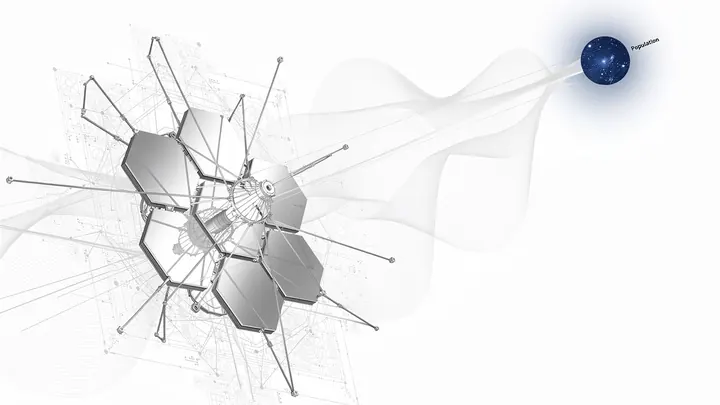
The telescope is placed at the Sun-Earth L2 point, providing a stable thermal environment. A five-layer sunshield made of Kapton passively cools the instruments to about 40 K. The segmented beryllium primary mirror with gold coating corrects wavefront errors using adaptive optics systems. Detectors register infrared radiation, which is then analyzed by spectrometers and cameras. Observations rely on spectroscopy and gravitational lensing (for amplifying distant objects).
Fun fact
Webb's mirror is made of gold and is the size of a tennis court. Its sunshield is as big as a bus stop, and it always keeps the telescope in the shade, like a beach umbrella.
The orchestra is playing fortissimo, and someone in the third row is whispering. Hearing that whisper is the challenge astronomers face at the star HR 8799: four bright giant planets drown out the faint light of a possible fifth, hidden very close to the star.
The HR 8799 system is a proving ground for direct exoplanet imaging.
Beyond Neptune's orbit lies an ocean of icy islands that has remained nearly unchanged for four billion years. These islands, known as trans-Neptunian objects, hold the recipe for planet formation. Until recently, astronomers could only see the large ones, while the small, city-sized ones stayed invisible.
A stroboscope in a dark room picks out fleeting shadows from the crowd, shadows the eye cannot catch. A primordial black hole the size of a virus, passing in front of a distant star, briefly magnifies its light for a few seconds, like a magnifying glass held over a bulb.
In the dense galaxy cluster Abell 2744, where gravity bends light like a lens, the James Webb Space Telescope spotted a new point of light. It appeared in images from 2023 and then began to change brightness. It was a supernova, the explosion of a dying star, but not just any kind: a Type IIP.
In the dense galaxy cluster Abell 2744, where gravity bends light like a lens, the James Webb Space Telescope spotted a new point of light. It appeared in images from 2023 and then began to change brightness. It was a supernova, the explosion of a dying star, but not just any kind: a Type IIP.
In a distant galaxy, light from hot gas should reveal its composition. The James Webb Telescope split that light into a spectrum, and astronomers saw: oxygen lines too weak.
Two stars, AF Lep A and ε Indi A, have become the focus of close attention. Using the GHOST spectrograph on the Gemini telescope, astronomers split their light into colors and, from absorption lines, determined how much carbon, oxygen, sulfur, and thirteen other elements are in the stars' atmospheres.
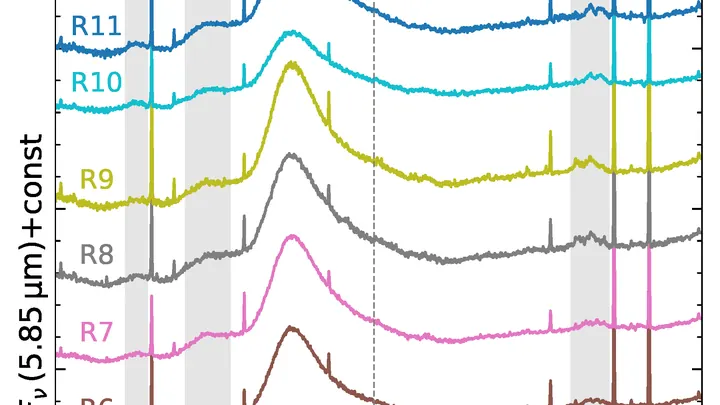
The Tarantula Nebula is a giant stellar nursery in a neighboring galaxy. Hundreds of thousands of stars are born there, and their light illuminates clouds of dust. This dust glows in the infrared, and its spectrum shows mysterious bands. For a long time, astronomers debated which molecules produce them.
Every morning, a janitor sweeps leaves into a pile. The Sun, as it travels through the galaxy, does something similar: its gravity gathers diffuse interstellar gas into an invisible cone — a giant funnel.
Every morning, a janitor sweeps leaves into a pile. The Sun, as it travels through the galaxy, does something similar: its gravity gathers diffuse interstellar gas into an invisible cone — a giant funnel.
Starlight passing through the atmosphere and telescope optics shimmers like sunlight dancing on water. Hidden in that ripple are planets — faint sparks next to a blinding glare. To see them, you have to freeze the ripple: make the light as smooth as glass.
Galaxy NGC 5584 is a vast stellar city, where some neighborhoods are just being built while others are already marked by aging giants. To see both, astronomers used two very different flashlights. The ultraviolet telescope Swift lit up hot blue patches — stellar nurseries where massive stars have recently ignited.
The orchestra plays, but the musicians can't hear each other. The conductor keeps stopping the music and walking over to each player to tune the instrument. That's roughly how space telescopes with segmented mirrors work.
The orchestra plays, but the musicians can't hear each other. The conductor keeps stopping the music and walking over to each player to tune the instrument. That's roughly how space telescopes with segmented mirrors work.
A distant light in the fog looks tiny and reddish: you'd think it's miles away. But then the light shifts sideways, and it becomes clear: it's a cyclist twenty steps away, just with a nearly dead rear light. That's how, in 2025, astronomers stumbled upon 'Capotauro'—a compact red source in images from the James Webb Space Telescope.
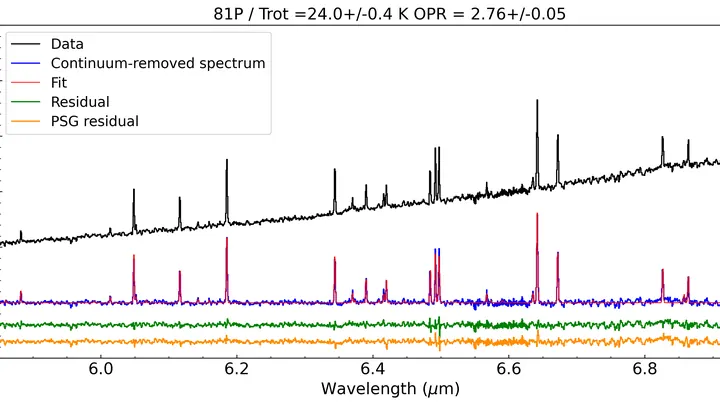
In March 2023, the James Webb Space Telescope pointed its instruments at the short-period comet 81P/Wild 2. This celestial body, about the size of a small town (nucleus radius around 1.77 km), is already familiar to scientists: in 2006, the Stardust probe flew through its tail and collected dust samples that were later studied in Earth laboratories.
In March 2023, the James Webb Space Telescope pointed its instruments at the short-period comet 81P/Wild 2. This celestial body, about the size of a small town (nucleus radius around 1.77 km), is already familiar to scientists: in 2006, the Stardust probe flew through its tail and collected dust samples that were later studied in Earth laboratories.
The night sky is like an ocean: the longer you stare, the more faint lights you notice in the depths. That's how astronomers, peering into the outskirts of the Milky Way, found Aquarius IV — a tiny stellar system that had been hiding in the dark until now.
The system was spotted in images from an early survey by the future Vera Rubin Observatory.
When an orchestra of thousands of musicians plays in harmony, the credit goes not only to each player's talent but also to the invisible work of the conductor.
A star wrapped in an invisible blanket warms up more than it should. That's exactly how ten red dwarfs look, which astronomers from the Hephaistos project have been monitoring. These stars lie within 300 parsecs (about 1000 light-years) of us and emit far more infrared energy than their modest sizes can explain.
Edge of the spotlight. Remove the dazzling light of the central star, and a theater of shadows emerges. The James Webb coronagraph, like a dense curtain, hid the star TW Hydrae — and on a stage 120 astronomical units long (four times the distance to Neptune), its protoplanetary disk came alive.
Edge of the spotlight. Remove the dazzling light of the central star, and a theater of shadows emerges. The James Webb coronagraph, like a dense curtain, hid the star TW Hydrae — and on a stage 120 astronomical units long (four times the distance to Neptune), its protoplanetary disk came alive.
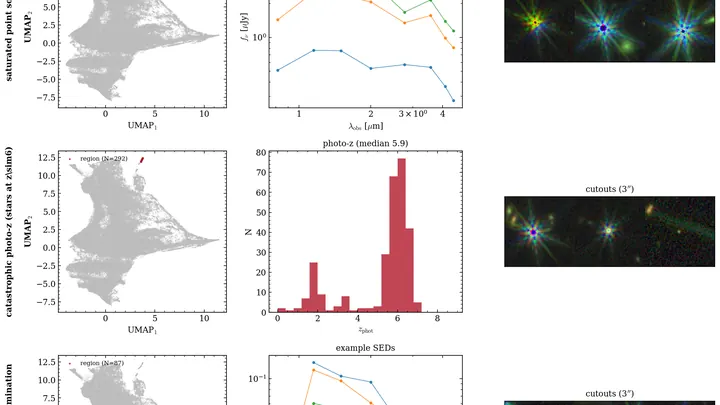
Two hundred forty-two thousand three hundred twenty-seven galaxies — like grains of sand on a beach. But astronomers turned this chaos into a map: the UMAP algorithm (a machine learning method) took from each galaxy eleven parameters — seven colors from optical to mid-infrared (that's photometry), magnitude…
In the early universe, just a few hundred million years after the Big Bang, astronomers see strange objects — little red dots. They are compact, red, and in their spectra, broad Balmer lines scream the presence of supermassive black holes. But how did the hole manage to accumulate millions of solar masses in such a short time?
The hunter of ancient light, the James Webb Telescope, aimed its mirrors at a tiny patch of sky and caught a strange beacon. The object, with the working name beacon_1420-$$5253_{4770}$$, flashed and faded. At first, it was logged as a candidate for the most distant galaxy, as if we were seeing it just 300 million years after the big bang.
Water comes in different varieties. Not just fresh or salty, but also "heavy"—when one of its hydrogen atoms is replaced by deuterium, its heavier cousin. Such water is called HDO, and it's a true cosmic passport: the amount of deuterium in water reveals where and when that water was born.
In 2034, a rocket leaves a spaceport with an unusual payload: two spheres the size of a large globe, each weighing nearly a ton. No engines, no electronics. Just a mirrored surface of hundreds of corner-cube reflectors — tiny prisms that return light exactly to where it came from. This is the future space tuning fork.
In 2016, astronomers saw something incredible: a distant star, named Icarus, flared up for several weeks, crossing the abyss of space. Gravitational lensing, an effect predicted by Einstein, had kicked in: a massive object bends spacetime and focuses light like a giant magnifying glass.
In 2024, the Hephaestus project sifted through millions of stars and flagged a few dozen suspicious ones: they shone brighter in the mid-infrared than a normal red dwarf should. Two of these candidates, labeled D and E, looked especially tantalizing, as if an invisible heater were working next to the star.
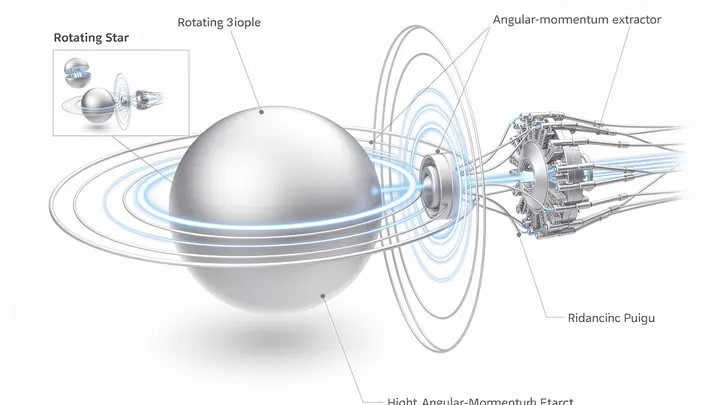
For decades, SETI has hunted for Dyson spheres — hypothetical shells that capture a star's light stars and re-radiate it in the infrared. But the cosmos remains silent. Perhaps an alien intelligence operates more elegantly: instead of collecting light, it tames the rotation of a sun, like a giant flywheel.
The era of cosmic noon is a time when the Universe was experiencing its stormy youth. Three billion years after the Big Bang, galaxies were giving birth to stars at a frantic pace, and supermassive black holes were growing in their centers.
Tiny seeds of life can cross the black void on icy wanderers like comet 3I/ATLAS. The James Webb Space Telescope found water and methane on it for the first time, and light analysis revealed an unusual gas composition.
The James Webb Space Telescope has peered into a strange binary world. Here, a dead star, a white dwarf, slowly roasts its companion, a brown dwarf. The object, named ZTFJ0038+2030, completes a full orbit in just a few hours. One side of the brown dwarf always faces the white dwarf, much like the Moon faces Earth.
Right after the Big Bang, the Universe was a chemical desert — only hydrogen and helium, not a hint of metals. But moments passed (by cosmic standards), and the birth of the first stars — Population III — began.
Deep underground, iron glows white-hot, and the pressure is so intense that an ordinary instrument would be crushed flat. To peer into this world, physicists built a special microscope based on tiny diamond defects (so-called NV centers).
Hundreds of light-years away, there's a planet that looks like a giant mirror. LTT9779b reflects most of the light that hits it — far more than you'd expect from a Neptune-sized body. Astronomers have long debated what makes it so shiny: a thick carbon-rich haze or a layer of clouds.
The James Webb Space Telescope has helped settle the debate.
Using James Webb, astronomers 'fished out' a third giant planet from the murky dust disk of the star β Pictoris. Two others were already known, but this one was hiding in the bright light, like a fish in muddy water.
WASP-121 b is not just a hot ball. It's a world where iron vaporizes and the sky glows with its own heat. A fresh look at it has revealed what 'ingredients' went into making it.
The James Webb Space Telescope has for the first time clearly detected vaporized silicon monoxide in its atmosphere — a refractory substance usually locked inside dust grains.
For decades, two independent methods of measuring the rate at which galaxies are flying apart, the Hubble constant, have given conflicting numbers. The situation resembled a room with two thermometers showing different temperatures.
The planet WASP-121 b is a gas giant, heated to 2500°C. It always faces its star with one side, like a globe frozen under a lamp. But as it passes in front of the star's disk, its rotation reveals different facets to us — as if that globe were slowly turned, letting us peer into every corner.