Gas Curtain of 'Little Red Dots': Why It's So Common in the Early Universe ✛
Forty reddish sparks frozen in the images from JWST. The telescope spotted them in the depths of space, at distances where the Universe was less than two billion years old. These objects are active galactic nuclei — very compact and unusually red. Their color earned them the nickname 'little red dots' (LRDs).
When astronomers spread the light of these dots into spectra, a surprise awaited. In 14 out of 40, dark troughs appeared in the hydrogen lines — signs of cold gas hanging in front of the bright core. Such Balmer absorption is rare for active nuclei. In the nearby Universe, it is found in one out of two and a half thousand. But here — 35%.
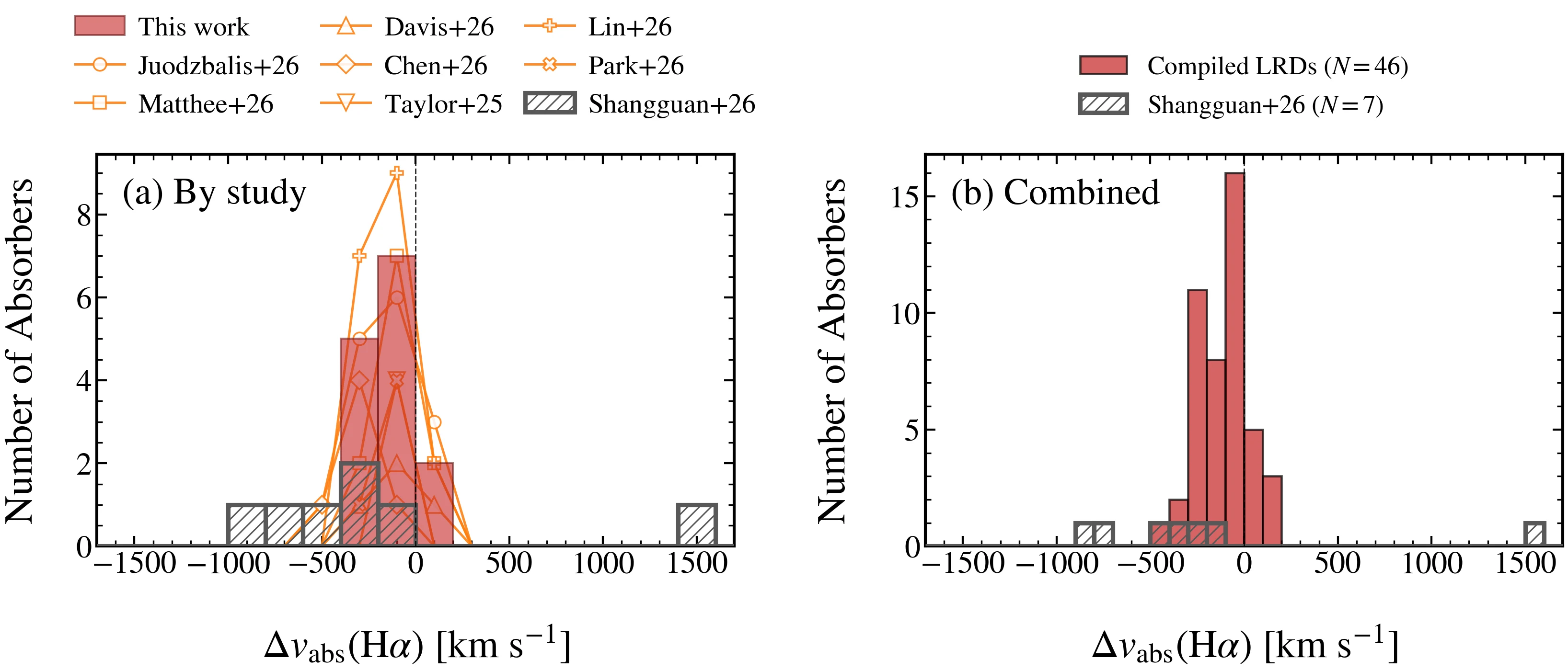
The gas is not stationary. From the Doppler shift to the blue side, it's clear that almost all these clouds (12 out of 14) are rushing toward us — outflowing from the black hole. Velocities are modest: from −375 to +100 km/s. But that is only seemingly modest. Compared to the gravitational trap set by the black hole, the difference with nearby active nuclei vanishes. The curtain flutters as fast relative to its 'hosts'; the black holes themselves are just smaller and weaker in the early Universe.
Why is the curtain so important? It not only explains the red continuum — that unusual hue of LRDs. Dense gas reprocesses the core's radiation, making it redder. But more importantly, it tells about the life of supermassive black holes during their rapid growth phase. A model of radiation pressure shows that under typical conditions, these clouds remain bound to the hole. They burst outward, but the radiation force is insufficient to tear them away from gravity. The curtain flaps in the wind — but does not fly off.
Forty red sparks in the image are not just dots. They are the neighborhoods of black holes, where a dense canopy of hydrogen occasionally opens and closes. Watching its flutter, astronomers learn to read the history of the first giants' growth. For now, one thing is clear: in the early Universe, such curtains are the rule, not the exception.
The term 'little red dots' arose from the visual similarity of these objects in JWST images — they look like point-like reddish sources, though in reality they are entire galaxies with an active nucleus.