In 1885, 60-year-old Johann Jakob Balmer (a Swiss mathematician and teacher) noticed numerical harmony in the wavelengths of the hydrogen spectrum. He empirically derived a formula that was later generalized by Johannes Rydberg for all series (Lyman, Paschen, etc.). Balmer's discovery became the empirical foundation for subsequent quantum theories of atomic structure—Niels Bohr in 1913 explained the Balmer formula by postulating quantization of angular momentum.
History
Johann Balmer published 'Notiz über die Spektrallinien des Wasserstoffs' (Note on the Spectral Lines of Hydrogen) in 1885. His formula amazed contemporaries with its predictive accuracy. In 1888, Johannes Rydberg generalized it to other series. Niels Bohr in 1913 derived the formula from his postulates, giving it physical meaning. Arnold Sommerfeld later refined the model by introducing elliptical orbits and the fine-structure constant.
How it works
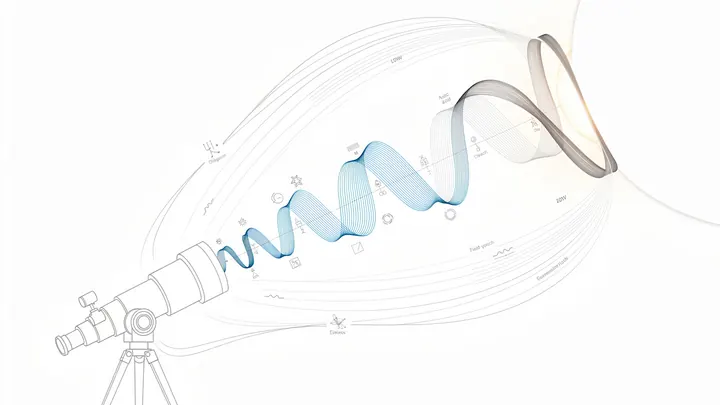
It is applied in astrophysics to determine the redshift of distant objects and analyze stellar chemical composition. Limitations: it does not account for fine or hyperfine structure; for heavy multi-electron elements the formula is inapplicable—there quantum electrodynamics is needed.
In practice
Thanks to this formula, one can tell from a star’s spectrum how much hydrogen it contains and how fast it moves.
Fun fact
Balmer was so fascinated by numerical patterns that he tried to explain the layout of Egyptian pyramids and even the proportions of the human body using simple fractions.
A cartographer receives a sheet with distances between hundreds of unnamed islands. No island is labeled, but the distances repeat, forming triangles and quadrilaterals. From these repetitions, the cartographer reconstructs the map of the archipelago, not knowing which island is which. This is roughly how the new work in molecular spectroscopy works.
When stars are born in a galaxy, they make hydrogen glow, like a neon sign, but on a cosmic scale. This light could tell us a lot about how many stars are forming, but on its way to us, it passes through cosmic dust. Dust is like a fogged-up window: it dims the glow and alters its color.
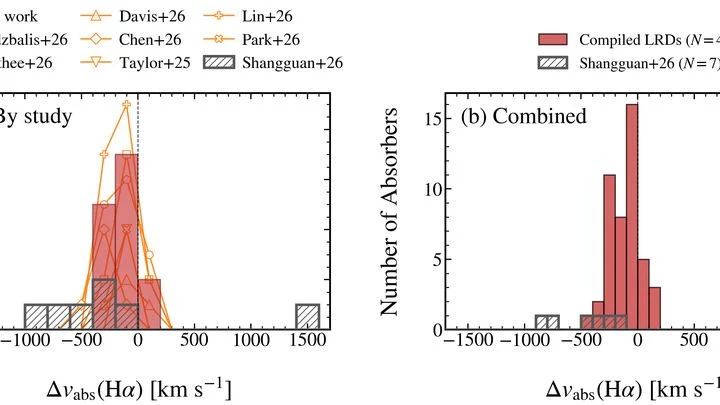
Forty reddish sparks frozen in the images from JWST. The telescope spotted them in the depths of space, at distances where the Universe was less than two billion years old. These objects are active galactic nuclei — very compact and unusually red. Their color earned them the nickname 'little red dots' (LRDs).
Each morning, dozens of telescopes swing toward the Sun. Their cameras catch a narrow band of red light — the Hα line, discovered by Johann Balmer. The images reveal dark, whimsically curved threads. They look like stitches in a giant tapestry sewn through the blazing corona.
In 1,433 pairs of galaxies scattered across the sky, astronomers noticed an unusual pattern. Neighbors located 'above' or 'below' a massive stellar system contain up to a quarter more oxygen than those lying in the plane of its disk.
An artist makes a quick charcoal sketch, and the face in the portrait is already recognizable. Astrophysicists face a similar challenge: the spectrum of a star is its individual portrait, revealing temperature, composition, and gravity.
The Sun is not just a blazing ball, but a colossal orchestra, where the strings are solar filaments — giant arches of dense plasma floating in the scorching corona. They tremble, and each oscillation is an encrypted melody of magnetic fields.
A stone falls into water, and ripples spread in all directions. Throw a handful of stones at once, and the ripples overlap: you can no longer tell which ripple came from which stone. A neutron beam hitting a detector looks much the same: a bright spot blurred by many causes.
The James Webb Space Telescope peered into the era when the expansion of the Universe stretched the light of distant objects into the red, and found a scattering of strange sources — 'little red dots'. Their spectra broke the usual patterns: they are blue in the ultraviolet, but deep red in the optical, as if seen through a cherry veil.
The antiproton is a mirror twin of the proton: same mass, but negative charge. When it approaches an atomic nucleus, the particles can annihilate, turning into radiation.