We have retold 6 papers by this author. 2 of them with a full read. most often about: supernova, Reionization, supernova remnant. 30 co-authors across our retellings.
A massive galaxy cluster acts as a giant lens. Its gravity warps the fabric of space, and the light of distant objects, bending around this curvature, is amplified and split into multiple images.
Thanks to gravitational lens — an effect predicted by Fritz Zwicky, where a galaxy cluster acts like a magnifying glass — the James Webb Space Telescope spotted two red dots in a galaxy 800 million years after the Big Bang.
The galaxy CEERS2-588 flared up like a bonfire fed with an armful of wood all at once. Just 400 million years after the Big Bang, it had already built up a mass of a billion suns and ignited countless stars. But then the fuel ran out, and over the last 10 million years, star formation in it has almost completely ceased.
A distant galaxy always looks redder than it really is. That's the work of cosmic dust — tiny solid particles that scatter blue light more than red, like haze at sunset. Astronomers measured this effect for tens of thousands of galaxies using two powerful instruments.
For thirteen billion years, light battled through cosmic emptiness. It bent around massive galaxy clusters that, as Einstein predicted, acted as giant lenses — amplifying and distorting the distant glow. In 2023, the NIRSpec instrument on the James Webb Space Telescope captured this light and spread it into spectra.
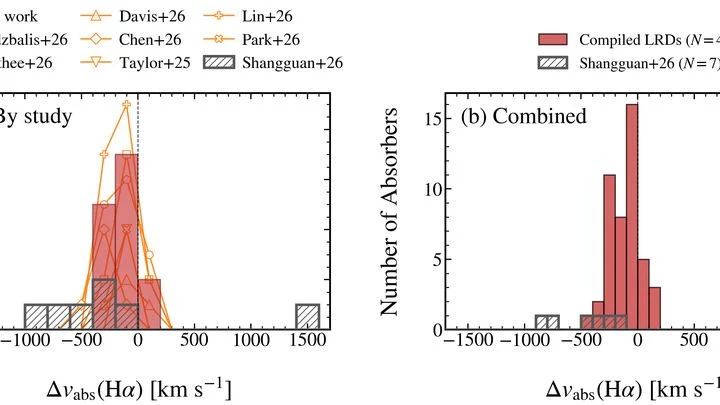
Forty reddish sparks frozen in the images from JWST. The telescope spotted them in the depths of space, at distances where the Universe was less than two billion years old. These objects are active galactic nuclei — very compact and unusually red. Their color earned them the nickname 'little red dots' (LRDs).