Gas curtains of 'little red dots': the mystery of Balmer absorption ✛
Context
In 2023, the JWST trained its mirrors on a patch of sky and saw hundreds of compact, reddish objects — 'little red dots'. It soon became clear that these are the cores of distant galaxies at redshifts of 2–7, where supermassive black holes lurk. But unlike familiar active galactic nuclei (AGN) in the local Universe, their spectra held a surprise: Balmer absorption lines, extremely rare in nearby AGN (one case in two and a half thousand), appear here in nearly every third. Thus the suspicion arose that in the early Universe black holes are wrapped in a dense gaseous veil — a 'curtain' that not only reprocesses light but also betrays itself by its motion.
Methods
40 objects were examined, selected from spectroscopy data taken with NIRSpec on JWST from the DJA archive. For each, a model of the Hα line profile was built, including narrow and broad emission, and when necessary, a multiplicative absorption component with partial covering. Statistical significance was assessed using the BIC information criterion. To understand whether the apparent narrowness of the velocity distribution is due to missing fast absorbers, numerical simulations were performed: real absorption profiles from SDSS were injected into LRD spectra and the recovery rate was checked.
Results
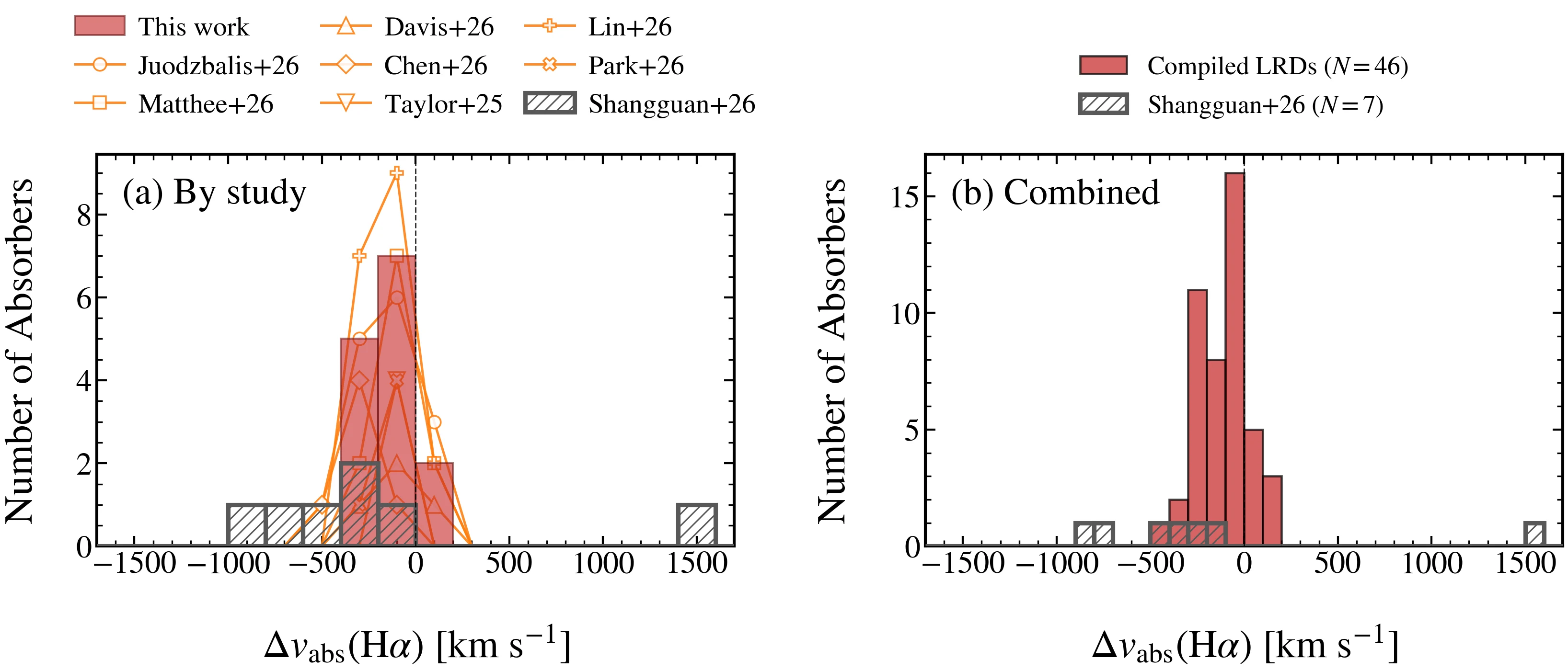
Out of 40 LRDs, Hα absorption was found in 14 — that's 35%. For comparison, among more than 14,000 AGN from the SDSS survey there are only 6 such cases, meaning the frequency is three orders of magnitude lower. Accounting for sample incompleteness, the true fraction of absorbers among LRDs may be even higher. The absorption velocities range from −375 to +100 km/s relative to the systemic (from the [O iii] line), and 12 of 14 are shifted to the blue side — the gas is moving toward us, i.e., outflowing from the black hole. In a compilation with literature data (46 absorbers in 45 objects) 83% also show blueshift. The absolute velocities are modest compared to absorbers in nearby AGN, but after normalizing by the escape velocity from the broad-line region the difference almost disappears. In other words, the gas in LRDs moves slower simply because the black holes there are probably less massive and create a shallower gravitational well.
Implications
These results mean that dense gas — with a concentration of hydrogen atoms in the second excited state, capable of absorbing in Balmer lines — is a common component of black hole surroundings in the early Universe. It may explain the mysterious 'red continuum' of LRDs, acting as a semi-transparent curtain that reprocesses radiation from the central source. The radiation pressure model shows that for a typical Eddington ratio λ~0.1 and column density NH ~ $10^{24}$ cm⁻², most such clouds remain gravitationally bound — they flow outward but are doomed to return. This makes them akin to a 'curtain' that billows from radiation but does not fly away. Only at lower densities can the gas overcome the gravity of the black hole and, obeying the law of universal gravitation but gaining enough radiative acceleration, escape into intergalactic space.
Future development
The topic will develop as high-resolution spectra and multiwavelength observations accumulate. X-ray and radio observations are especially promising, as they will allow us to estimate the total column density of the gas and test whether we are truly seeing the boundary between inflowing and outflowing streams. Numerical hydrodynamics simulations with realistic radiative transfer will help reproduce the absorption profiles and understand the geometry of the gaseous 'curtain' — whether it is a wind, a disk atmosphere, or something in between.
Impact
The discovered connection between Balmer absorption and LRDs touches on several fields: the physics of accretion onto supermassive black holes, the chemical evolution of galaxies, and the cosmology of the early Universe, as the outflowing gas can regulate star formation and enrich the intergalactic medium.
Next steps
Next steps include a targeted search for absorbers with NIRSpec in high-resolution mode (R~2700) to refine the profiles, as well as a statistical analysis of correlations between absorption strength and continuum properties to separate the stellar and non-stellar components.
Key open problems
This work directly addresses the unsolved problems of the formation and growth of the first supermassive black holes: if dense gas effectively screens the radiation, then accretion can proceed in a super-Eddington regime, and Balmer absorption serves as a diagnostic of this process. Moreover, the fate of the outflowing gas is relevant for understanding feedback in galaxies.
The knowledge machine's view
This section is addressed to the author of the paper and their colleagues. Neighbouring works were found by meaning-based search across our archive, not by word overlap. We do not review: we show the field around the work.
What the work does
The study examines the spectra of 40 'little red dots' (LRDs) at z~2–7 using NIRSpec/JWST data. Models of the Hα profile with an absorption component are constructed, statistical significance is assessed via BIC, and numerical simulations are run to check sample completeness. It is shown that Balmer absorption occurs in 35% of LRDs, predominantly with a blueshift, indicating gas outflows.
Where its strength is
A high incidence of Balmer absorbers in LRDs is found—three orders of magnitude higher than in nearby AGN—and it is shown that outflow velocities, when normalized by the escape velocity, are similar to local ones, linking gas dynamics to the properties of the central black hole.
Where it could go next
- It might be interesting to compare the obtained outflow picture with the radiation-dominated shell model, where dense gas produces the red continuum and explains the compactness of LRDs.based on: Cosmic Pressure Cooker: Unraveling the Mystery of Little Red Dots arXiv:2607.17448v1
- A related study considers LRDs as cores hidden by hydrogen fog and proposes a unified scheme linking absorption to orientation and evolutionary stage; this could help interpret the diversity of profiles in your sample.based on: Scarlet Invisible Cores: How Hydrogen Fog Conceals Black Holes arXiv:2606.04711v1
Worth trying
- Test whether the presence and width of Balmer absorption correlate with X-ray or radio properties of LRDs, using archival survey data.
- Apply the partial covering model to other Balmer lines (Hβ, Hγ) in the same spectra to assess the homogeneity and geometry of the absorbing gas.
- Compare the outflow velocity distribution in LRDs with predictions from hydrodynamic simulations of super-Eddington accretion.
Why this may matter
If dense gas veils are a common feature of early AGN, this changes the estimates of bolometric corrections and accretion rates in the reionization epoch, and may also explain how black holes rapidly gained mass while remaining partially obscured.
Nearby works in our archive
- Red Lanterns of the Cosmos: What Compact Objects from the Early Universe Concealsimilarity 0.71
- Scarlet Invisible Cores: How Hydrogen Fog Conceals Black Holessimilarity 0.69
- Tiny Black Holes Build Giantssimilarity 0.69
- Why Some Galaxies Are Blue and Others Redsimilarity 0.67
- Cosmic Pressure Cooker: Unraveling the Mystery of Little Red Dotssimilarity 0.66
- Dusty Black Hole in a Young Galaxysimilarity 0.66
The archive is crowded around this work: 10 reviews nearby, closest at 0.71. This ground is well walked — and there is plenty to compare against.
Original abstract
as written by the authors arXiv:2607.26269v1
We present the statistical properties of H$$\alpha$$ and H$$\beta$$ line absorption in little red dots (LRDs) at $$z\simeq2.5$$--7.2 using archival JWST/NIRSpec spectra from the DAWN JWST Archive and complementary NIRSpec/IFU observations. Among 40 LRDs with broad H$$\alpha$$ and [O~{\sc iii}] obtained with medium- or high-resolution gratings, 14 objects exhibit H$$\alpha$$ absorption. We find that the incidence of Balmer line absorption is $$\sim35$$\% ($$=14/40$$), significantly higher than that in SDSS low-$$z$$ type 1 AGNs ($$\sim0.04$$\%), demonstrating that Balmer line absorption occurs approximately 850 times more frequently in LRDs than in type 1 AGNs. We combine our 14 detections with 32 additional LRD Balmer absorbers from the literature, yielding a census of 46 absorbers. Their velocities span $$\Delta v_\mathrm{abs}(\mathrm{H\alpha})\sim-430$$ to $$+140\ {\rm km\,s^{-1}}$$, markedly narrower than the $$-800$$ to $$+1600\ {\rm km\,s^{-1}}$$ range of Balmer absorption in SDSS type~1 AGNs, for which our simulations confirm that the velocity difference is too large to be explained by detection incompleteness. The lower absolute absorber velocities in LRDs may partly reflect the shallower gravitational potential at their characteristic BLR radii. We also find that 38 of the 46 absorbers (83\%) are blueshifted, with only eight redshifted, indicating that most of Balmer absorbers are moving outward. An analytic model with radiation pressure suggests that most absorbers with $$N_{\rm H}\gtrsim10^{24}\ {\rm cm^{-2}}$$ remains gravitationally bound. The smaller number of redshifted (i.e., infalling) absorbers may indicate that outbound absorbers lose density: some return to the BLR, whereas others undergo stronger radiative acceleration and escape.
The term 'little red dots' arose from the visual similarity of these objects in JWST images — they look like point-like reddish sources, though in reality they are entire galaxies with an active nucleus.
Key numbers
- Fraction of LRDs with absorption: 35% (vs. 0.04% in SDSS)
- Frequency excess: approximately 850 times
- Absorber velocity range: from −430 to +140 km/s
- Number of absorbers in compilation: 46
- Median velocity shift: −95 km/s