A nebula is a giant cloud of gas and dust in space. It looks like smoke from a campfire, but hundreds of light-years across. New stars are born inside such clouds.
History
The first telescopic observations of nebulae were recorded by Galileo, but the first systematization belongs to Charles Messier, who published a catalog of 110 objects to avoid confusing them with comets. In the 19th century, William and John Herschel compiled a general catalog, later becoming the New General Catalogue (NGC). Spectral studies by William Huggins (1864) proved the gaseous nature of many nebulae. Modern theory of star formation in nebulae builds on the work of James Jeans, while emission mechanisms rely on quantum mechanics (the Schrödinger equation for energy levels).
How it works
The main emission source of emission nebulae is recombination and cascade transitions in hydrogen atoms, described by the Schrödinger equation and selection rules. The spectral shape is explained by Maxwell's equations for moving charges and Planck's radiation law for the thermal background of dust. The balance between gravitational contraction and gas pressure is regulated by Noether's theorem (energy conservation) and the second law of thermodynamics during radiation. In reflection nebulae, light polarization is described by Mie scattering theory, and the particle size distribution follows power laws.
Fun fact
The most beautiful nebula is perhaps the Horsehead Nebula. It resembles a foal's head floating in space, though it is actually dust obscuring the light of a distant star.
In 1054, a star flared up in the constellation Taurus. The light of its death was so bright that it was visible in daylight for nearly a month, and Chinese astronomers recorded it in their chronicles. Today, the Crab Nebula is spreading over that spot, and its claws are clouds of gas still being whipped up by the dead star at its center.
In a distant galaxy, light from hot gas should reveal its composition. The James Webb Telescope split that light into a spectrum, and astronomers saw: oxygen lines too weak.
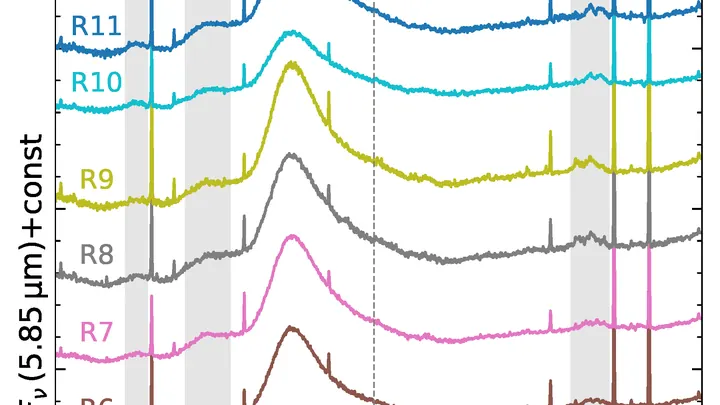
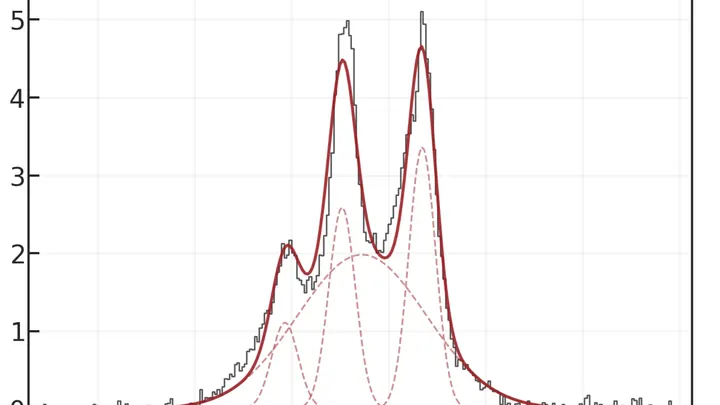
The Tarantula Nebula is a giant stellar nursery in a neighboring galaxy. Hundreds of thousands of stars are born there, and their light illuminates clouds of dust. This dust glows in the infrared, and its spectrum shows mysterious bands. For a long time, astronomers debated which molecules produce them.
Light from a distant galaxy reaches us through its own dust. This dust is not a smooth haze but ragged clouds, like wisps of cotton. Old models treated it as a uniform mist, and then the galaxy didn't add up energetically: too much light disappeared in the ultraviolet and too little came back in the infrared.
Astronomers did what a cook does when they dice a potato instead of tossing it in whole.
A galaxy is like a city: bright lights and dense buildings at the center, sparse lights and emptiness toward the outskirts. But if you watch how gas rotates in a galaxy's disk, you see that its speed barely drops at the edges. As if invisible neighborhoods keep the motion going. Astronomers have found a way to map this invisible city.
A neutron star is the ultra-dense remnant of a supernova: the mass of the Sun packed into a sphere the size of a city. For billions of years, it travels through space, gathering around itself invisible matter, dark matter, which emits no light but pulls with gravity.
Two cities endure a series of fires. In one, the wind carries ash far beyond the outskirts, leaving the sky clear. In the other, ash settles as a dense veil, painting sunsets crimson. Roughly the same thing, just on a galactic scale, happens with supernova explosions, the final flares of massive stars.
The Orion Nebula is a showcase of astrophysics, a laboratory for studying star formation right in our backyard. For over a century, its light has been split into spectra, and each forbidden line whispers its own version of how many electrons per cubic centimeter.
Around some young stars where star formation has recently ended, there swirl not just dust rings but actual planetary battlefields — extreme debris disks.
Dark matter — the invisible foundation of cosmic architecture — makes up 85% of all mass, yet eludes direct observation. In the 1920s, Edwin Hubble discovered the expansion of the universe and the realm of galaxies; by the 1930s, Fritz Zwicky suspected hidden mass in their clusters.
Two million years away, around the young star CI Tau, a gas-dust disk whirls — a protoplanetary cradle. ALMA observations have already shown rings and gaps in it, but the finest details remained invisible: their width is smaller than the instrument's resolution.
When a star dies, it turns into a white dwarf — a dense ball of carbon and oxygen the size of Earth. Predicted by Subrahmanyan Chandrasekhar, these objects were long thought to be lifeless graveyards.
The birth of planets resembles the workings of a cosmic forge. Rocky blocks collide and fuse together. A powerful impact strikes a spark — material heats to white-hot and glows like cooling metal. Computer simulations show: the flash is visible from days to years, peaking at a tenth of the sun's light.
In the boundless night of space, galaxies come together in a slow gravitational dance, merging into one. Such collisions are not head-on impacts but rather like fingers moving slowly through water, leaving swirls and tails behind.
The hot broth of the early universe cooled unevenly. At some point, bubbles of a new phase began to pop within it, like steam bubbles in boiling water. But these bubbles weren't made of steam; they were made of a new state of matter in which particles of the dark sector clumped into larger lumps. That's how dark matter could have been born.
Moments before totality, swift shadow bands glide across the ground, like ripples from pebbles tossed into water. For centuries, this phenomenon baffled scientists. It turns out the key is that light is a wave.
The Sun isn't a pinpoint lamp but a vast disk. When the Moon nearly covers it, a thin glowing crescent remains.
At the center of many galaxies lurks an invisible halo of dark matter: it holds the stars at the edges, keeping them from flying apart. For a long time, it was described as a dilute gas of particles, but new work offers a different view: dark matter might gather into a quantum droplet.
Civilizations in the Universe are separated not just by distance, but by the vast gulf of time. Hunting for their traces is like archaeology: instead of palace ruins, we find clouds of cosmic dust.
When astronomers peer at distant worlds, they often don't see crisp lines of water vapor or methane, but a blurry silhouette, as if the planet has thrown on a thick veil. This veil, a haze of organic particles, behaves like a temperamental photographic plate: it darkens under harsh ultraviolet light, revealing hidden chemical patterns.
The James Webb Space Telescope peered into the era when the expansion of the Universe stretched the light of distant objects into the red, and found a scattering of strange sources — 'little red dots'. Their spectra broke the usual patterns: they are blue in the ultraviolet, but deep red in the optical, as if seen through a cherry veil.
The young super-Jupiter TWA5B, a scorching ball 25 times Jupiter's mass, floats just fifty light-years away. Its faint infrared glow long hid its chemical makeup. Now, high-resolution spectroscopy with CRIRES+ has registered the ghostly trace of SiO — silicon monoxide.
The James Webb space telescope peered into an era when the Universe was less than a billion years old and discovered hundreds of strange objects there. Tiny yet dazzlingly bright, they glowed a deep red — like burning coals scattered across the black velvet of space.
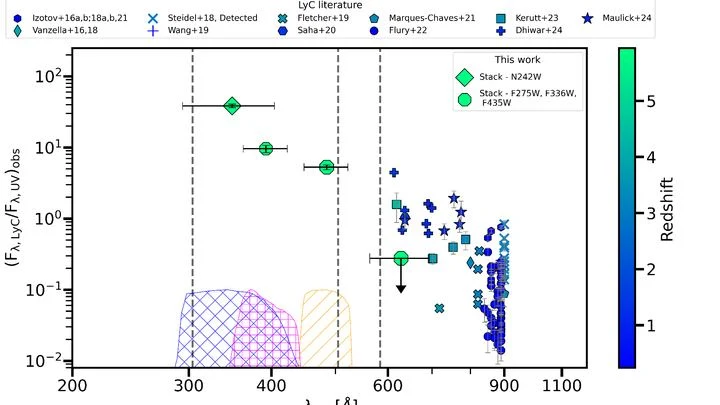
In the heart of a molecular cloud, a massive star is born. Its ultraviolet light ionizes hydrogen, and the cloud flares in the Lyman-alpha line. But for the photon, this flare is not liberation but imprisonment in a hall of mirrors.
In the heart of the Eagle Nebula, about 7000 light-years away, three giant pillars of gas and dust rise — the Pillars of Creation. Their shape is familiar to many from Hubble Space Telescope images. Now, Webb's infrared camera has allowed us to peer inside these dense cocoons where stars are born.
Drop a stone into a pond, and ripples spread outward. Something similar happens inside compact clumps of dark matter when they encounter a special medium — a scalar field. This field, which pervades everything around us, can spontaneously intensify in the depths of such objects, much like ripples on water growing ever taller and more pronounced.
A street where houses have just been built. Some shine with clean windows, others are covered in construction dust. That's roughly what galaxies looked like when the universe was only a few hundred million years old. The new James Webb telescope peered into that era and saw dozens of bright star islands.
The JWST telescope has spotted a multitude of bright galaxies in the young universe. Their ultraviolet light was barely absorbed by cosmic dust — defying previous expectations.
In the searing plasma of the newborn Universe, when space itself still rang with the echo of the Big Bang, objects may have emerged that challenge gravity itself. Not ordinary black holes — but electrically charged giants, astrons.
A pot of water has just been stirred: the whirlpools and eddies gradually calm down, and the liquid becomes smooth. A similar process, but in the quantum world, occurs in superfluid helium or in a cloud of ultracold atoms.
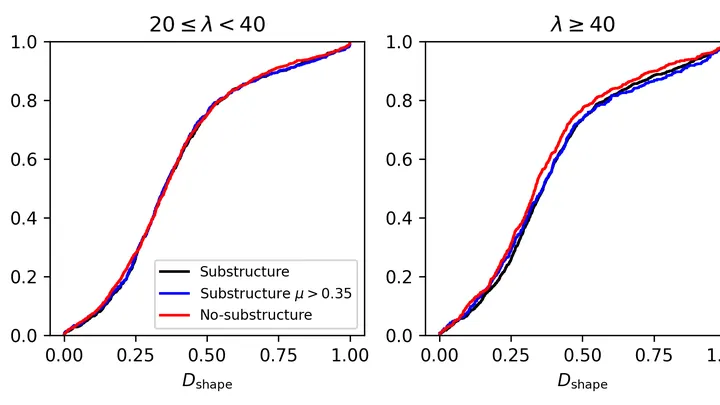
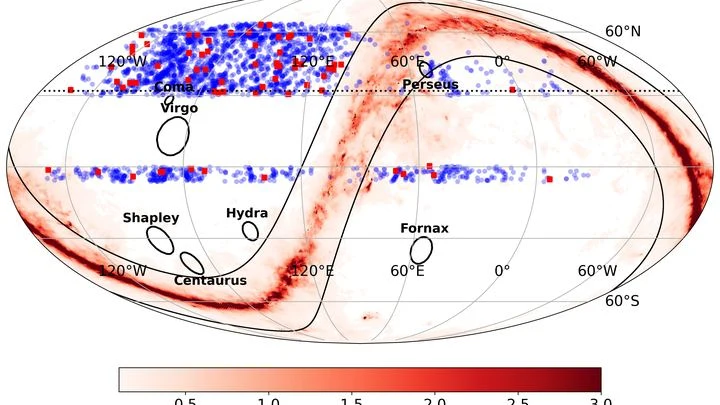
Giant galaxy clusters are cities of thousands of star islands, held together by gravity. Inside them, hot gas churns and glows in X-rays. If a cluster has recently collided with another, it develops clumps of galaxies and distortions in the gas, like ripples on water after a stone is thrown.
A glowing cloud in a telescope looks like a wisp of fog about to dissipate. Planetary nebulae are gas shells cast off by dying stars. Young nebulae are bright and compact, but as they age, they expand, cool, and become increasingly transparent until they vanish into the interstellar medium.
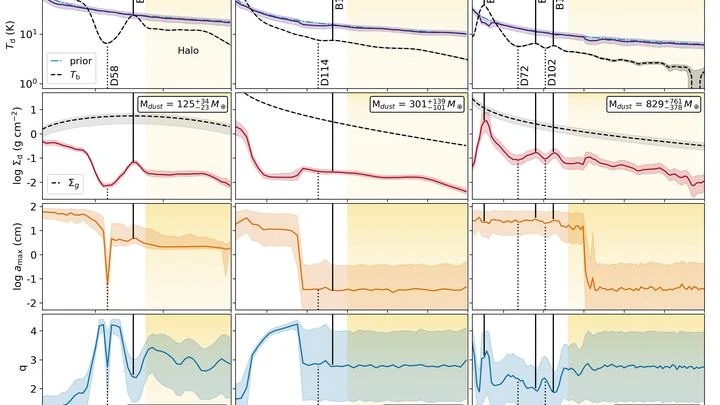
A young star is surrounded by a flat, rotating disk of gas and dust, like pizza dough that's been spun out. Planets are born inside such a disk. But around three stars (Elias 2-24, IM Lup, and DM Tau) astronomers noticed something odd: far beyond the edge of the bright disk stretches a barely visible but enormous dust halo.
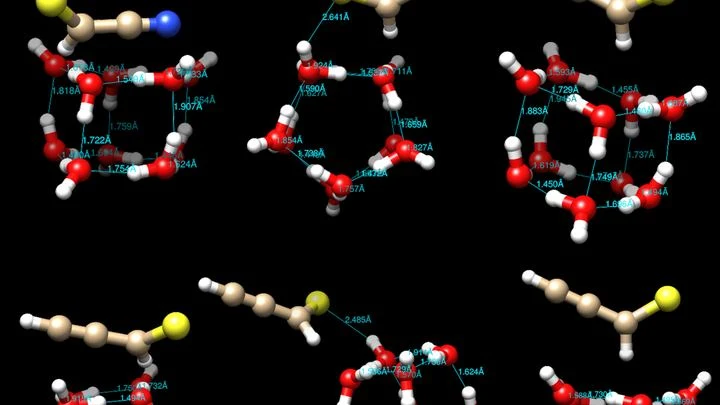
In a cold cloud of gas and dust that astronomers call TMC-1, two sulfur-bearing compounds were recently found: one smells like bitter almonds, the other like rotten eggs. But such a cloud contains less sulfur than it should. Where does it go? It seems to hide in tiny icy pockets on the surface of dust grains.
Space ice is not like a skating rink. It is fluffy, like snow, and full of crevices and hollows.
In the vast cosmic web, the James Webb Space Telescope spotted something unusual — tiny but bright red sparks that astronomers have nicknamed 'little red dots.' They shine as if an invisible fire is raging inside: their spectrum looks like a letter V, and the hydrogen lines are broadened, as if someone smeared paint across a canvas.
After the Big Bang, the Universe was filled with cold gas — mostly neutral hydrogen and helium. It enveloped the cosmos like a morning fog, impenetrable to light. The Dark Ages began.
When the first galaxies ignited, their radiation, like a searchlight beam, started knocking electrons out of atoms.
Around young stars, flat clouds of gas and dust swirl, like pizza dough from which planets will eventually be shaped. This cloud contains various chemical elements, and sulfur is one of the most elusive: it's hard to catch with telescopes because it hides in solid grains or escapes as gas.
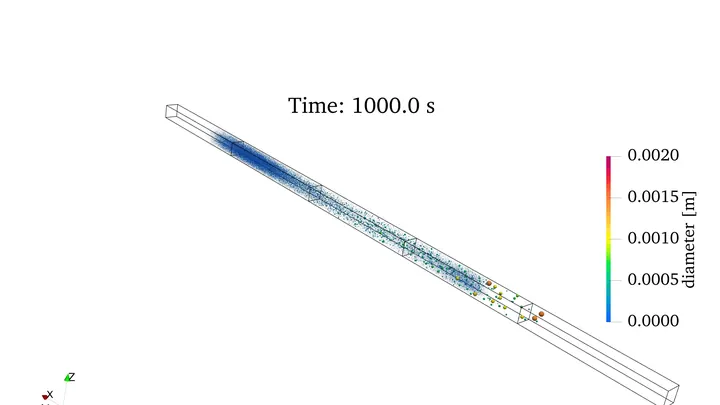
In a cloud, thousands of tiny water droplets hang in the air. For rain to fall, they need to grow: stick together into larger drops and become heavy enough to fall to the ground. But how exactly do droplets find each other in a huge cloud?
Scientists created a computer model that tracks each droplet individually, as if each one had its own little sensor.
Every galaxy floats in an invisible cloud of gas, like fruit in syrup. This gas is the leftover building material from which stars were assembled, and it is constantly replenished by fresh supplies from intergalactic space. Seeing it directly is nearly impossible: it is too tenuous and too cold.
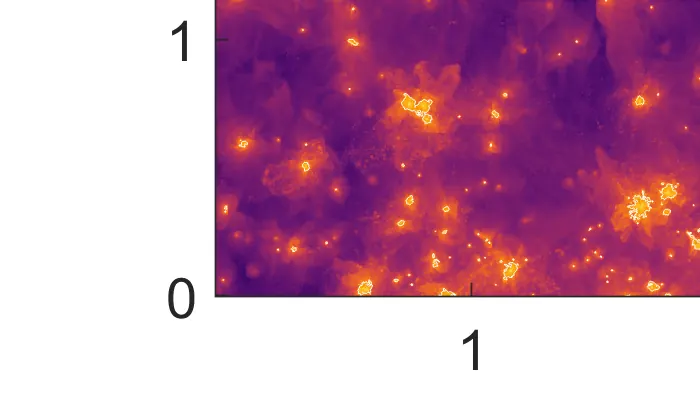
In cold clouds of interstellar gas, long, dense filaments stretch out. Inside them, like overcrowded incubators, future stars are maturing. For a long time, it was thought that within such filaments, everything was governed by gravity: matter smoothly flows toward the centers, where density increases and eventually a star ignites.