Star Punches Through Cloud, Leaving a Million-Year Mark express
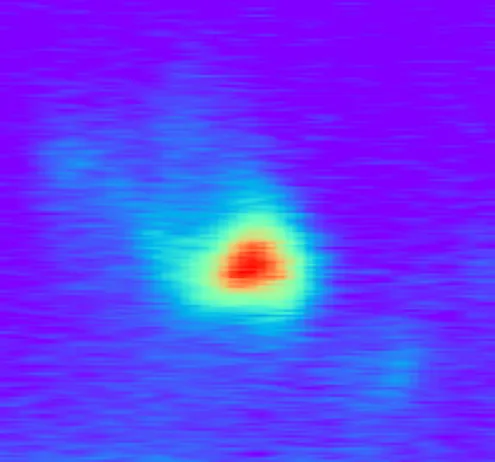
At a distance of 1900 parsecs, in the constellation Vulpecula, the star V420 Vul pulsates — a Mira-type variable. Such stars, nearing the end of their lives, swell and shed their outer layers. But around V420 Vul, astronomers spotted not just a shed envelope, but something trickier.
Archival data from the Arecibo Telescope revealed an extended structure of neutral hydrogen — a cloud 20 parsecs long (about 65 light-years). Its mass, roughly 70 solar masses, is too great for material the star could have blown off itself. So this is mostly interstellar gas that was already out there. But the most interesting part is how it moves.
The spectra showed that the gas velocity is symmetric relative to the star. On one side, the cloud moves toward us; on the other, away from us; and the center rests at a radial velocity of 47.6 km/s. This looks like an expanding sphere. But in brightness, the cloud is asymmetric — denser in one spot, more rarefied in another. So how did the motion stay so tidy?
The authors of the study propose an explanation: the stellar wind of V420 Vul blows through a porous interstellar cloud. Imagine a sponge you blow air through: the streams pass where resistance is lower, but the overall flow keeps its shape. Same here: the star's wind found paths through the inhomogeneous medium, leaving a symmetric kinematic imprint. This imprint has persisted for about a million years: that's the dynamical age of the structure.
So even on scales of tens of parsecs and timescales of a million years, a stellar wind can maintain ordered motion. This matters for understanding how dying stars stir up the interstellar medium and enrich it with heavy elements. The star's trail in the cloud is like an autograph left for a million years.
The Arecibo Telescope, whose data led to this discovery, had a dish 305 meters in diameter, so large that a football field with running tracks could fit inside it.