The interstellar medium (ISM) is the ensemble of gas (99% of mass, mostly hydrogen and helium), dust (1%, particles of silicates, carbon, ices), cosmic rays, magnetic fields, and radiation between stars. It exists in different phases: cold molecular clouds with temperatures around 10 kelvins (where stars form), warm neutral medium (~10,000 K), hot ionized gas (~1 million K), inflated by supernova explosions. The average density is about 1 atom per cm³, but in clumps it can be millions of times higher. The ISM absorbs, scatters, and re-emits light, so when observing distant galaxies, corrections for its influence must be made.
History
The idea of a non-empty interstellar space crystallized by the early 20th century. In 1904, J. Hartmann discovered absorption lines of ionized calcium that did not shift with the spectrum of a binary star—evidence of gas. Later, interstellar dust was suspected from the reddening and dimming effects on light from distant objects. Radio astronomy after World War II, especially the discovery of the 21 cm hydrogen line (1951), revolutionized the field: it became possible to map the spiral arms of the Galaxy. Space telescopes (IR infrared observatories IRAS, Spitzer, Herschel) made it possible to see cold dust. Today the ISM is studied across a multi-wavelength range: from radio to gamma rays.
How it works
The life of the ISM is a complex cycle. In molecular clouds, under self-gravity (often after a jolt from a supernova shock wave or a spiral density wave), cores collapse, giving birth to protostars. Ultraviolet radiation from massive stars ionizes the surrounding gas, creating HII regions. Stellar winds and supernova explosions enrich the medium with heavy elements and heat the gas. This feedback compresses neighboring clouds, triggering new episodes of star formation. Dust grains serve as catalysts for molecule formation (primarily H₂) and shield them from destructive UV radiation. A turbulent cascade transfers energy from large scales (supernova bubbles) to small, maintaining the kinetic state. Key physical processes: radiative cooling of rarefied plasma, thermal instability (leading to multiphase structure), and amplification of magnetic fields via a dynamo effect. Markers used for observations: rotational lines of CO (molecular gas), the 21 cm line (atomic hydrogen), recombination lines from HII regions, thermal emission from dust. Polarization of starlight by elongated dust grains aligned by the magnetic field allows inference of the field geometry. Laws: ideal gas (equation of state), radiative transfer (absorption and emission), magnetohydrodynamics (MHD), gravitational instability (Jeans criterion).
In practice
Analysis of the interstellar medium makes it possible to understand the life cycle of galaxies and the conditions for planet formation; without accounting for it, astronomical images from satellites like JWST would be misinterpreted due to absorption and scattering of light.
Fun fact
Dust in the interstellar medium is a veritable cosmic smog: microscopic grains (about 0.1 micron in size), which form in the cold atmospheres of old stars and gradually acquire icy mantles. Complex organic molecules have been discovered in dust grains—a sort of 'building blocks' for possible prebiotic chemistry.
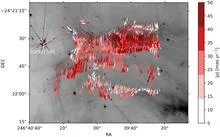
The cloud L1688 in the constellation Ophiuchus resembles a dance floor where partners don't always hold hands. Astronomers have long assumed that gas in molecular clouds moves together with the young stars born within them.
The cloud L1688 in the constellation Ophiuchus resembles a dance floor where partners don't always hold hands. Astronomers have long assumed that gas in molecular clouds moves together with the young stars born within them.
In the depths of sub-Neptunes, the most common type of planet in the Galaxy, though not one you could stand on, silicate magma and hydrogen mix into a single supercritical cocktail. Previously, it was thought that beneath the dense hydrogen atmosphere lay a sharp boundary with molten silicate, like oil on water.
Deep inside a sub-Neptune, where pressures reach a hundred thousand bars and temperatures hit four thousand degrees, rock behaves like boiling soup. Heavy vapors of silicon and magnesium rise, cool, and fall back as a rain of solid particles.
A laser beam strikes a thin target hidden inside layers of another material. Within billionths of a second, the material is compressed to a density of 25 grams per cubic centimeter, as if a piece of lead became more than twice as heavy without moving an inch.
Light from a distant galaxy reaches us through its own dust. This dust is not a smooth haze but ragged clouds, like wisps of cotton. Old models treated it as a uniform mist, and then the galaxy didn't add up energetically: too much light disappeared in the ultraviolet and too little came back in the infrared.
Astronomers did what a cook does when they dice a potato instead of tossing it in whole.
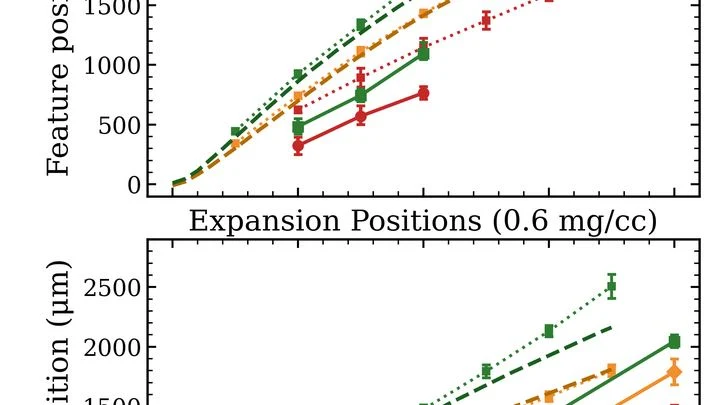
A copper plate the size of a coin vaporizes under the laser's strike in billionths of a second. The hot copper cloud slams into cold helium like a jet of steam into frosty air. The images show a distinct bubble with thin filaments at the edges — the plasma doesn't expand uniformly but breaks into fibers as thin as a human hair.
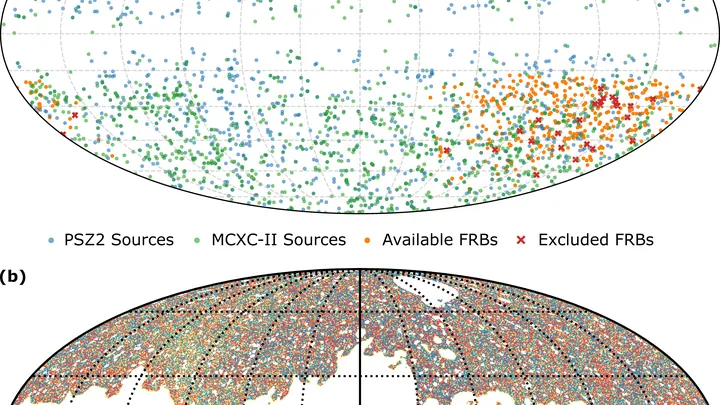
An accountant tallies up all the factories, warehouses, and shops, but the balance doesn't add up — half the inventory seems to have evaporated. That's roughly how astronomers have spent decades searching for ordinary matter in the present-day Universe.
A galaxy is like a city: bright lights and dense buildings at the center, sparse lights and emptiness toward the outskirts. But if you watch how gas rotates in a galaxy's disk, you see that its speed barely drops at the edges. As if invisible neighborhoods keep the motion going. Astronomers have found a way to map this invisible city.
An accountant tallies up all the factories, warehouses, and shops, but the balance doesn't add up — half the inventory seems to have evaporated. That's roughly how astronomers have spent decades searching for ordinary matter in the present-day Universe.
A star is not just a distant sun. It's a cradle for planets, and its light carries the birth story of the entire system. The chemical composition of a star is its DNA. Astronomers peer into this DNA to understand why some stars host rocky worlds like Earth, while others host gas giants.
At a distance of 1900 parsecs, in the constellation Vulpecula, the star V420 Vul pulsates — a Mira-type variable. Such stars, nearing the end of their lives, swell and shed their outer layers. But around V420 Vul, astronomers spotted not just a shed envelope, but something trickier.
At a distance of 1900 parsecs, in the constellation Vulpecula, the star V420 Vul pulsates — a Mira-type variable. Such stars, nearing the end of their lives, swell and shed their outer layers. But around V420 Vul, astronomers spotted not just a shed envelope, but something trickier.
A pot of boiling porridge: bubbles burst, steam escapes, and everything gets mixed up. Massive stars in giant gas clouds behave in much the same way. Their radiation and stellar winds blow out enormous cavities, molecular bubbles, scattering material all around.
In the black depths of space, on the surfaces of tiny icy dust grains, a quiet construction is underway. There, where temperatures drop to near absolute zero and harsh radiation abounds, the ordinary amino acid glycine, the simplest protein building block, links up with itself.
A planet in the habitable zone is no guarantee of life. Like a conductor leading an orchestra, a star dictates the tempo and character of planetary atmosphere evolution over billions of years.
The universe is a vast, dark ocean. We see only the glowing foam on its surface — stars and galaxies. But hidden in the depths are two invisible forces: dark matter, which with its gravity keeps galaxies from flying apart, and dark energy, which, on the contrary, pushes space itself apart, making the universe expand faster and faster.
The galaxy is not a smooth lake but a pond with ripples. These ripples are created by ultralight dark matter (particles billions of billions of times lighter than an electron).
In 1,433 pairs of galaxies scattered across the sky, astronomers noticed an unusual pattern. Neighbors located 'above' or 'below' a massive stellar system contain up to a quarter more oxygen than those lying in the plane of its disk.
A supernova explosion blasts off the outer layers of a dying star. What remains is the core — a neutron star, packed into a sphere the size of a city. The existence of such stars was predicted back in 1934 by Fritz Zwicky.
A speed of 7,5 kilometers per second is the threshold beyond which a cosmic collision turns dust grains into a chemical reactor. In the interstellar medium drift tiny cosmic dust grains — the legacy of dying stars.
In a single star system, two teams of planets orbit. Some follow neat paths, like figure skaters on an ice rink, avoiding collisions. Others crowd together, their trajectories cross, and sooner or later a cosmic accident occurs — a giant impact.
A heaping teaspoon, and the scale reads a billion tons. That's roughly what a teaspoon of neutron star matter would weigh if you could scoop it up and put it on a scale. Such objects are born after a supernova explosion: the star's core collapses into a sphere the size of a city, and the density exceeds that of an atomic nucleus.
For thirteen billion years, light battled through cosmic emptiness. It bent around massive galaxy clusters that, as Einstein predicted, acted as giant lenses — amplifying and distorting the distant glow. In 2023, the NIRSpec instrument on the James Webb Space Telescope captured this light and spread it into spectra.
A star's age is the key to the galaxy's history. But prying that key from nature is no simple task: unlike a tree, a star doesn't grow annual rings. Yet, its atmosphere holds a chemical code — the ratio of elements that slowly shifted as generations of stars died and new ones were born.
In the silent ocean of the Galaxy, mature civilizations have likely long chosen an unexpected strategy: instead of loud beacons, they scatter quiet fireflies — autonomous interstellar laser beacons, drifting in the void and dropping microsecond flashes. These 'seeds of contact' are not tied to their home stars and do not drown in their glow.
Around some young stars where star formation has recently ended, there swirl not just dust rings but actual planetary battlefields — extreme debris disks.
In a giant cosmic cradle, the Tarantula Nebula, astronomers took a close look at 122 massive stars, each at least 30 times heavier than the Sun. They measured the nitrogen abundance in their atmospheres, and the picture turned out to be unexpected.
At the center of the Milky Way, where the supermassive black hole Sagittarius A* reigns supreme (its metric first derived by Karl Schwarzschild), star S4714 makes a dizzying voyage.
Tiny seeds of life can cross the black void on icy wanderers like comet 3I/ATLAS. The James Webb Space Telescope found water and methane on it for the first time, and light analysis revealed an unusual gas composition.
In 2019, an unusual visitor, comet 3I/ATLAS, zoomed into the Solar System. It came from another star, and for the first time, astronomers were able to see what its dusty tail is made of.
A pot of porridge boiling over a high flame: bubbles carry grains from the bottom to the surface. A similar mechanism works on a neutron star. As it accumulates hydrogen and helium from a companion star, it occasionally triggers a powerful nuclear explosion — an X-ray burst.
A giant cloud of invisible matter acts like a funhouse mirror — distorting the light from a distant galaxy. From these distortions, astronomers can weigh the cloud and peer into its depths.
The Universe at 700 million years old was a noisy construction site, just beginning to light up. Telescopes caught a signal from that distant epoch: the galaxy REBELS-25, massive and full of stellar fuel.
When astronomers peer at distant worlds, they often don't see crisp lines of water vapor or methane, but a blurry silhouette, as if the planet has thrown on a thick veil. This veil, a haze of organic particles, behaves like a temperamental photographic plate: it darkens under harsh ultraviolet light, revealing hidden chemical patterns.
Space is full of invisible sprinters — particles racing nearly at the speed of light. They are caught in the solar wind, near neutron stars, and even in the intergalactic void between galaxies. But what accelerates them where there are no shock waves or magnetic reconnections?
The young super-Jupiter TWA5B, a scorching ball 25 times Jupiter's mass, floats just fifty light-years away. Its faint infrared glow long hid its chemical makeup. Now, high-resolution spectroscopy with CRIRES+ has registered the ghostly trace of SiO — silicon monoxide.
Among the icy chunks hurtling through the void, there are special travelers — interstellar comets. They were born around distant stars and happened to wander into our neighborhood. One of them, 3I/ATLAS, came under the gaze of telescopes as it approached the Sun. Its material, frozen gases and refractory dust, began to evaporate, leaving a glowing tail behind.
The cosmic accounting has hit a snag. The bookkeeper is balancing the books: in one column, all the planets astronomers have counted in the galaxy; in the other, the stockpile of building material in the dusty cocoons of newborn stars. The numbers don't line up. Even if you gathered every last grain of dust and molded it into planets, there wouldn't be enough material.