Yong Zhang

13 articles · 30 co-authors · latest: 2026-08-08
80 citations · h-index 4 · 15 papersData: Semantic Scholar

We have retold 13 papers by this author. most often about: supernova remnant, supernova, cosmic rays. 30 co-authors across our retellings.

Links in the knowledge graph
High Energy2025-10-302 minarXiv:2510.26112express
Stellar Explosions as Particle Accelerators of Record Energies
When a massive star exhausts its thermonuclear fuel, its core collapses, and the outer layers are ejected into space at speeds of thousands of kilometers per second. This is how a supernova remnant is born — an expanding cloud of shock-compressed gas spanning light-years.
General Relativity2025-12-031 minarXiv:2512.03561express
Whirlpools Around Black Holes: A Key to Dark Matter
A spinning black hole acts like a giant funnel, but instead of just sucking in everything around it, it twists space itself, like a swift river current. New calculations show that in this maelstrom, stable vortices can be born from ultralight particles — likely building blocks of dark matter.
High Energy2026-01-061 minarXiv:2601.02801express
Solar Storm Illuminated Magnetic Fields in Space
Cosmic rays are like a downpour pelting from all sides. But when the wind blows, the droplets change direction. In the same way, a solar storm, a cloud of magnetized gas from the Sun, bends the paths of these particles that normally rain down on Earth evenly. Cosmic rays are invisible messengers from distant galaxies.
Quantum Physics2026-01-301 minarXiv:2601.22697express
Billiards and Quanta: One Equation for All
The world of physics works like a music box: there's a speed knob. Turn it slowly, and the melody is strict — balls roll along trajectories (classical mechanics). Speed it up — the notes blend into a chord: a particle is in many places at once, all probabilities (quantum regime). The secret of switching is in the parameter κ.
Galaxies2026-02-121 minarXiv:2602.11617express
The Finest Threads of Stellar Cradles
Inside cold clouds of gas and dust where new stars ignite, astronomers have spotted unexpectedly delicate structures. The ALMA telescope, working in the millimeter range, has revealed more than 323 ultra-thin dust filaments within 121 massive clumps.
High Energy2026-02-132 minarXiv:2602.13411express
Three Years of Watching a Cosmic Beacon
For three years straight, every night, telescopes have stared at one point in the sky. There lies the galaxy Mrk 421, whose core shoots a jet of particles aimed almost exactly at Earth. Such objects are called blazars. A black hole at the galaxy's center spins matter into a disk, and some of it is ejected outward in two narrow beams.
High Energy2026-03-172 minarXiv:2603.16145express
A Pulsar Near an Old Cluster: Random Companion or One of the Family?
In the dense family of old stars that astronomers call the cluster NGC 6791, a lonely radio beacon has been spotted — the pulsar PSR J1922+3745. Such objects are born when a massive star explodes and its core collapses into a tiny sphere the size of a city, which spins and emits radio waves like a rotating lighthouse beam.
Stellar2026-04-152 minarXiv:2604.13990express
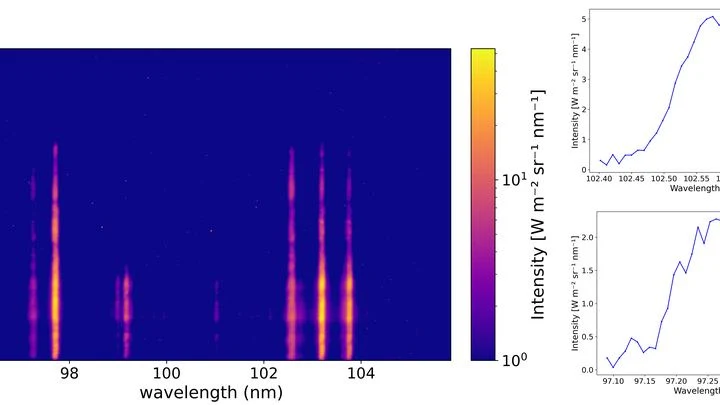
A Solar Prominence Backlit
Above the Sun's limb hangs a cloud of tenuous, hot gas — a prominence. It can linger for weeks, then suddenly break loose and fly off into space. On April 15, 2023, the SPICE instrument on the Solar Orbiter probe got its first detailed look at such a cloud in ultraviolet light.
High Energy2026-04-242 minarXiv:2604.22621express
Cosmic accelerators push particles to the limit
Every second, invisible projectiles from the depths of space pierce through us. These are cosmic rays — atomic nuclei accelerated to speeds nearly indistinguishable from the speed of light. Their energy is hundreds of millions of times greater than what our most powerful accelerators can achieve. Where does this monstrous force come from?
High Energy2026-06-231 minarXiv:2606.25054express
Cosmic Accelerator Flirts with the Limit
In the constellation Aquila, about 40,000 light-years away, one of the most powerful natural accelerators in the Galaxy is at work. It's the microquasar GRS 1915+105—a pair consisting of an ordinary star and a black hole.
Statistical Mech2026-08-042 minarXiv:2608.03180express
Why Heat Gets Stuck in a Crystal
In a crystal, heat travels on waves. Atoms vibrate, and these vibrations, called phonons, carry energy from the hot edge to the cold one. For a long time, it was believed that if phonons hit resonance (their frequencies exactly match) and can exchange energy, heat would flow like an avalanche. It turns out that's not the case.
Stellar2026-08-062 minarXiv:2608.06245express
Star Punches Through Cloud, Leaving a Million-Year Mark
At a distance of 1900 parsecs, in the constellation Vulpecula, the star V420 Vul pulsates — a Mira-type variable. Such stars, nearing the end of their lives, swell and shed their outer layers. But around V420 Vul, astronomers spotted not just a shed envelope, but something trickier.
High Energy2026-08-081 minarXiv:2608.07850express
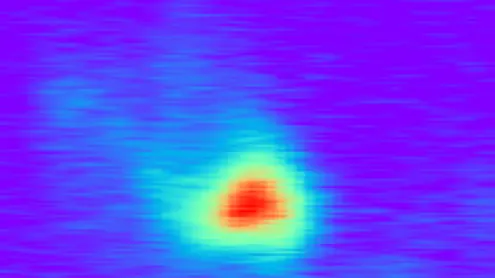
The Pulsar Tail You Can See Through
Pulsar PSR J1740+1000 is a city-sized star spinning faster than a kitchen blender. After a supernova explosion, it left behind a dense core that accelerates particles to near-light speeds. These particles fly into space, and previously it was thought they scatter in all directions, like splashes from a stone thrown into water.