method

radial velocity

A technique detecting planets by measuring the star's wobble via spectral shifts.
24 related articles

Description

Radial velocity is an astronomical technique for detecting exoplanets by measuring the periodic wobble of a star caused by the gravitational pull of an orbiting planet. As a planet orbits, it tugs the star slightly, causing the star to move in a small circle or ellipse. This motion is detected via the Doppler effect: the star's light is blueshifted as it moves toward us and redshifted as it moves away. By measuring these tiny shifts in the star's spectral lines, astronomers can infer the planet's mass and orbital period.

History

The technique was pioneered in the 1980s–1990s by astronomers like Michel Mayor and Didier Queloz, who used it to discover the first exoplanet around a Sun-like star, 51 Pegasi b, in 1995, for which they won the 2019 Nobel Prize in Physics.

How it works

The star and planet orbit their common center of mass. The star's velocity along our line of sight changes sinusoidally with the planet's orbital period. High-resolution spectrographs measure the Doppler shift of stellar absorption lines to precisions of about 1 meter per second. The amplitude of the velocity variation gives the minimum planet mass (the true mass depends on the unknown orbital inclination), and the period gives the orbital distance via Kepler's laws.

In practice

Radial velocity is a cornerstone of exoplanet discovery and characterization, used to confirm and measure planets found by transit surveys, and to study planetary system architectures.

Fun fact

The radial velocity method can detect a planet by measuring stellar wobbles as slow as a walking pace — about 1 meter per second — from hundreds of light-years away.

Concept graph →

Related articles · 24

Scales Where Overly Heavy Planets Tip the System
Astronomers catch distant planets by the trembling of their stars: an invisible companion tugs the star toward us and away, and its light subtly shifts in color. But that trembling tells only half the truth. If the planet's orbit is tilted to our line of sight, only part of its weight rocks the star, so telescopes reveal not the true mass but its shadow.
Exoplanets2026-07-112 minarXiv:2607.10175express
How to Weigh a Planet by Its Shadow
When a distant planet passes in front of its star, it briefly blocks part of the light. Astronomers call this a transit and judge the planet's size by the depth of the dip. But light has a property: a massive body acts like a lens. Even a giant planet can slightly bend the star's rays, and the dip becomes a bit shallower than you might expect.
Optics2026-07-082 minarXiv:2607.06931express
How to Spot a Pale Planet in a Star's Blinding Light
A spotlight blazes straight into your eyes, and a few steps away a tiny firefly flickers. That's roughly what it's like hunting for an Earth-like planet around a neighboring star: the planet is a hundred million to ten billion times fainter than its star, and in the sky they almost merge into a single point.
Exoplanets2026-06-292 minarXiv:2606.30377express
A Quiet Error in Planet Hunting
In a quiet observatory, a spectrograph catches the light of a distant star. The instrument spreads it into a rainbow — the spectrum. Lines in the spectrum shift slightly back and forth: an invisible planet is tugging the star. To spot this shift, astronomers compare the spectrum with a reference — a "portrait" of the star assembled from many observations.
General Relativity2026-06-172 minarXiv:2606.19446express
The Tidal Dance of Neutron Stars
When two neutron stars circle each other, they don't remain rigid spheres. The partner's gravity stretches each star, creating tidal bulges — much like the Moon raises ocean tides on Earth. But unlike water, here it's superdense matter that deforms: a teaspoon of this stuff weighs billions of tons.
Exoplanets2026-06-091 minarXiv:2606.10624express
A Dance of Dust and Light Around a Young Star
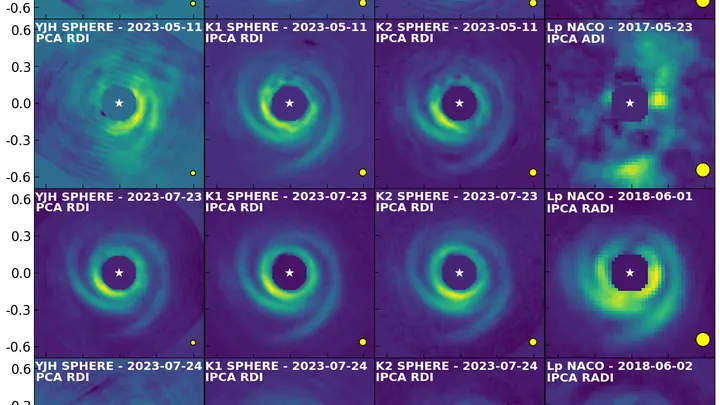
460 light-years away, around the star HD 135344B, a dense disk of gas and dust is swirling. It looks like a giant vinyl record that someone has cracked: a gap yawns in the disk, and across it, like a slender bridge, stretches a dust filament.
Exoplanets2026-06-091 minarXiv:2606.11292express
How a Neptune-like planet flipped its star
A planet the size of Neptune wandered too close to its star. The star begins to pull the planet's outer layers onto itself — gas streams off the planet like water from an overflowing bucket. This process is called Roche-lobe overflow (astronomers use this term for the boundary beyond which a star can tear material away from a planet).
Dance of Photons: When the Solar Sail Becomes Its Own Brake
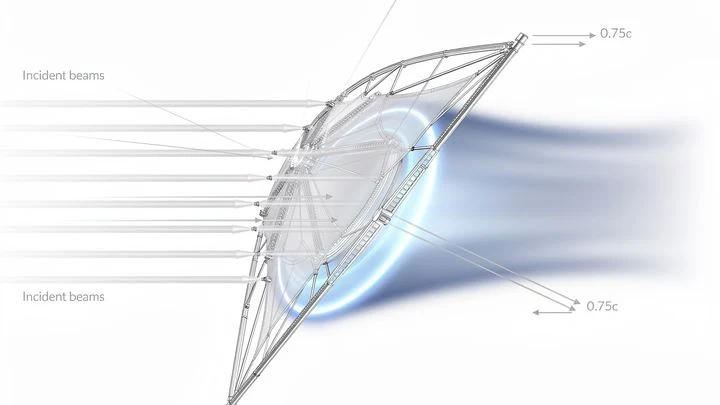
Imagine a three-faced dancer on the crest of a light wave. One face is a catcher, absorbing incoming photons. The second is a perfect mirror, throwing light back. The third is frosted glass, scattering rays in all directions. As long as speed is low, the dance is harmonious. But at near-light speeds, the choreography breaks. This is like a surfer chasing a wave.
Stellar Orthography: How ExoVeil Reads Missed Planets
A star's light curve is not chaotic noise, but a text written by pulsations, spots, and the steady glow of a thermonuclear furnace. Any planet slipping across the disk leaves a typo in this text: a tiny dip in brightness lasting hours.
Exoplanets2026-05-212 minarXiv:2605.22931express
Catching a Sunset on a Distant Planet
When a planet slips behind the edge of its star, the star backlights the planet's atmosphere, just as a setting sun illuminates clouds on the horizon. This brief moment, lasting only minutes, carries the imprint of the gases through which the starlight has passed.
High Energy2026-05-131 minarXiv:2605.14077express
How to Hear a Planet Near a Dead Star
The first exoplanet was discovered around an unusual cosmic lighthouse — a neutron star known as a pulsar. These ultra-dense remnants of dead stars spin at tremendous speeds and emit precise radio pulses.
Instrumentation2026-05-121 minarXiv:2605.11822express
How Antennas on Earth Hear Solar Flares
The ionosphere at an altitude of 70 kilometers acts like a giant mirror for radio waves. Ground antennas constantly beam signals into it and listen for the reflection. When a solar flare occurs on the Sun, a stream of X-rays reaches Earth in 8 minutes and compresses the lower layer of the ionosphere.
General Relativity2026-04-302 minarXiv:2604.27734express
A Gravitational Waltz with Quirks
A pair of figure skaters spins while holding hands. If their path is a perfect circle, each push from a partner is predictable. But stretch that path into an oval, and the effort becomes uneven: a jerk as they come together, a lull as they pull apart. Something similar happens with two black holes in the final minutes before they merge.
Galaxies2026-04-201 minarXiv:2604.18278express
The Milky Way's Halo: Stars Dance to Different Tunes
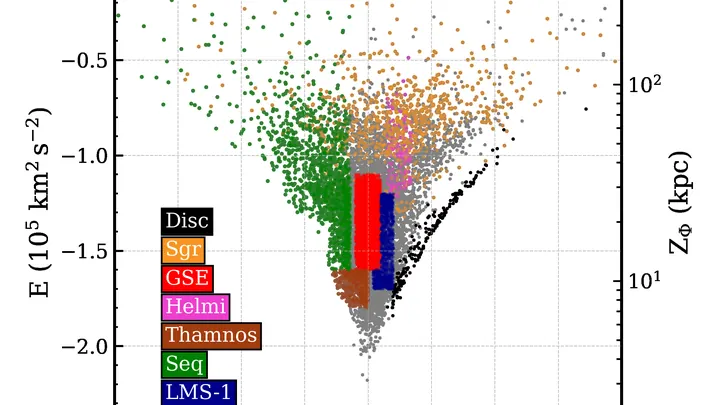
The halo of our Galaxy is a huge, sparse cloud of old stars that envelops the familiar disk. It holds the story of how the Milky Way grew by gobbling up neighboring dwarf galaxies.
Stellar2026-04-151 minarXiv:2604.13670express
Mars Radio Signal Probes the Sun's Corona
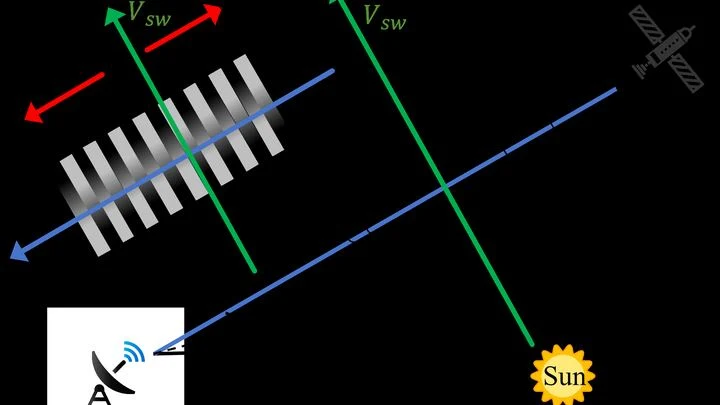
A radio signal travels from Mars to Earth, but on the way it has to push through the invisible "wind" of charged particles blowing from the Sun. This wind, like ripples on water, slightly distorts radio waves.
Exoplanets2026-04-081 minarXiv:2604.06969express
A Distant Planet's Magnetic Pulse
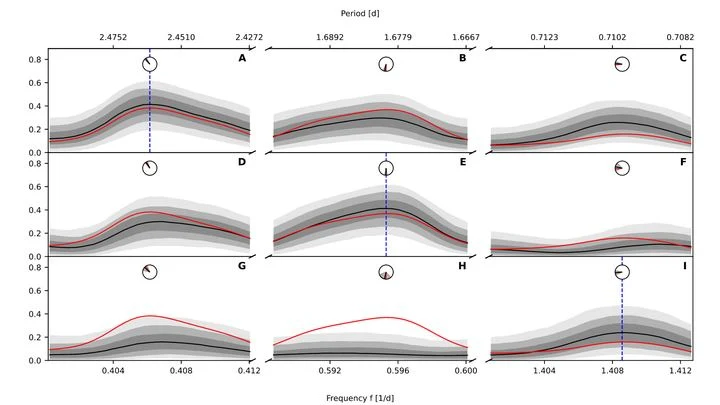
The star GJ 436 is a dim red dwarf, and orbiting it is a Neptune-sized planet on a nearly vertical, tilted orbit. Astronomers spent 18 years taking spectra of this star to track its spots and flares. Suddenly, a rhythm emerged in the data that matched neither the star's rotation nor its 8-year activity cycle. This rhythm exactly followed the planet's orbit.
Exoplanets2026-03-221 minarXiv:2603.21413express
The Sun as a Training Ground for Finding Earth's Twins
Scientists search for planets around distant stars by detecting a slight wobble in the star's motion: the planet tugs on the star, making its light shift slightly toward the blue and then toward the red. But stars have their own ripples — dark spots and bright faculae on their surfaces. These also shift the light, making it hard to tell them apart from a planet.
Stellar2026-03-211 minarXiv:2603.20874express
How Radio Signals Reveal Secrets of the Solar Wind
Radio waves passing through the solar corona, the outer atmosphere of the Sun, are distorted just like the air shimmers over scorching asphalt. This haze is caused by seething streams of charged particles — the solar wind.
Exoplanets2026-03-191 minarXiv:2603.19402express
A Quiet Star: How They Searched for a Planet and Found Nothing
The Gaia space telescope measures star positions with an accuracy of a microarcsecond, like spotting a coin on the Moon from Earth. In 2022, it noticed that the bright star HD 12800 was wobbling slightly, as if tugged by an invisible companion. Astronomers hypothesized that a planet orbits the star. But a wobble can be deceiving.
Exoplanets2026-02-191 minarXiv:2602.17760express
Neural Network Cleans Stellar Noise from the Search for Distant Worlds
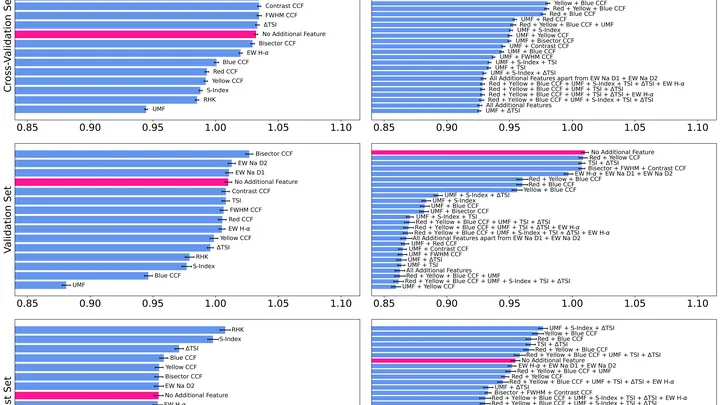
For six straight years, the HARPS-N telescope on La Palma island stared at the Sun as if it were a distant star — taking spectra, tracking brightness, and recording every quiver of spectral lines. All this was to understand how to distinguish a star's subtle sway from a genuine planetary signal. A star doesn't sit still: its surface boils like a pot of soup.
Stellar2026-02-171 minarXiv:2602.15735express
Why Spinning Stars Stay Silent
A star like the Sun hums like a bell: sound waves inside make its surface tremble ever so slightly. From this trembling, astronomers, like doctors reading a pulse, infer the star's temperature, density, and age. But the Kepler telescope spotted an oddity: many stars that spin fast and are covered in spots show no trembling at all. It's as if they've lost their voice.
Stellar2026-01-271 minarXiv:2601.20008express
Why Hot Stars Spin Faster
The Gaia space telescope has measured how fast more than a hundred thousand stars spin. It turns out that a star's rotation speed depends on its temperature. For stars cooler than 6500 degrees, the surface moves at 10–20 kilometers per second.
Stellar2026-01-091 minarXiv:2601.05980express
How Young Stars' Rotation Destroys Their Magnetic Field
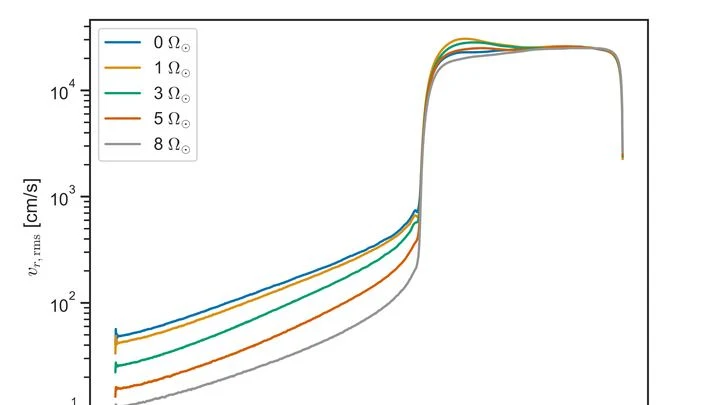
A young star is like a layered spinning top: its outer layers rotate slower, its inner ones faster. The magnetic field here acts like sturdy threads binding these layers together. When the speeds differ, the threads begin to twist and stretch more and more.
Exoplanets2025-10-161 minarXiv:2510.14229express