Magnetic stripes hum along with the crystal express
A magnetic film just three thousandths of a millimeter thick sits on a crystalline substrate. When excited, waves of magnetization run across it, like ripples on water. At the same time, elastic vibrations can arise in the substrate, similar to the trembling of a plucked string. Physicists made these two types of waves 'talk' to each other.
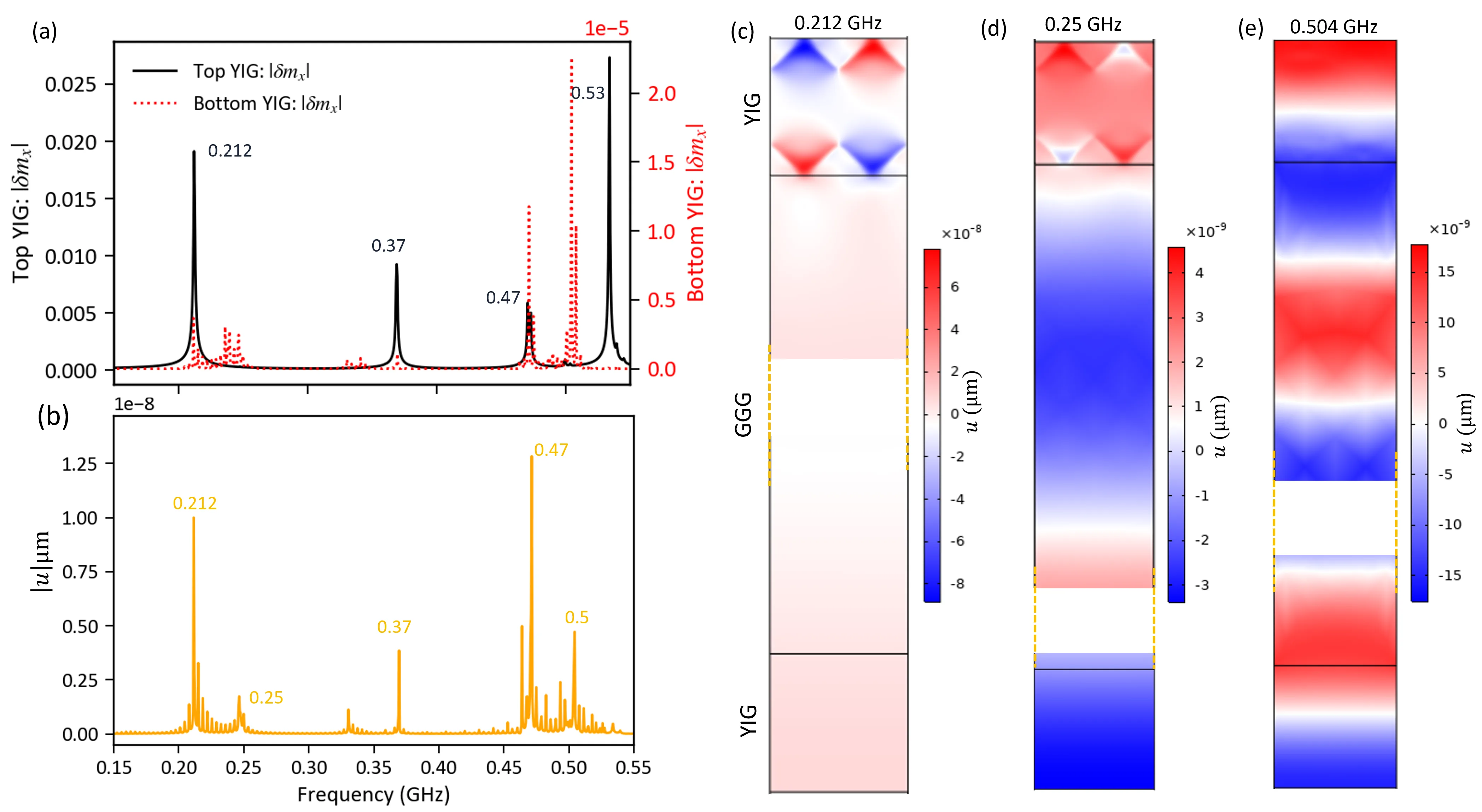
It turned out that the conversation happens at frequencies spaced 3.5 megahertz apart: these are the natural frequencies of the substrate, which behaves like a stack of thin plates clamped at both ends. The magnetic waves in the film tune themselves to this rhythm. But the coupling is weak: energy flows slowly, about 0.3–0.5 million times per second. The reason is that the magnetic film is divided into stripes with alternating magnetization directions. Contributions from neighboring stripes almost completely cancel each other out, like two people pushing a swing in opposite directions.
But even that fraction is enough for substrate vibrations to excite magnetic waves in another film lying on the same crystal. If the magnetic waves are made asymmetric, the transfer efficiency increases dramatically. This means the texture of magnetic stripes can be used as a tuning knob — to control the flow of vibrations from one layer to another.
Such tuning could be useful in devices where information is transmitted not by electric current but by magnetization waves and elastic vibrations. This is a path toward faster and more energy-efficient electronics of the future.
Yttrium iron garnet is a transparent crystal used in microwave filters and lasers. It loses almost no energy from magnetic oscillations, making it a favorite material for experiments with magnons.
In Stanislaw Lem's novel 'Solaris', the planet's ocean responds to human signals by generating complex structures. Here, the magnetic film and substrate also exchange vibrations, but according to strict laws of physics.