A magnetic domain is a microscopic region within a ferromagnetic material (like iron, cobalt, or nickel) where the magnetic moments of atoms are aligned in the same direction, producing a uniform local magnetization. In an unmagnetized piece of iron, these domains point in random directions, canceling each other out on a macroscopic scale. When an external magnetic field is applied, domains aligned with the field grow at the expense of others, and the material becomes magnetized.
History
The concept was proposed by Pierre-Ernest Weiss in 1907 to explain why ferromagnetic materials can have zero net magnetization despite having aligned atomic spins.
How it works
The alignment arises from quantum mechanical exchange interactions that favor parallel spins, but the material minimizes its total energy by splitting into domains with different orientations, reducing the external magnetic field energy. Domain walls — thin transition regions between domains — move when a magnetic field is applied or when the material is stressed. This motion is not smooth but jerky, causing the characteristic 'Barkhausen noise' heard as a crackle in a speaker when a magnet is brought near a wire coil.
In practice
Magnetic domains are the basis of data storage in hard disk drives, where bits are written by locally orienting domains in a thin magnetic film; they are also crucial in transformer cores and magnetic sensors.
Fun fact
The smallest magnetic domain that can be written in a modern hard drive is only a few nanometers wide, containing roughly a million atoms.
Imagine a ladder whose rungs are tiny magnets. If neighboring magnets point in opposite directions, the ladder is "calm." But if you make them all point the same way, the whole structure becomes magnetized and "stubborn."
Scientists built such a ladder from germanium atoms — a semiconductor used to make transistors.
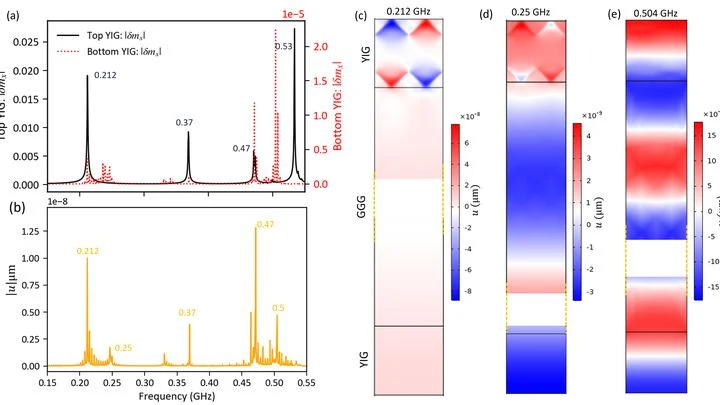
A magnetic film just three thousandths of a millimeter thick sits on a crystalline substrate. When excited, waves of magnetization run across it, like ripples on water. At the same time, elastic vibrations can arise in the substrate, similar to the trembling of a plucked string.
A guitar string keeps vibrating even after the musician lets it go, and that vibration changes the sound the listener hears. Magnetic moments in a crystal behave much the same way: they align into a strict antiferromagnetic order (neighbors point in opposite directions), but they never completely freeze.
An ocean permeates all of space, yet remains invisible to us. This ocean is dark matter, and the waves on its surface are particles called axions. They are so light and elusive that they pass through Earth without noticing it. But if these waves crash against a shore made of a special material, they might leave a trace — a tiny electric current.
A spinning top whirls so fast it's about to fly apart. Add to it a super-strong magnet — one that, if placed on the Moon, would wipe data from every credit card on Earth. That's a magnetar: an ultra-dense remnant of an exploded star, a lump of matter where a teaspoon weighs as much as a mountain.
A regular fridge magnet attracts iron because all its tiny magnetic arrows point in the same direction. But there are materials where the arrows arrange themselves more cunningly: neighboring rows point in opposite directions, so from the outside it looks like there's no magnetism at all. Such materials are called altermagnets.
A struck tuning fork fades: its vibrations leak into the air. But there are systems where the oscillation does not decay, even though there are plenty of free waves around, ready to carry energy away. Physicists call such 'captured' states bound states in the continuum (BIC).
In a thin nickel oxide film, magnetic regions are arranged in strict order like mosaic pieces. A single laser pulse instantly heats the material, and the mosaic falls apart: domains lose their orientation and mix.
A crystal does not grow as a single whole but like a city of neighborhoods — grains. In each neighborhood, atoms are arranged in their own way, and the boundaries between them are like streets.
Deep inside every hard drive or flash drive lies a material that can 'remember' an electric field. Such a material is called a ferroelectric. When you apply a voltage, tiny regions inside the crystal (domains, like compass needles) flip. Flip the needle one way, you've written a one; flip it back, a zero. But what happens to the atoms at the moment of that flip?
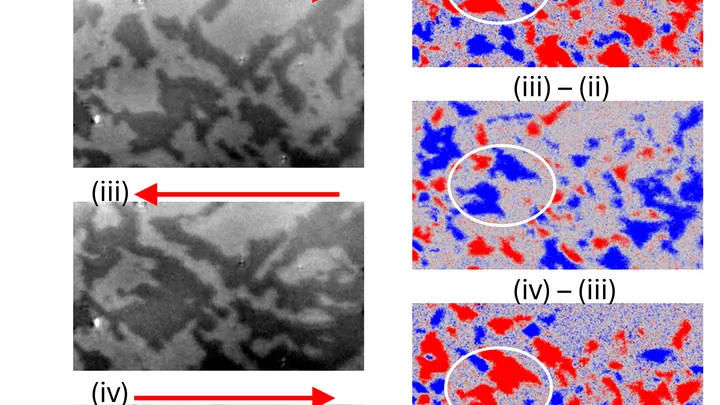
A lithium cobalt phosphate crystal resembles a chessboard, where the black and white squares are regions with opposite directions of the magnetic moments of cobalt ions. These regions are called antiferromagnetic domains, and until now they have been hard to see: conventional methods required complex equipment or damaged the sample.
A beam of charged particles, like a fine pen, draws an invisible pattern on a metal film. Where it touches, the material changes its internal atomic order: from a close-packed arrangement, like a pyramid of oranges in a crate, the atoms rearrange into a looser one, like cubes stacked in a box.
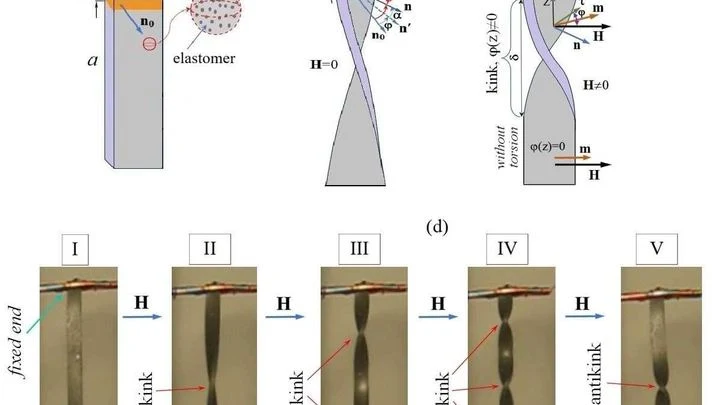
An ordinary rubber strip filled with fine iron filings doesn't just bend in a magnetic field: it ties itself into a stable knot. This effect was predicted and reproduced in experiments by physicists working with magnetoactive elastomers: a silicone base with carbonyl iron particles.
Twisted layers of atoms in a material form a pattern of tiny regions, domains, each of which can be electrified in one of two directions, like a compass needle pointing north or south. Previously, such materials were studied only as a whole, measuring thousands of domains at once, and their collective behavior was like a choir where individual voices are not heard.
An ordinary magnet can be imagined as a row of soldiers all facing the same direction. An antiferromagnet is arranged differently: neighboring 'soldiers' face opposite directions, but the row as a whole remains ordered. Flipping such a row is difficult: it doesn't respond to weak external fields.
The crystal was cooled to minus 228 degrees Celsius, and a pattern emerged on its surface, like frost on a window. But it's not moisture that draws it; it's the magnetic field: tiny iron particles suspended in a liquid settle on magnetized regions, revealing their location. That's the method the researchers used.
The pattern turned out to be two-tiered.
A compass needle always points north because inside the material, all the atomic magnets are aligned in one direction. But there are materials where neighboring atoms face opposite ways, like rows of soldiers turned to face each other. Such materials are called antiferromagnets.
Two pendulums linked by a spring of light begin to swing in unison without ever touching. In the quantum world, such synchronization means something more: particles lose their individuality and become a single object.