Yttrium iron garnet (YIG) is a synthetic magnetic material with the chemical formula Y₃Fe₅O₁₂. It is renowned for its exceptionally low magnetic damping, meaning that magnetic excitations (magnons) can propagate over long distances without losing energy. This property makes YIG the material of choice for studying spin waves and magnonics — the science of using spin waves to carry and process information.
History
YIG was developed in the 1950s at Bell Labs and MIT, with key contributions from J. F. Dillon and others. Its unique magnetic properties were quickly recognized, and it became a standard material for microwave devices by the 1960s.
How it works
YIG is a ferrimagnetic insulator: its magnetic moments are arranged in a crystal lattice with two sublattices that partially cancel, leaving a net magnetization. The low damping arises from the material's high resistivity (it's an insulator) and its perfect crystal structure, which minimizes scattering of magnons. When a microwave field is applied, it excites collective spin precessions that travel as waves through the material, carrying information without moving electric charges.
In practice
YIG is used in microwave filters, oscillators, and phase shifters in radar and communication systems. In modern research, it is the platform of choice for magnonic circuits, spin-wave logic devices, and quantum information experiments with magnons.
Fun fact
A thin YIG film can support spin waves that travel for centimeters — a distance millions of times their wavelength — making it possible to build wave-based computing devices that operate at room temperature.
A room of funhouse mirrors: you stand in the center, and the echo of your voice comes back from an unexpected direction, amplified and distorted. That is how spin waves in a thin magnetic film, excited by an antenna, reflect off defects and irregularities, creating a tangled pattern of fields.
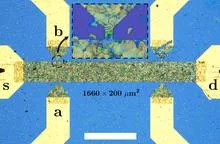
On the lab bench lies a piece of graphite grown from gas, like a deposit on the wall of a reactor. Usually, such material is not suitable for converting heat into electricity: inside it, electrons and holes run in opposite directions and cancel each other out.
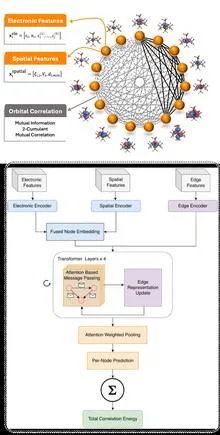
A cartographer who draws not mountains and rivers but invisible bonds between electrons: that's one way to describe the new neural network. Instead of atomic coordinates, it takes molecular orbitals and draws a graph where nodes are orbitals and edges are measures of their quantum entanglement.
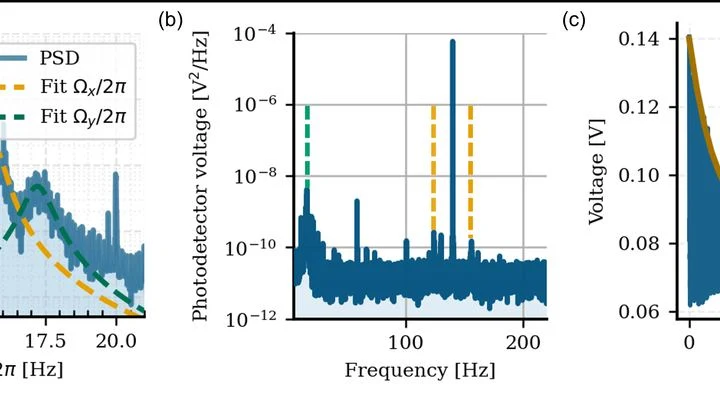
A magnetic top that doesn't fall. A tiny sphere of yttrium iron garnet hovers in midair, held by invisible forces. This isn't a magic trick but a Paul trap — an alternating magnetic field that rapidly changes direction and keeps the sphere from falling, like a juggler tossing balls.
The sphere trembles but doesn't fall.
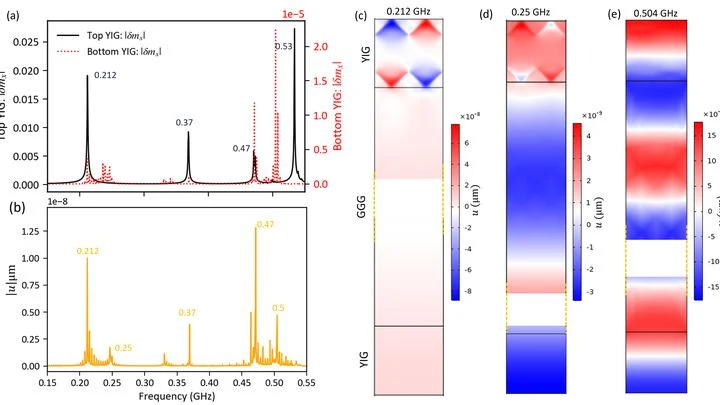
A magnetic film just three thousandths of a millimeter thick sits on a crystalline substrate. When excited, waves of magnetization run across it, like ripples on water. At the same time, elastic vibrations can arise in the substrate, similar to the trembling of a plucked string.
Inside a crystal, an invisible ballet unfolds: the magnetic moments of atoms, like dancers, sometimes align in unison, sometimes scatter in antiphase. The choreography is dictated by quantum exchange — music sensitive to the geometry of bonds.
Deep beneath our feet, in the scorching mantle, iron leads a double life. It can be divalent or trivalent, like a coin that lands heads or tails. Which side dominates determines how much oxygen stays in the planet's rocky shell and how much sinks into the core.
A factory laser that cuts and welds metal on production lines has been made to work as a particle accelerator for the first time. Physicists took a standard ytterbium laser, its heart is a crystal the size of a palm, and turned its flashes into a tool for accelerating electrons to nearly the speed of light.
Earth's magnetic field, the one that swings a compass needle, is strong. The new sensor picks up fields a hundred thousand times weaker, and it needs neither liquid helium nor bulky setups. Everything fits on a circuit board, just like the one inside your smartphone.
Two sheets of graphene — carbon film one atom thick — without a twist resemble a harbor clogged with shoals: lithium ions either run aground or rush past without stopping. But a 9.43° twist lays out a perfect fairway. The ion ships dock securely to carbon 'piers' and immediately cast off without losing speed.
A sheet of graphene one atom thick is like a flexible metal mesh through which electrons zip almost unimpeded. Stack two such sheets with a slight twist, and the material's properties change dramatically: it can become an insulator that blocks current.
A magnet, like a compass needle, likes to point in a certain direction. But what if the material is layered, like a stack of pancakes? Scientists took just such a magnet made from a compound of chromium, germanium, and tellurium and set out to find out how stubbornly it resists having its magnetization turned.
A chunk of nuclear fuel inside a reactor is not just a solid. When heated, the uranium atoms in it start to 'wiggle' their magnetic moments, and this motion changes thermal conductivity and other properties.
A beam of charged particles, like a fine pen, draws an invisible pattern on a metal film. Where it touches, the material changes its internal atomic order: from a close-packed arrangement, like a pyramid of oranges in a crate, the atoms rearrange into a looser one, like cubes stacked in a box.
There is always noise in the microworld. Even in absolute emptiness, something trembles, and these quantum fluctuations interfere with precise measurements. But noise can be "squeezed," like a balloon: if you squeeze it from the sides, one part gets thinner while the other bulges.
Drop a stone into a pond, and ripples spread across the water. Magnets have waves too — only instead of water molecules, it's the directions of atomic magnetic arrows that oscillate. These waves are called magnons, and their behavior reveals a lot about the invisible forces between atoms.
If you toss a stone into a pond, ripples spread across the water. Tiny magnetic crystals also host waves — except it's not water that oscillates but the direction of magnetization. These are called spin waves. They travel through the crystal like ripples on a surface and can carry information.
In a thin magnetic film, spin waves run like ripples along a taut string. Add metal strips to the film, and you get a resonator — like a music box where some notes ring out loud and others fall silent. Normally, such a resonator strictly filters frequencies, but the researchers noticed: just slightly boost the signal, and the 'deaf' bands shift.
Earth's magnetic field is like an invisible river that meanders beneath our feet. Navigators and geologists rely on maps of this river, but instruments only take readings at scattered points, leaving blank spots in between. Filling those gaps is like trying to sketch the river's course from a few pebbles found on the bank.
The magnets in this crystal behave like guests at a party where everyone wants the same chair. No one can settle down for good, and from this chaos, a special state emerges. In it, spin momentum (what makes an electron a tiny magnet) manages to travel 480 micrometers.
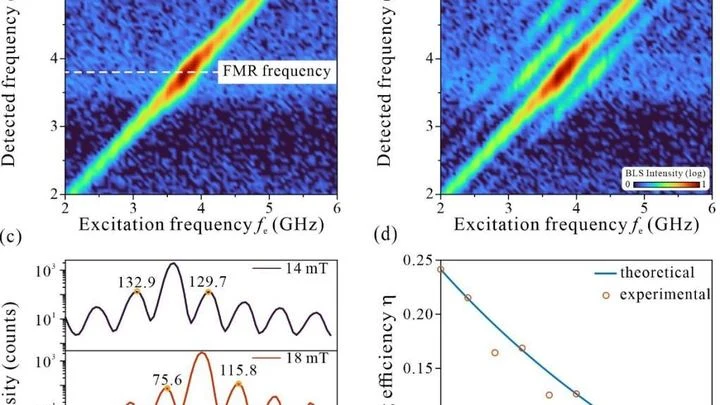
Waves in magnets resemble the vibrations of a string: if you pluck a string, it sounds a single note, but with a strong pluck, overtones appear — sounds at multiple frequencies.
Magnetic materials can store oscillatory energy, like a tuning fork that keeps ringing after being struck. When such a material is placed in a microwave cavity, its oscillations (magnons) start interacting with light (photons).
A dense piece of plastic the size of a coin flashes when an invisible particle hits it. That's how scintillators work — materials that turn radiation into faint light. They're usually made from fragile crystals or expensive polymers. But now there's a simpler option: plain polyurethane, the stuff used to mold furniture foam and shoe soles.
A tiny magnet made of layers of sulfur, chromium, and bromine sits on a microscope stage. Inside it, like unexpected guests, sit erbium atoms — a rare-earth metal. These atoms can glow when hit with a laser, and their light tells us what's happening around them.
An ordinary wave in a magnet is like ripples on water: the shorter the wavelength, the higher the energy. Physicists call such waves magnons. But in a thin film of bismuth yttrium iron garnet, they managed to create waves with the opposite behavior: their energy decreases as the wavelength gets shorter. These are antimagnons.
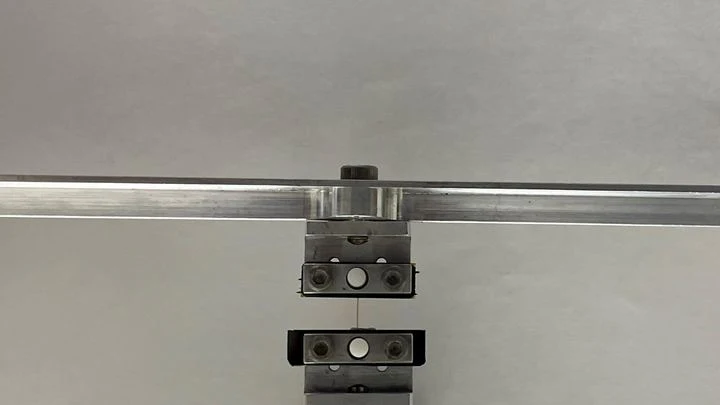
A weight about the size of a small apple hangs from a thread hundreds of times thinner than a human hair. The thread doesn't snap and barely interferes with the weight's swinging. This setup is the heart of a new lab scale for measuring gravitational attraction.
A magnetic compass in a test tube sounds like a magic trick, but it's pure physics. In a solution of fumarate (a salt of malic acid), carbon-13 nuclei behave like tiny spinning tops.
Graphene is a sheet of carbon one atom thick. If you cut it into narrow strips, you get graphene nanoribbons. Their properties depend on how the strip is cut: just as from a single piece of fabric you can sew both a smooth tablecloth and a pleated skirt.
In the new work, chemists assembled a ribbon of asymmetric shape.
The tiny magnetic arrows inside a crystal of terbium-iridium oxide behave strangely: instead of lying along their preferred axis, they stand across it. This state fully forms when cooled to 1.5 Kelvin — colder than outer space.
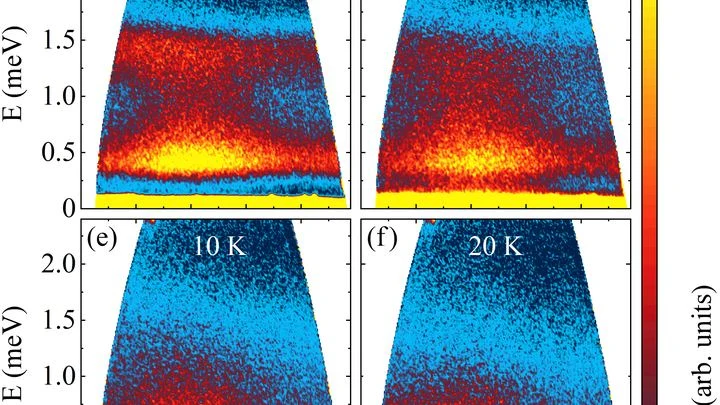
Researchers probed the crystal with neutrons and observed how these flipped arrows oscillate and exchange energy.
Imagine a stack of pancakes where each pancake is magnetized, but the magnetization directions in adjacent pancakes are opposite. That's exactly how this new magnetic material is arranged: in each atomic layer, all magnetic moments — the atom's 'arrows'—point in one direction, while the next layer is magnetized in the opposite direction.