Inelastic neutron scattering (INS) is a powerful experimental technique that measures how neutrons lose or gain energy when they scatter off a material. Because neutrons have a magnetic moment, they interact with both the atomic nuclei and the electron spins in a sample. By analyzing the energy and momentum transfer, INS reveals the dispersion relations of collective excitations—phonons (lattice vibrations) and magnons (spin waves)—across the Brillouin zone. This makes it an indispensable tool for studying magnetoelastic coupling, the interaction between magnetic order and lattice distortions, which underpins phenomena like multiferroicity and magnetostriction.
History
The technique was pioneered in the 1950s by Bertram Brockhouse, who developed the triple-axis spectrometer, for which he shared the 1994 Nobel Prize in Physics. The first magnon dispersion measurements were performed in the early 1960s.
How it works
A beam of monochromatic neutrons is directed at a crystal, and detectors record the scattered neutrons' energy and angle. The energy change corresponds to the creation or annihilation of a phonon or magnon, while the momentum change gives the wavevector of that excitation. By scanning over a range of energies and momenta, one maps out the full dispersion curves. The intensity of the scattering peaks reveals the coupling strength between the magnetic and lattice subsystems, as well as the exchange interactions between spins.
In practice
INS is used to characterize magnetic materials for data storage, to study high-temperature superconductors, and to design multiferroic materials for sensors and actuators.
Fun fact
Neutrons are ideal probes because they have no electric charge, so they penetrate deep into materials, yet they carry a spin that couples directly to electron spins, making them uniquely sensitive to magnetic order.
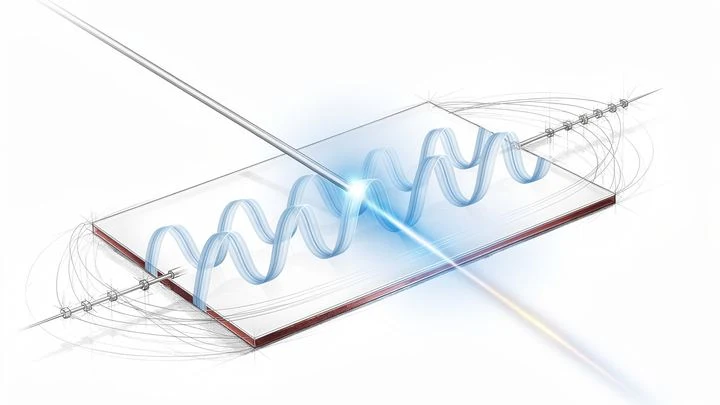
A room of funhouse mirrors: you stand in the center, and the echo of your voice comes back from an unexpected direction, amplified and distorted. That is how spin waves in a thin magnetic film, excited by an antenna, reflect off defects and irregularities, creating a tangled pattern of fields.
In a crystal of rutile niobate, nickel atoms sit in oxygen cages — octahedra. Sometimes one atom loses an electron, and the charge hops to a neighboring atom like a baton in a relay race. But this hop is not random: it is triggered by vibrations of the entire lattice.
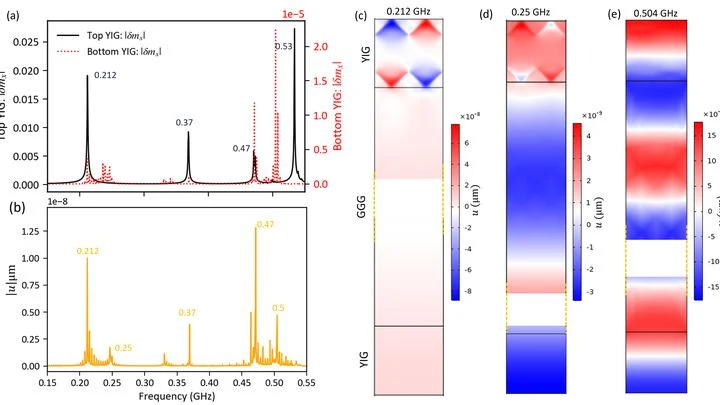
A magnetic film just three thousandths of a millimeter thick sits on a crystalline substrate. When excited, waves of magnetization run across it, like ripples on water. At the same time, elastic vibrations can arise in the substrate, similar to the trembling of a plucked string.
Neutron stars are the last clumps of visible matter before collapsing into a black hole. In their interiors, matter is squeezed to trillion-fold densities. Here, nuclear forces and gravity weave into an exotic substance inaccessible to any earthly particle accelerator.
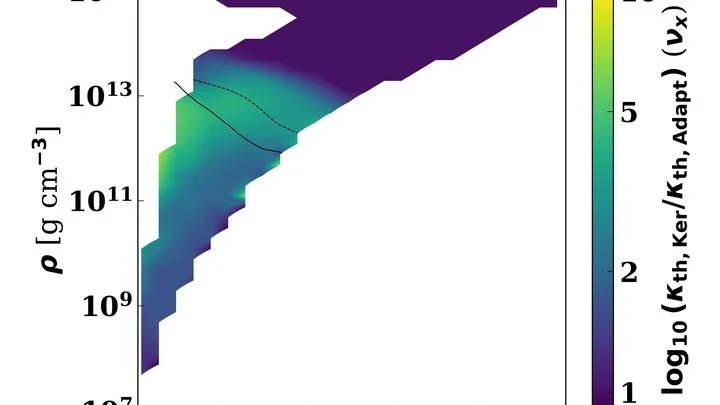
The collision of two neutron stars is a cosmic laboratory where matter is compressed to unimaginable densities. In the first moments after the merger, a hot cloud forms and cools by emitting neutrinos. These ghostly particles carry away energy and dictate how much matter is ejected into space and which heavy elements are synthesized.
Quantum technology urgently needs a universal 'translator' between the languages of microwaves and light. Superconducting qubits communicate on centimeter wavelengths, while photons in optical fiber talk at optical frequencies.
Trying to count people in a dark room by the sound of their breathing hits a wall of background noise — individual breaths are inaudible. Scientists working with quantum spins in solids face a similar challenge. Each spin (the electron's magnetic moment) has its own "voice," but it is drowned out by the technical noise of the instruments.
The La3Ni2O7 crystal resembles a layered pie, where the filling of nickel and oxygen atoms alternates with lanthanum layers. At ambient pressure, it does not conduct without resistance, but squeeze it or grow it as a thin film, and high-temperature superconductivity emerges.
A cold cloud of atoms is like a swarm of fireflies drawn to one another. The attraction between atoms tries to pack them into a single dense ball. But quantum jitter, the unavoidable motion of particles, keeps the ball from collapsing. When the attraction is strong, the cloud breaks into separate clumps.
Deep beneath the Apennine Mountains, in a tank holding three tons of liquid xenon, something gives a barely perceptible shudder every few days. It's a solar neutrino, a ghostly particle born in the Sun's thermonuclear furnace, that has traveled 150 million kilometers through empty space and solid rock to finally collide with a xenon nucleus.
The crystal CeB6 is like a box with a secret: inside it, electrons can occupy four nearly identical positions, like four chairs around a table. While no one is watching, the electron seems to sit on all four at once. Physicists call this hidden state quadrupolar, and it affects magnetic properties, but it is hard to see directly.
In a solid, atoms vibrate, transmitting sound. Sometimes this wave doesn't run straight but curls into a spiral, like a corkscrew entering a cork. In ordinary crystals, such 'sound vortices' are known, but in magnetic materials they had long eluded detection.
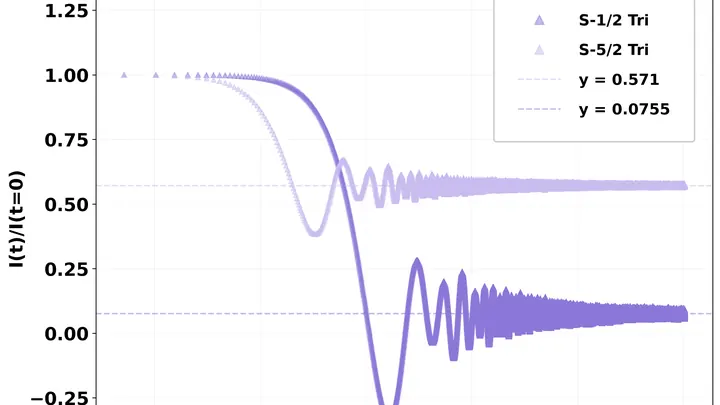
A fridge magnet sticks because the tiny atomic arrows inside it are aligned in one direction. But quantum mechanics makes these arrows jitter, so the overall magnetization falls short of the ideal.
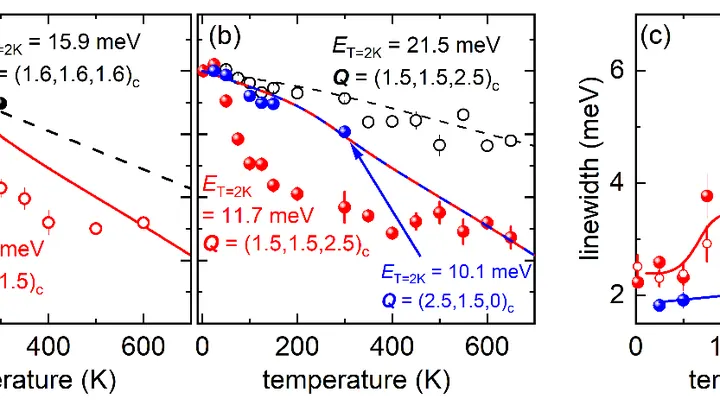
Heat a crystal, and its atoms start to tremble more vigorously, like strings tightened or loosened. In a LaCoO3 crystal (a compound of lanthanum, cobalt, and oxygen), heating from 2 to 650 K triggers two major rearrangements: around 100 K, the magnetic state of cobalt ions changes, and around 550 K, the material transforms from an insulator into a…
Drop a stone into a pond, and ripples spread across the water. Magnets have waves too — only instead of water molecules, it's the directions of atomic magnetic arrows that oscillate. These waves are called magnons, and their behavior reveals a lot about the invisible forces between atoms.
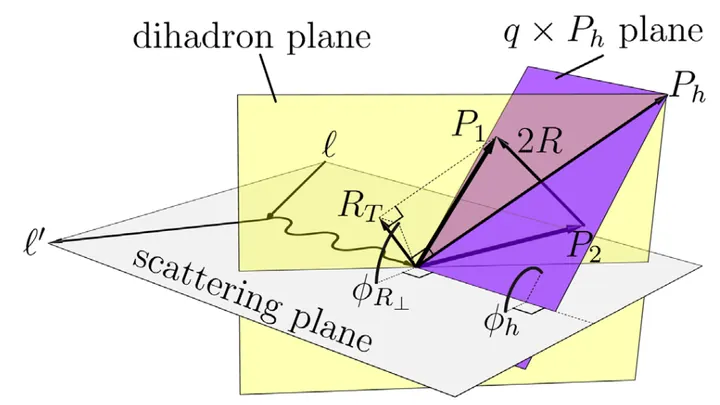
A beam of electrons, twisted like a corkscrew, slams into a proton. From the collision point, pairs of particles, a positive and a neutral pion, fly out. For the first time, physicists measured how often such pairs scatter at different angles when the electron's spin points left or right.
Magnetic materials can store oscillatory energy, like a tuning fork that keeps ringing after being struck. When such a material is placed in a microwave cavity, its oscillations (magnons) start interacting with light (photons).
An ordinary wave in a magnet is like ripples on water: the shorter the wavelength, the higher the energy. Physicists call such waves magnons. But in a thin film of bismuth yttrium iron garnet, they managed to create waves with the opposite behavior: their energy decreases as the wavelength gets shorter. These are antimagnons.