Magnetic domain imaging is a set of techniques used to visualize the spatial distribution of magnetic domains—regions within a magnetic material where the magnetization direction is uniform. These domains form to minimize the material's total magnetic energy, and their patterns reveal fundamental properties of the material, such as anisotropy, exchange interactions, and defects. Imaging these patterns is essential for understanding and engineering magnetic materials used in data storage, spintronics, and sensors.
History
The existence of magnetic domains was first proposed by Pierre-Ernest Weiss in 1907 to explain why ferromagnetic materials can have zero net magnetization. Direct imaging became possible in the 1930s with the development of the Bitter technique, which uses colloidal magnetic particles to decorate domain walls. Modern high-resolution methods emerged in the late 20th century.
How it works
Various physical principles are exploited to map magnetic domains. Magneto-optical Kerr effect (MOKE) microscopy uses the rotation of polarized light reflected from a magnetic surface to reveal domain contrast. Magnetic force microscopy (MFM) scans a sharp magnetic tip over the surface, detecting magnetic forces. Other techniques include Lorentz transmission electron microscopy, which images the deflection of electrons passing through thin magnetic films, and scanning SQUID microscopy, which measures local magnetic fields with extreme sensitivity. Each method offers different spatial resolution and sensitivity trade-offs.
In practice
Essential for characterizing magnetic storage media (hard drives, MRAM), developing spintronic devices, and studying novel magnetic phenomena like skyrmions. Also used in quality control of magnetic sensors and actuators.
Fun fact
The first direct observation of magnetic domains used a suspension of tiny magnetic particles that gathered at domain walls, creating patterns visible under an optical microscope—a technique still used in modified form today.
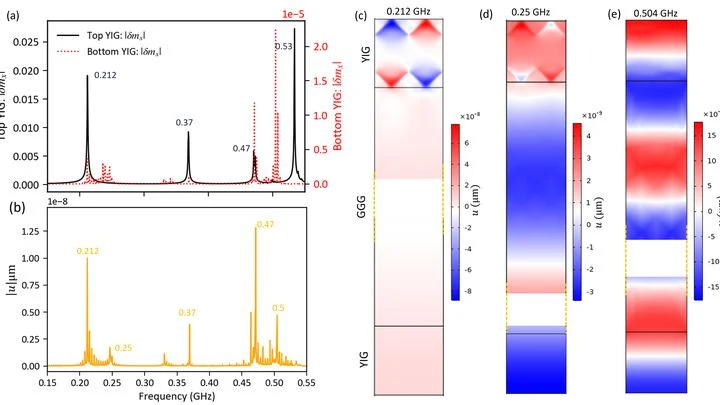
A magnetic film just three thousandths of a millimeter thick sits on a crystalline substrate. When excited, waves of magnetization run across it, like ripples on water. At the same time, elastic vibrations can arise in the substrate, similar to the trembling of a plucked string.
A single-pixel camera works like an artist creating a picture through a stencil with many holes. In each frame, only a portion of the light, modulated by a mask, a spatial light modulator, reaches the single sensor, and then the computer reconstructs the full image by assembling this mosaic with computational algorithms.
Quantum spin chains resemble a line of people passing along a secret handshake: each turns to a neighbor, and how firmly they clasp palms determines how the wave runs through the entire chain. In the ideal Heisenberg chain, quantum magnetism’s bedrock, all handshakes are equal.
Creating a material with desired properties is an art that long relied on intuition and luck. Nature gives no hints: dozens of elements in the periodic table, and the number of their combinations tends to infinity. Previously, materials scientists resembled alchemists, trying everything in a row, or relied on statistical models that lost power beyond the known.
A neat stack of atomic layers lies on a substrate. An invisible beam of terahertz light shines down on it, with a magnetic field applied from the side. After reflection, the beam's polarization rotates slightly.
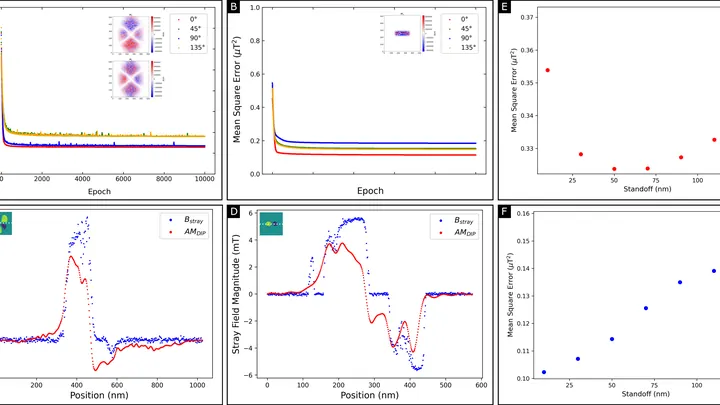
A magnetic film just tens of atoms thick stores information in tiny magnetic vortices. But you can't look inside and see these vortices directly: the instrument only senses the weak magnetic field around the film. Reconstructing the magnetization pattern from such a field is like guessing the shape of an invisible relief from its shadow on a wall.
An orchestra without a conductor is playing, and suddenly, without any visible cue, the violins grow louder and the woodwinds shift slightly in time. From the outside, nothing seems to have changed, but inside the ensemble, a regrouping has occurred. This is roughly how small physical systems behave during so-called third-order pseudotransitions.
A regular fridge magnet attracts iron because all its tiny magnetic arrows point in the same direction. But there are materials where the arrows arrange themselves more cunningly: neighboring rows point in opposite directions, so from the outside it looks like there's no magnetism at all. Such materials are called altermagnets.
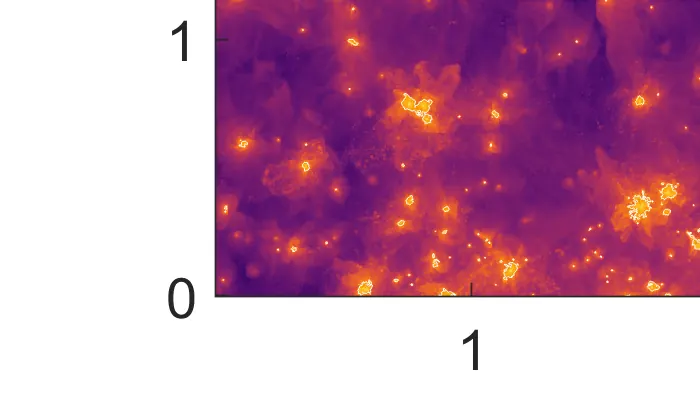
Every galaxy floats in an invisible cloud of gas, like fruit in syrup. This gas is the leftover building material from which stars were assembled, and it is constantly replenished by fresh supplies from intergalactic space. Seeing it directly is nearly impossible: it is too tenuous and too cold.
A crystal does not grow as a single whole but like a city of neighborhoods — grains. In each neighborhood, atoms are arranged in their own way, and the boundaries between them are like streets.
The crystal CeB6 is like a box with a secret: inside it, electrons can occupy four nearly identical positions, like four chairs around a table. While no one is watching, the electron seems to sit on all four at once. Physicists call this hidden state quadrupolar, and it affects magnetic properties, but it is hard to see directly.
The edge of a magnet works like a guitar fret: a string pressed near the edge sounds different, with a richer set of overtones. Magnetic waves in a thin strip of nickel and iron behave in much the same way.
A lithium cobalt phosphate crystal resembles a chessboard, where the black and white squares are regions with opposite directions of the magnetic moments of cobalt ions. These regions are called antiferromagnetic domains, and until now they have been hard to see: conventional methods required complex equipment or damaged the sample.
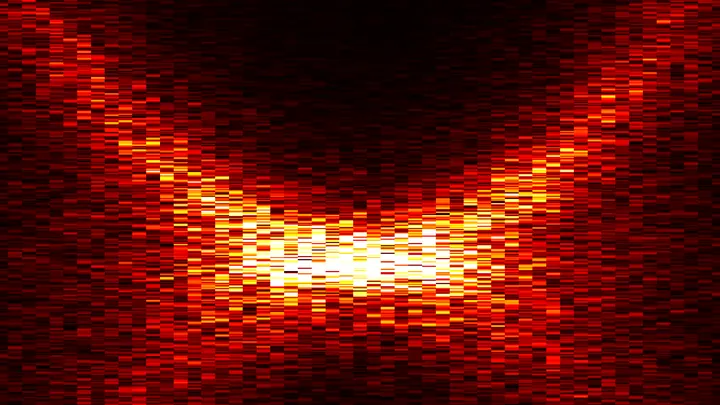
The Sun is not a calm sphere. Waves constantly ripple through its interior, like a bell after being struck. These oscillations reach the surface and reveal what's happening on the far, invisible side. Astronomers have long been able to 'listen' to this ringing and find large sunspot groups there.
A magnetic field is invisible, but you can make it 'glow' using tiny defects in diamond — nitrogen-vacancy centers. Each such defect acts as a miniature compass, telling you which way the field points. The problem is that there are many of these compasses, and reading them all in sequence is like transcribing every letter in a thick book by hand.
Earth's magnetic field is like an invisible river that meanders beneath our feet. Navigators and geologists rely on maps of this river, but instruments only take readings at scattered points, leaving blank spots in between. Filling those gaps is like trying to sketch the river's course from a few pebbles found on the bank.
An ordinary wave in a magnet is like ripples on water: the shorter the wavelength, the higher the energy. Physicists call such waves magnons. But in a thin film of bismuth yttrium iron garnet, they managed to create waves with the opposite behavior: their energy decreases as the wavelength gets shorter. These are antimagnons.
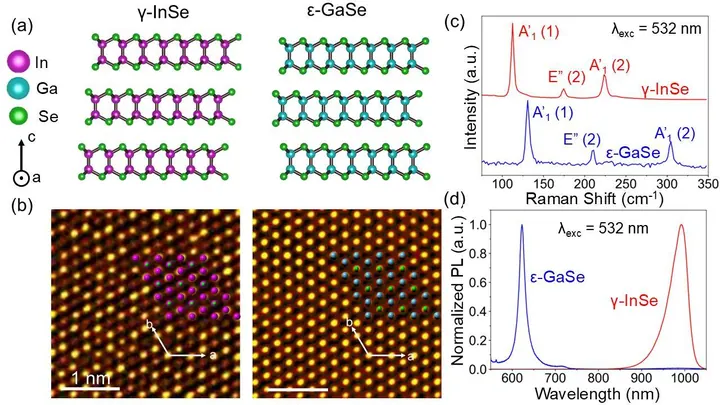
Light passing through a window pane refracts the same in all directions. But in thin layered crystals, it's a different story: light traveling along the layers sees the material differently than light traveling across them. It's as if a sheet of paper were transparent but transmitted light differently along and across its fibers.
The electron is a tiny particle, but inside a crystal it behaves as if it had a different mass. Physicists call this the effective mass. To measure it, they make electrons run in circles in a magnetic field, like a speed skater on an ice rink who is kept from leaving the orbit.
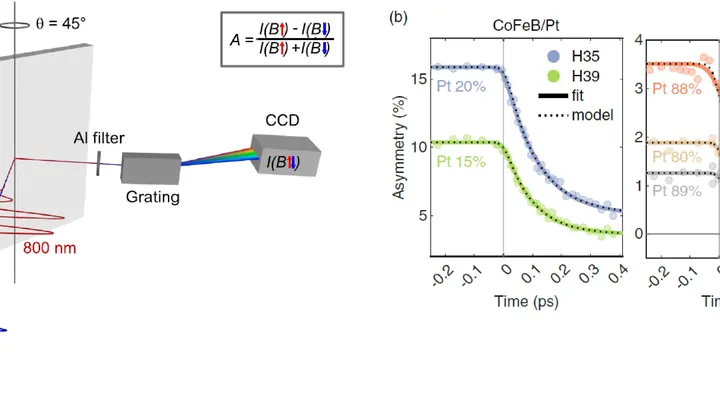
A fridge magnet holds on thanks to tiny internal arrows: each one like a miniature compass. If you hit the metal with an ultrashort flash of light, these arrows start to jitter chaotically, and magnetism melts away in a millionth of a billionth of a second. Previously, such 'melting' was too fast to observe.
A century ago, magnetic observatories recorded only the slow breathing of Earth's core. Today, their data have become hunting grounds for particle physics. At the Eskdalemuir Observatory in northern England, fluctuations of the magnetic field are recorded every hundredth of a second.