Phononmagnetism refers to the interplay between lattice vibrations (phonons) and magnetic order in crystalline materials. In certain magnetic crystals, the movement of atoms can influence the alignment of electron spins, and conversely, magnetic transitions can alter how sound waves propagate through the material. This coupling is a relatively subtle effect, but it provides a powerful probe of the internal dynamics of magnetic systems and can lead to unusual phenomena such as magnetic-field-dependent sound velocities or the excitation of spin waves by acoustic waves.
How it works
In a crystal, atoms vibrate around their equilibrium positions, and these collective vibrations are quantized as phonons. When the crystal also has magnetic order, the positions of the atoms affect the exchange interactions between electron spins. A passing phonon can modulate these interactions, creating a dynamic magnetic perturbation that can couple to spin waves (magnons). This coupling is often mediated by relativistic effects like spin-orbit interaction, which ties the electron's spin to its orbital motion and thus to the lattice. The result is that the energy and velocity of phonons can change in response to the magnetic state, and vice versa.
In practice
This effect is exploited in spintronics and magnonics, where phonons can be used to generate or manipulate spin currents, and in acoustic devices that are sensitive to magnetic fields.
Fun fact
In some materials, applying a magnetic field can change the speed of sound by a few percent, an effect large enough to be used in tunable acoustic filters.
An orchestra without a conductor: each musician tunes to a neighbor, and out of that comes a well-coordinated melody. In the world of microscopic magnets, the role of that orchestra is played by a tiny neodymium sphere levitating above a superconducting film.
An orchestra without a conductor can sound harmonious if the musicians feel the common rhythm. In the world of solids, phonons play that role: quanta of crystal lattice vibrations. When atoms in a substrate start moving in circles, they can transfer their rotation to a magnetic layer on top and flip its magnetization.
An orchestra without a conductor can sound harmonious if the musicians feel the common rhythm. In the world of solids, phonons play that role: quanta of crystal lattice vibrations. When atoms in a substrate start moving in circles, they can transfer their rotation to a magnetic layer on top and flip its magnetization.
Two caravans travel toward each other along a narrow road. One is wide and slow, carrying a load of density. The other, a string of light carts carrying current, slips between the first. Thus, in a magnetron discharge, two structures rotating in opposite directions coexist: the density spoke and the current filaments.
Two strings are stretched side by side: one thick and dull, the other thin and bright. Pluck the thick one, and you get a muddy sound with no clear pitch. The thin one responds with a pure tone. But link them together, and an unexpected effect appears: a sharp dip in the spectrum, as if someone muted a single note.
The magnetic framework of the EuMnSb2 crystal resembles scaffolding: manganese atoms form rigid vertical pillars, while europium atoms act as movable crossbars. Until now, there was no consensus on the angle at which these crossbars rest and how they rotate when a magnetic field presses on the scaffold.
The Sun has quiet regions where the magnetic field is barely visible. But even there, sound waves find loopholes to rise higher. These loopholes are magnetic tubes that expand upward like funnels. Inside them, sound travels more freely.
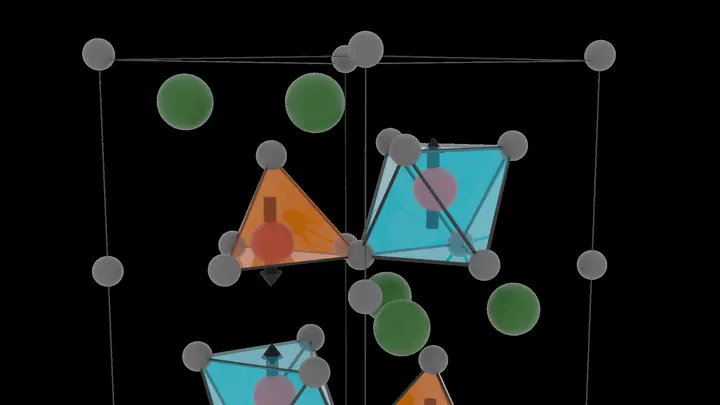
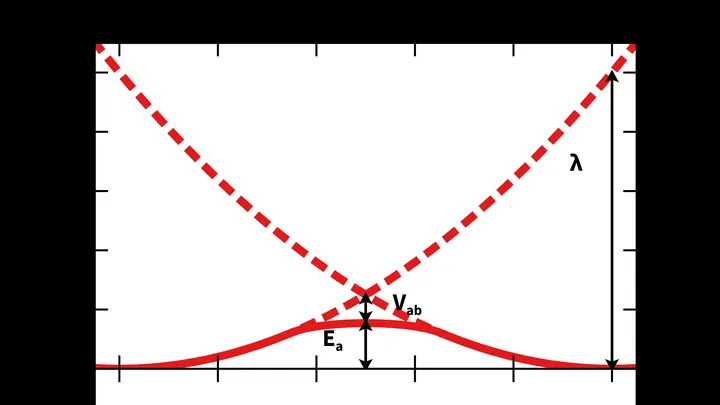
In a crystal of rutile niobate, nickel atoms sit in oxygen cages — octahedra. Sometimes one atom loses an electron, and the charge hops to a neighboring atom like a baton in a relay race. But this hop is not random: it is triggered by vibrations of the entire lattice.
A magnetic vortex is like a tiny whirlpool in the sea, except that instead of water, it's magnetization that swirls. Such vortices could become memory cells in future computers, but to write and read information, you need to be able to move each vortex individually. So far, this is done crudely — shifting a whole bunch at once.
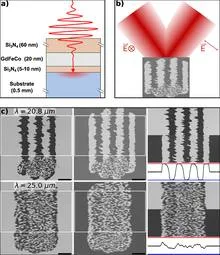
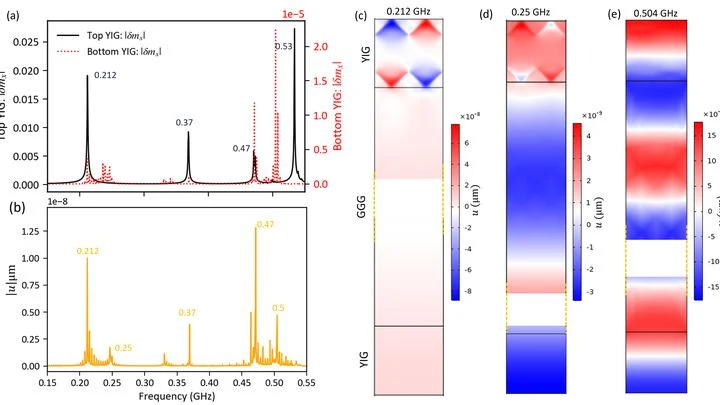
A magnetic film just three thousandths of a millimeter thick sits on a crystalline substrate. When excited, waves of magnetization run across it, like ripples on water. At the same time, elastic vibrations can arise in the substrate, similar to the trembling of a plucked string.
In a crystal, heat travels on waves. Atoms vibrate, and these vibrations, called phonons, carry energy from the hot edge to the cold one. For a long time, it was believed that if phonons hit resonance (their frequencies exactly match) and can exchange energy, heat would flow like an avalanche. It turns out that's not the case.
The crystal Mn₂Mo₃O₈ resembles a tiny city where manganese atoms are arranged in strict order: their magnetic moments (tiny internal arrows) point alternately up and down. This state is called collinear altermagnetism.
A magnetic mirror is a tube open at both ends. The magnetic field inside is arranged so that hot plasma doesn't leak out: at the ends, the field lines bunch up like a cork in a bottle. Plasma particles flying toward the exit are repelled by these "corks" and bounce back. But some still escape: that's the classic "loss cone" argument.
A massive aluminum cylinder weighing a ton hangs in a vacuum. A gravitational wave, a ripple in spacetime, passes through it, and the bar begins to tremble almost imperceptibly. That trembling can be heard as sound: gravitational waves turn into a phonon — a quantum of sound vibrations.
A tuning fork struck once rings pure and long. But if you shake the fork itself while it sounds, the tone wavers and dies out quickly. Something similar happens to electrons in any piece of matter. Atoms in a lattice never stay put: thermal vibrations keep them jittering.
In 1915, Albert Einstein and Wander Johannes de Haas demonstrated that when an iron rod is magnetized, it twists slightly — the angular momentum of electrons is transferred to the crystal lattice.
The flash lasts a thousandth of a second, but in that instant it releases as much energy as the Sun emits in a day. Such signals, fast radio bursts, have been caught by telescopes since 2007, and their source remains a mystery. A new study offers an elegant answer: it's all about a cosmic amplifier.
A guitar string keeps vibrating even after the musician lets it go, and that vibration changes the sound the listener hears. Magnetic moments in a crystal behave much the same way: they align into a strict antiferromagnetic order (neighbors point in opposite directions), but they never completely freeze.
In a crystal that for centuries was called 'fool's gold,' physicists have spotted genuine treasure. The compound MnTe2 with a pyrite structure has become the stage for a quantum ballet: spin waves here twist into left- and right-handed vortices, with the twist direction firmly tied to momentum.
The solar wind rushes from the Sun to Earth, but the magnetosphere bends the flow and sculpts it into plasma tails. The same motif plays out at the heart of galaxies: jets from accretion disks around black holes are twisted by the invisible hand of a magnetic field.
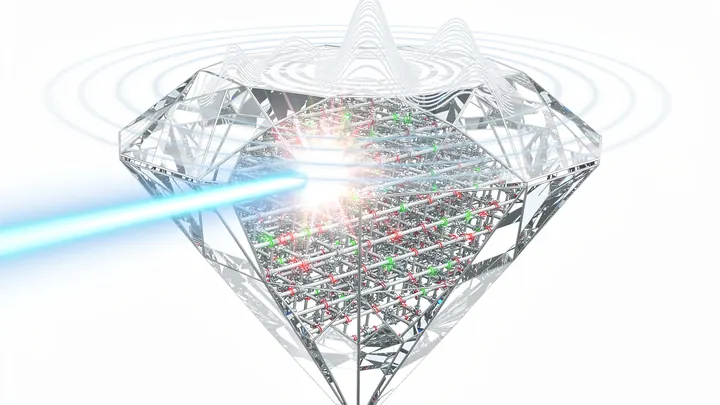
In the depths of a diamond crystal, studded with NV centers, a symphony slumbers. Each defect is like a tuning fork, ready to respond to a passing acoustic wave. But alone, their voices are barely audible: the spin-phonon coupling is weaker than a whisper. A maestro is needed, one who can turn timid vibrations into a resounding choir.
Inside a crystal, an invisible ballet unfolds: the magnetic moments of atoms, like dancers, sometimes align in unison, sometimes scatter in antiphase. The choreography is dictated by quantum exchange — music sensitive to the geometry of bonds.
Light from a distant blazar, an active galactic nucleus whose jet points our way, travels for billions of years. Along the way, it triggers cascades of charged particles that the intergalactic magnetic field deflects sideways. This creates a blurred gamma-ray glow around the blazar: a secondary halo.
In some crystals, the magnetic moments of atoms oscillate in sync, like a wave in a stadium. It carries spin without charge current, without heating the material. This flow resembles an invisible river — silent and cold. Two-dimensional altermagnets are special materials: spin waves in them run differently along different axes.
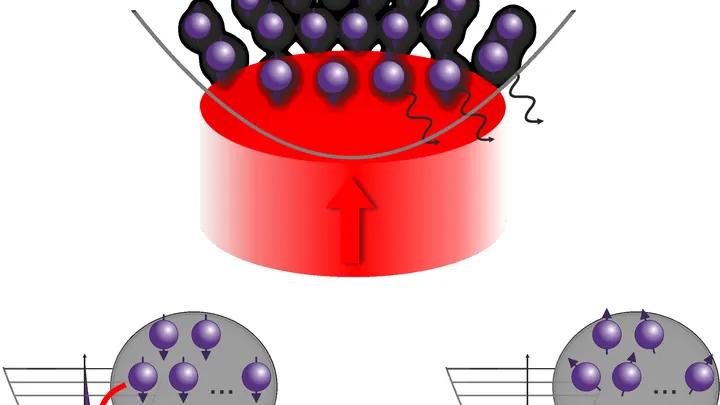
A tiny crystal of charged atoms, trapped in a trap, trembles with heat. Each ion oscillates like a ball on a spring, and these vibrations hinder using the crystal for precise quantum operations. Usually, excess energy is removed with a laser — the beam hits the ions and slows their motion, like a stream of air damping a pendulum.
Trying to count people in a dark room by the sound of their breathing hits a wall of background noise — individual breaths are inaudible. Scientists working with quantum spins in solids face a similar challenge. Each spin (the electron's magnetic moment) has its own "voice," but it is drowned out by the technical noise of the instruments.
A dead star with a magnetic field billions of times stronger than Earth's is a magnetar. Its crust cracks, sending a powerful X-ray burst into space. But some of that light doesn't reach us in its usual form. In an ultra-strong field, photons can turn into gravitational waves — the trembling of space itself.
A tellurium crystal resembles a tiny spiral staircase: its atoms are twisted into a helix. When heat runs through such a crystal, it is carried not by electrons but by sound waves — vibrations of the lattice itself. These waves don't just push back and forth; they also rotate around their axis like a spinning top.
Two magnets on a table either attract or repel — depending on how their poles are oriented. Inside each piece hide tiny regions where all the magnetic arrows point in the same direction. These regions are called domains, and their arrangement determines how the material behaves in an electrical circuit.
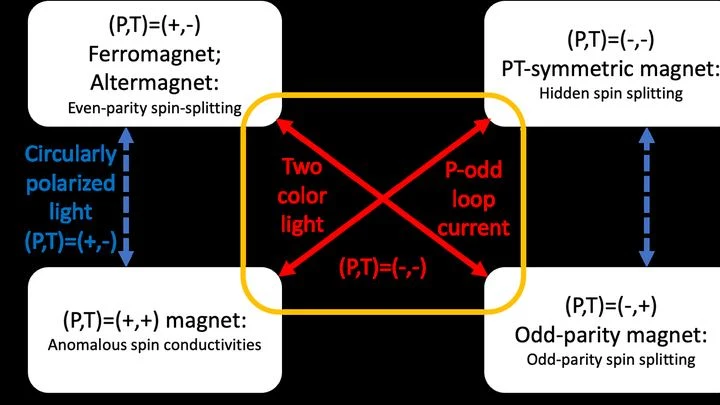
In altermagnets, a new class of materials, domains are trickier.
A giant drum has just taken a hit. Its membrane is still trembling, but besides the main boom, a fine ripple spreads across it — someone ran a finger over the taut skin. In much the same way, in the first moments after the Big Bang, spacetime vibrated not only with the "roar" of expansion but also with the tension of suddenly emerging magnetic fields.
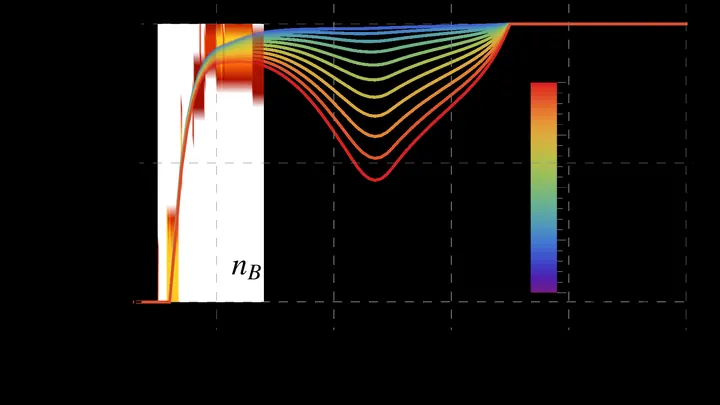
In the orchestra of atoms, each instrument has its own score. But sometimes two musicians start playing in unison, and the sound amplifies many times over. In the quantum world, this 'harmony' is called a Feshbach resonance. It allows you to control atomic interactions with jeweler-like precision.
The La3Ni2O7 crystal resembles a layered pie, where the filling of nickel and oxygen atoms alternates with lanthanum layers. At ambient pressure, it does not conduct without resistance, but squeeze it or grow it as a thin film, and high-temperature superconductivity emerges.
In a piece of ordinary magnet, all electron spins, tiny magnetic arrows, point in the same direction. It's a formation of soldiers facing their commander. This order is called a collinear altermagnet.
A hot spoon in a cup of tea — heat runs along the metal from the hot end to the cold one. Textbooks describe this process as atoms jiggling and passing on their jolts to each other. But atoms don't just jiggle: they also spin, like tiny tops. Until now, physicists had no common language to describe both motions at once.
The authors of the work built such a language.
A vast, dark cloud of gas stretched across the young universe. Inside it, like invisible fingers, magnetic field lines left over from the very birth of the cosmos threaded through. These fields act on charged particles, pushing them together, like a gentle breeze gathering fallen leaves into piles.
In an ordinary crystal, atoms stand in neat rows like soldiers on a parade ground. Any deviation from this formation is usually considered harmful: disorder scatters waves and quickly dampens collective motions of particles.
A superfluid gas behaves like a frictionless liquid. Two clouds of such gas are connected by a narrow bridge, and a stream of particles flows through it. This resembles the Josephson effect in superconductors, but here the particles are neutral atoms instead of electrons.
A piece of magnetite, an ordinary iron stone, behaves strangely. At room temperature, it conducts electricity, but cool it below minus 150 degrees, and its resistance jumps sharply. This jump, discovered back in 1939, physicists could not explain for nearly a century.
A new study offers a solution.