Quantum Puzzle: How Measurements Assemble Complex States express
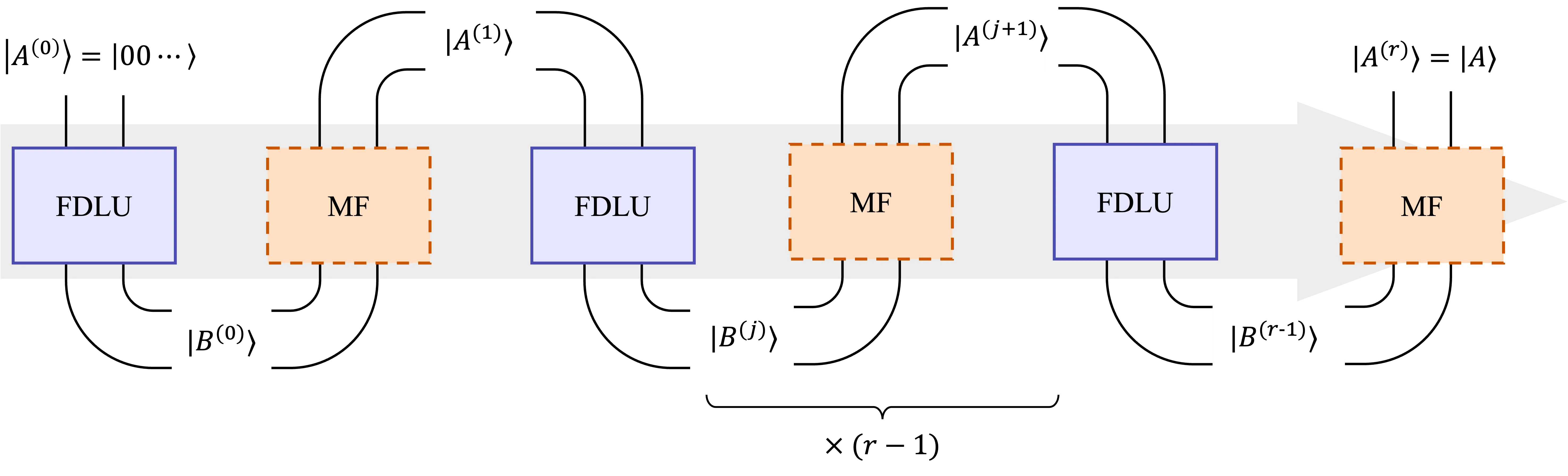
Imagine a huge puzzle where each piece is a quantum particle. To complete the picture, you don't just fit the pieces together: you need to entangle them in a special way. Usually, this is done by carefully applying operations one after another, like assembling the puzzle strictly by the instructions, row by row. But there's a faster way: occasionally glance at the already-assembled section, and if something's off, immediately adjust the neighboring pieces. In the quantum world, this is called measurement-based feedback.
The authors of the new work figured out how to systematically build such 'fast' circuits for one-dimensional chains of particles. They introduced the concept of pushed defects — something like virtual threads that connect puzzle pieces. If you can pull such a thread through a node, slightly rotating the neighboring pieces, then the state is assembled in a single round of measurements. It turns out that the whole trick lies in which threads can be pushed and how they interact with each other — much like a game where you need to rearrange strings without tangling them.
Interestingly, these pushing rules are closely related to irreversible symmetries — special transformations that cannot simply be undone. For example, if the threads obey a fusion rule like that of the cosine symmetry, the state can be obtained from a simple product using duality operators. This perspective turns quantum state preparation into a kind of algebraic puzzle.
In the end, we get not just a recipe for a specific state, but a whole classification: each class corresponds to its own circuit and its own defect algebra. This is like a puzzle catalog, where for each picture it tells you how many times you need to peek and adjust to assemble it fastest. Such a connection between quantum computing and abstract symmetries could simplify the creation of complex entangled states, a resource for future quantum computers.
The idea of 'pushed defects' resembles the children's game of string figures: by changing the position of your hands, you can create different shapes without untangling the whole structure.
In Hannu Rajaniemi's novel 'The Quantum Thief,' quantum states are used as keys and locks, such preparation methods could become the basis for 'hacking' these systems.