Quantum entanglement training refers to the use of quantum entanglement as a resource to train or control quantum systems, often for applications in quantum computing and quantum memory. Entanglement is a phenomenon where particles become correlated in such a way that the state of one particle cannot be described independently of the others, even when separated by large distances. By leveraging this property, researchers can develop algorithms and protocols that improve the performance of quantum devices, such as error correction, state preparation, and quantum simulation.
History
The concept of using entanglement for quantum information processing dates back to the 1990s, with pioneering work by physicists like Charles Bennett and Peter Shor. However, the specific idea of 'training' quantum systems using entanglement is a more recent development, emerging in the 2010s with the rise of quantum machine learning and variational quantum algorithms.
How it works
In quantum entanglement training, entangled states are used as a 'teacher' or reference to guide the evolution of a quantum system toward a desired state. For example, in machine learning-inspired approaches, a quantum algorithm may use entangled qubits to explore a larger solution space more efficiently than classical methods. The entanglement provides a way to encode complex correlations that can be manipulated to optimize the system's behavior, often through iterative feedback loops that adjust parameters based on measurements of the entangled partners.
In some experiments, quantum entanglement has been used to 'train' a quantum system to recognize patterns, achieving results that outperform classical neural networks on certain tasks, despite having far fewer parameters.
Imagine a huge puzzle where each piece is a quantum particle. To complete the picture, you don't just fit the pieces together: you need to entangle them in a special way. Usually, this is done by carefully applying operations one after another, like assembling the puzzle strictly by the instructions, row by row.
Hot water sometimes freezes faster than warm water: this odd fact is known as the Mpemba effect. Now something similar has been found in the quantum world: a state with weak entanglement (a special quantum connection between particles) can beat a more entangled one to the finish line.
A black hole doesn't just swallow everything around it: it also slowly evaporates, like a chunk of ice in the sun. As the hole shrinks, the quantum fields around it start behaving unusually. In a new study, physicists traced how entanglement, a special kinship between particles that persists even when they are far apart, changes.
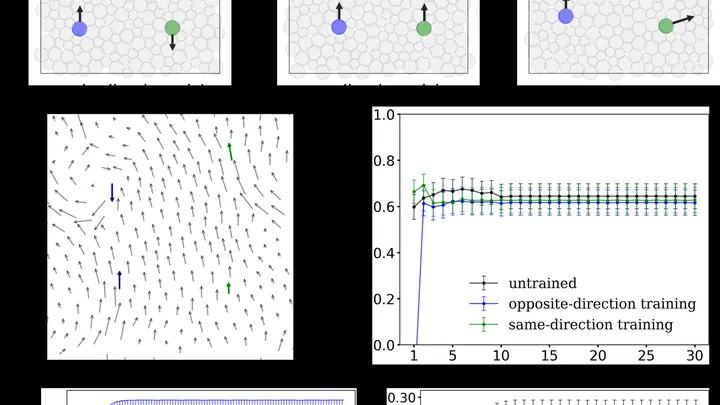
A handful of sand on a table is just a pile. But if you shake the grains just right, the pile starts behaving like a memory: it remembers which motion follows which. In the new experiment, particles were moved cyclically, and after training, they reproduced the desired pattern even without a full command.
The secret lies in the contacts between particles.
In ping-pong, two paddles connected by an invisible thread feel each other's movements, guessing the ball's trajectory. Researchers gave a computer a similar thread — quantum entanglement. Into an ordinary trial-and-error learning program, they embedded a quantum circuit of eight qubits — particles that can spin like a coin on its edge.
Quantum communication via satellite is like a roll call between two distant lighthouses: the beam must hit the detector exactly, or the message can't be read. But in space, everything shakes — sunlight heats the hull, thrusters cause vibrations, and delicate optics drift off-axis.
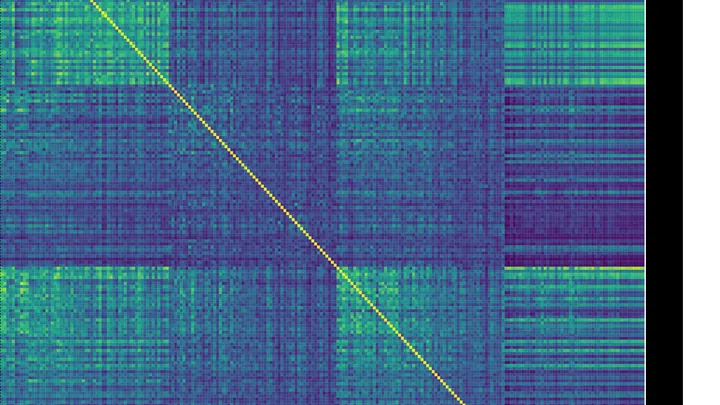
Fine-tuning a neural network is like trying to alter a black hole without touching its event horizon: you change only a tiny fraction of parameters. Researchers looked inside and saw stunning patterns — strong links between pieces of the model, akin to quantum entanglement.
The atomic nucleus is not just a bag of protons and neutrons. It is a quantum system where particles are bound by invisible threads of entanglement. When two protons or neutrons interact, their states become intertwined so that describing one without the other is impossible.
In 1867, James Clerk Maxwell imagined a demon that sorts gas molecules and thereby violates the second law of thermodynamics. The demon needs to know the speeds of the particles. In the quantum world, a similar task arises: keep entanglement from growing like an avalanche, but you cannot observe the entire system.