Imagine you want to describe the tension inside a piece of rubber: you pull it along, across, or diagonally – the force responds differently. A tensor is like a 'summary table' of all such interactions at once. It stores information about how a material responds to stress in any direction. Simply put, if a number is a point, a vector is an arrow, then a tensor is a whole system of interconnected arrows.
History
The history of tensors begins with works on differential geometry and mechanics. Gauss and Riemann laid the foundations, but the systematic calculus was developed by Ricci-Curbastro and Levi-Civita in 1884–1900. In 1915, Albert Einstein used their apparatus to formulate general relativity, where gravity manifests as the curvature of spacetime, described by the Ricci tensor and the Einstein tensor. James Clerk Maxwell had already in 1865 essentially written his equations in tensor form, though he didn't use the term. Hendrik Lorentz in 1904 derived transformations that became the basis for understanding the tensor nature of physical laws in special relativity.
How it works
The transformation law for tensor components when transitioning to new coordinates x'^μ = x'^μ(x^ν) is given by the product of Jacobian matrices. For example, for a tensor of rank (1,1): T'^μ_ν = (∂x'^μ/∂x^α) (∂x^β/∂x'^ν) T^α_β. Maxwell's equations in tensor form: ∂_ν F^{μν} = μ_0 J^μ, where F^{μν} is the electromagnetic field tensor, J^μ is the 4-current. Einstein field equations: G_{μν} + Λ g_{μν} = (8πG/c^4) T_{μν}, where G_{μν} is the Einstein tensor expressing spacetime curvature through the metric tensor and its derivatives. Tensors also describe stress and strain in mechanics: σ_{ij} = C_{ijkl} ε^{kl}, where σ is the stress tensor, ε is the strain tensor, and C is the fourth-rank elasticity tensor.
Fun fact
Without tensors, we wouldn’t be able to accurately predict how a bridge deforms under the weight of a train. And it was tensors that helped Einstein describe how massive bodies warp spacetime – like a heavy ball on a stretched sheet.
A drop of ink in a glass of water spreads in intricate swirls. Similarly, a quantum particle exchanging energy with its environment changes its state in a complex and entangled manner. Describing this dance between particle and environment has long baffled scientists.
A drop of ink in a glass of water spreads in intricate swirls. Similarly, a quantum particle exchanging energy with its environment changes its state in a complex and entangled manner. Describing this dance between particle and environment has long baffled scientists.
Inside the atomic nucleus, protons and neutrons are packed so tightly that the forces between them resemble tightly coiled springs. Some springs compress and expand equally in all directions: these are the familiar central forces.
At the center of many galaxies lurks a black hole, wrapped in an invisible cloud — the halo of dark matter. This is not just a featureless mass: its density changes from the edge to the center, and the degree of this "compression" is called compactness.
Unlike regular cameras, event-based ones only record moments when light becomes brighter or dimmer. They don't produce snapshots; instead, they send an endless stream of such flashes. Scientists turned this stream into a sharp picture of the Earth while flying over it on a satellite. Each flash is like a piece of a mosaic; together they form a still image.
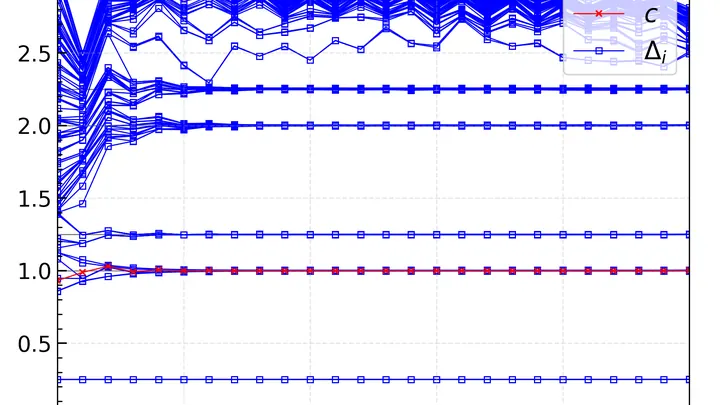
In quantum physics, there are theories where everything follows clear proportions, like a musical rhythm that always returns to the beginning of the bar. But there are also 'irrational' theories where the rhythm breaks and predicting the next beat is nearly impossible. One such theory is the compactified boson: a particle lives on a circle, and its behavior depends on the radius of that circle.
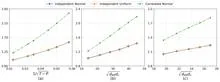
You can feel an unfamiliar object along its length, across its width, or diagonally: each time gaining new information. But what if one way of feeling tells you absolutely nothing about what another would reveal? That's exactly how mutually unbiased bases work in quantum mechanics: measuring in one of them leaves you completely in the dark about the outcome in another.
At a party, guests don't just chat in pairs; they gather in circles of shared interests: three discussing movies, four debating sports. The usual acquaintance map, like a phone's contact list, can't capture that: it only sees one-on-one links.
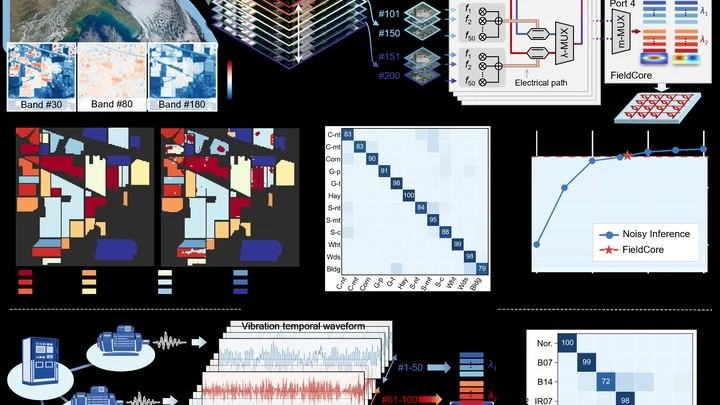
A typical computer shuttles electricity along copper traces, and every operation is a queue: first one thing, then another. Light works differently. In a single beam, you can mix dozens of signals without them interfering, like different voices in a choir, singing at once but each heard distinctly.
The new FieldCore chip uses five such "voices" at once.
When a typical computer searches for a law of nature from data, it tries to guess a complete formula in one go. It's like a cook who, without knowing the recipe, dumps all the ingredients into a pot at once and hopes for soup. Most often, the result is an inedible mess: the formula is long but meaningless, and it fails on new data.
A teacher in class explains the difference between 'dog' and 'tog': put your hand on your throat and feel the vibration. A speech recognition machine does much the same thing, except inside it's not a throat but long lists of numbers. It turns out these numbers can be sorted onto shelves, like alphabet blocks in a child's room.
Climate scientists have long debated where exactly the El Niño "pool" is located: the region in the equatorial Pacific that first responds to an impending weather shift. The debate isn't due to a lack of data. The ocean is measured along longitude, latitude, and depth, and each slice contains thousands of numbers. The problem is that there are too many numbers to see the pattern directly.
A translator in a meeting room hears not only individual voices but also how they bounce off each other: one speaker trails off, another picks up the thought, a third clarifies. Remove that interplay, and you are left with a set of monologues, and the meaning of the conversation slips away.