The quantum metric is a geometric quantity that measures the distance between quantum states in the Brillouin zone, the space of electron momenta in a crystal. It quantifies how much the wavefunction of an electron changes as its momentum is varied, providing a notion of 'overlap' between neighboring states. This metric is fundamental to understanding the geometry of quantum materials, complementing the Berry curvature, which describes the phase, not the distance.
History
The concept was introduced by J. Zak in the 1980s, building on earlier work in differential geometry applied to quantum mechanics by Michael Berry and others.
How it works
For a given band in a crystal, the quantum metric is defined as the real part of the quantum geometric tensor, which is computed from the derivatives of the Bloch wavefunctions with respect to momentum. It is a positive-definite matrix that assigns a length to infinitesimal changes in momentum. This metric determines the spread of Wannier functions, the localization of electrons, and the response of materials to external perturbations like electric fields or strain.
In practice
The quantum metric is used to design materials with exotic properties, such as flat bands that enhance superconductivity and correlated electron phenomena, and to optimize quantum sensing and information devices.
Fun fact
In a flat band, the quantum metric can be large even though the band has zero kinetic energy, leading to unusual phenomena like ferromagnetism without electron movement.
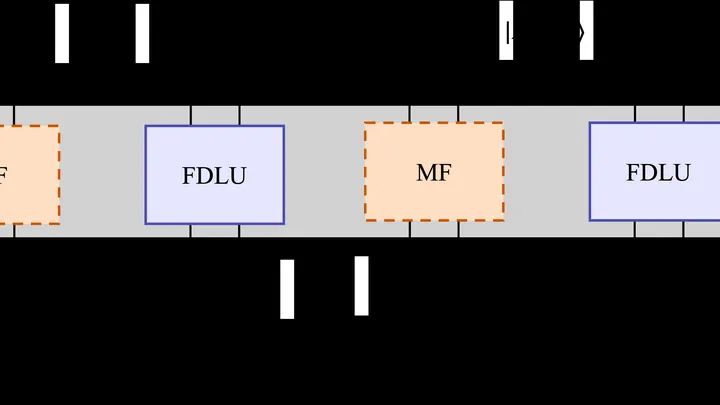
Imagine a huge puzzle where each piece is a quantum particle. To complete the picture, you don't just fit the pieces together: you need to entangle them in a special way. Usually, this is done by carefully applying operations one after another, like assembling the puzzle strictly by the instructions, row by row.
Imagine a postal service where couriers suddenly stop moving. It would seem that letters would stop arriving and communication between cities would break down. But what if the envelopes themselves suddenly gained the ability to change shape and transmit messages through a shared web without moving an inch?
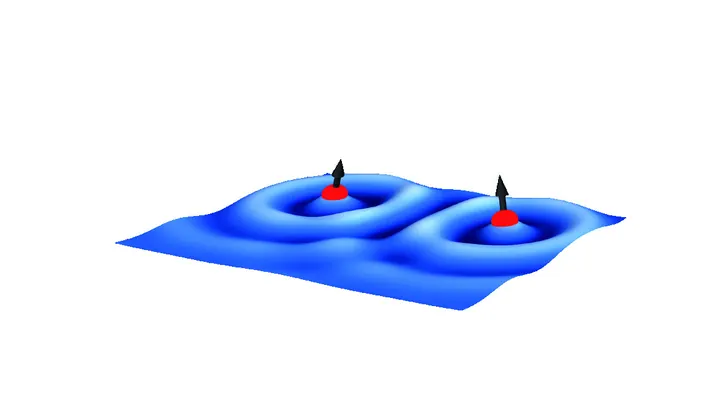
Imagine a quantum phase transition as an intricate dance. Electrons whirl in strict order, each step representing their spatial arrangement, and the rhythm their dynamics. For decades, physicists could only see a blur of motion, unable to tell if the figures were changing or the music speeding up.
Every quantum system (whether an atom, a crystal, or the entire Universe) has its own set of allowed energies, like the steps of a ladder. The hotter the system, the more readily particles climb to higher rungs.
If you carry a cup of coffee slowly and steadily around a room and then return to the same spot, nothing happens to the drink. But in the quantum world, things are different: a particle that makes such a loop comes back not quite the same. It picks up an elusive 'extra'—the geometric phase, which physicists call the Berry phase.
Sunlight hits a silicon wafer, and a current flows in the circuit. That's the familiar work of a solar cell: light knocks out electrons, and a p–n junction (the boundary between two layers with different conductivities) forces them to move in one direction. But in some crystals, current arises differently — without any junctions, purely from the material's internal structure.
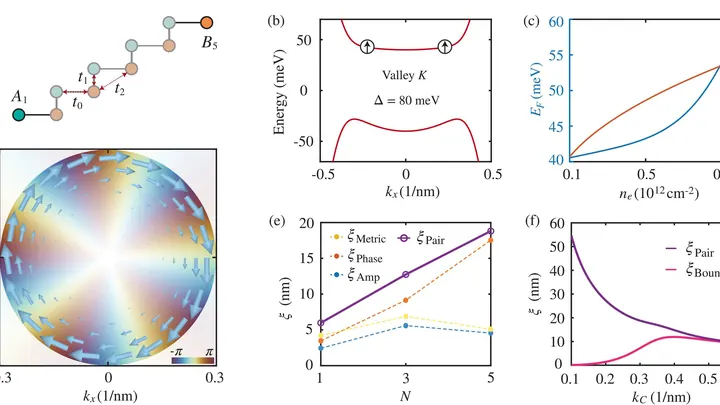
In a superconductor, electrons pair up like dancers holding hands. Usually, the distance between them, the pair size, depends on how fast they move and how strongly they are bound. But sometimes the dance floor almost disappears, and there's nowhere to move. This happens in materials with flat electronic bands: electrons nearly freeze, and the usual rules stop working.
An electron inside a crystal is like a traveler walking through a city with winding streets. Its direction of motion constantly changes depending on where it is. Physicists call this feature the geometric Berry phase, and it determines how a material conducts electricity or responds to a magnetic field.
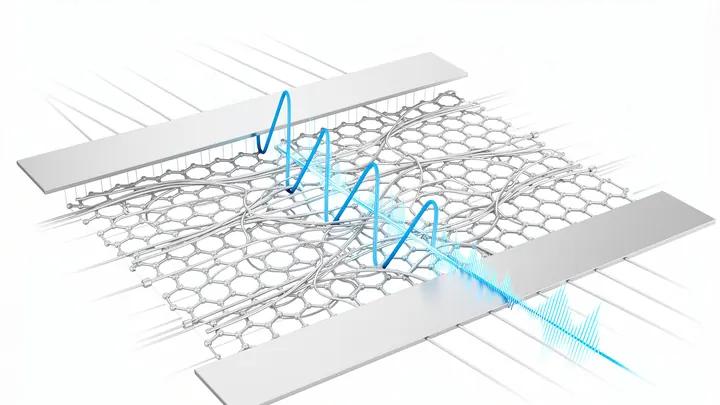
A thin film, clamped between two metal posts, trembles at the slightest nudge. Its movements are picked up by a microwave resonator — a cavity where radio waves bounce around like sound in an empty room. When the membrane shifts, the cavity's response changes.
A chef tastes the soup to see how much salt is in the pot. Physicists did something similar with crystals: they aimed X-rays at them and, from how the rays scattered, calculated how 'spread out' the electrons are in chemical bonds.
In diamond, carbon atoms are held together by shared electrons, like two people sharing one blanket.