How Stars Age: The Spin Rate Connection express
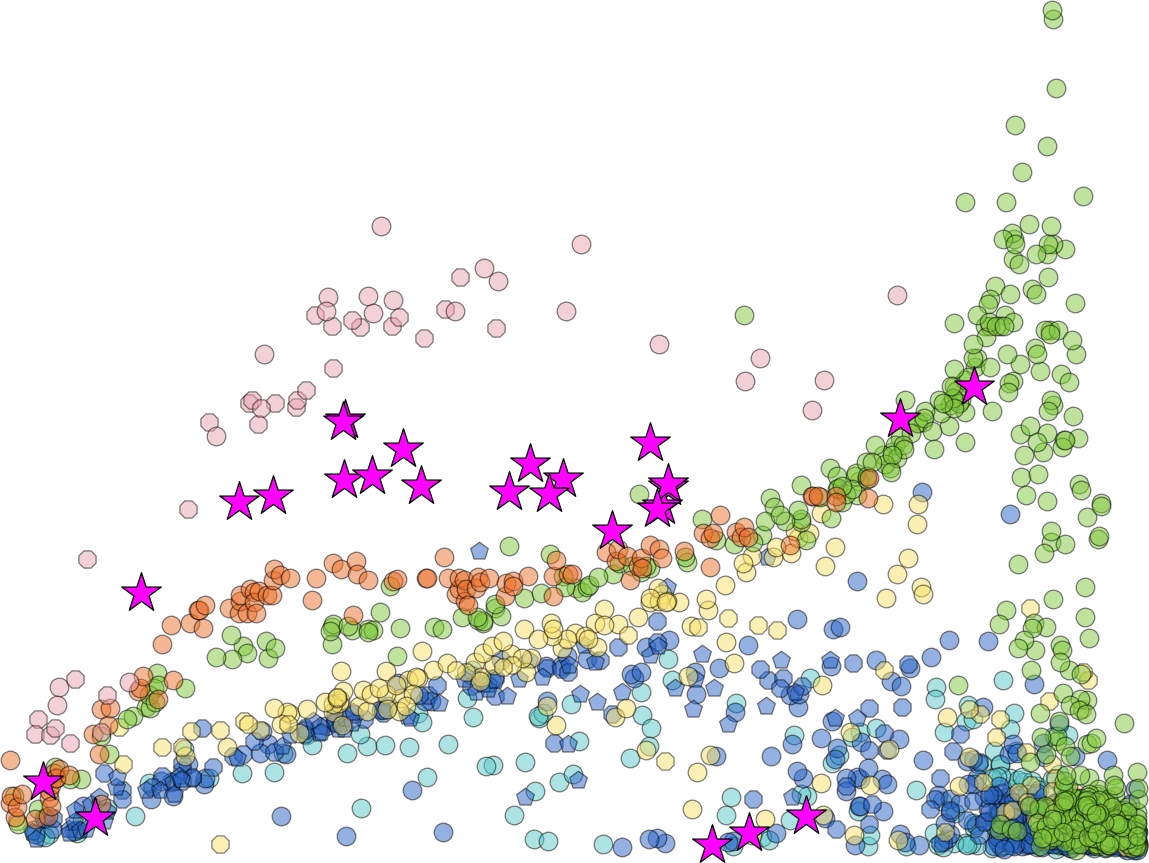
Stars are like spinning tops: they start fast and gradually slow down. This process acts like an hourglass — the slower a star spins, the older it is. Astronomers use this relationship to estimate stellar ages, but they need reference groups of stars with known ages.
The open cluster NGC 752 is such a group, with stars born together about 1.3 billion years ago. It fills a gap between the younger cluster NGC 6811 (1 billion years old) and the older NGC 6819 (2.5 billion years old). Previously, rotation speeds for the relevant stars in NGC 752 couldn't be measured, making the age–rotation calibration imprecise.
Comparing with models revealed that existing methods overestimate the ages of many stars by 20–50%. The culprit is the lack of data for intermediate ages. NGC 752 now serves as a reliable anchor for improving age estimates. This is especially important because future space missions like Gaia DR4, Roman, and PLATO will measure rotation periods for tens of millions of stars, and calibration accuracy will become the main bottleneck.
Original abstract
as written by the authors arXiv:2608.10077v1
Empirical gyrochronology relies on co-eval stellar associations to map stellar rotation as a function of mass and age. The accuracy of its age predictions is therefore limited by the number and quality of benchmark rotation sequences. The well-characterized clusters NGC-6811 (t ~ 1 Gyr) and NGC-6819 (t ~ 2.5 Gyr) bracket an intermediate-age interval in which stellar spin-down remains poorly constrained due to lack of available rotation data. At t ~ 1.3 Gyr, NGC-752 provides a critical benchmark within this gap, but previous measurements could not define the G- and K-dwarf rotation sequence needed for calibration. Here, we combine Gaia-based NGC-752 membership lists with literature rotation periods to map NGC-752's slow-rotator sequence for the first time. We identify a well-defined sequence intermediate between those of NGC-6811 and NGC-6819. Stars near Teff ~ 4500 K rotate more slowly than their counterparts in NGC-6811, indicating that stars experiencing stalled spin-down at ~1 Gyr have resumed appreciable spin-down by the age of NGC-752. Adopting an age of 1.3 Gyr for NGC-752, we further show that existing empirical gyrochronology models overestimate the ages of many G and early-K dwarfs by 20--50% because they lack intermediate-age calibration data, although uncertainty in the absolute age of NGC-752 may account for part of this offset. NGC-752 therefore provides a necessary anchor for improving rotational age estimates. This calibration is especially timely because Gaia DR4, Roman, and PLATO are expected to yield rotation periods for tens of millions of stars, making the age coverage of benchmark sequences a principal limitation on large-scale gyrochronology.
The cluster NGC 752 is visible even through binoculars in the constellation Andromeda, and it is older than Earth's mountains but younger than the oldest fossils.