Stellar age is a fundamental property of stars, but it is not directly observable. Instead, astronomers infer it from other measurable properties like luminosity, temperature, and chemical composition. Knowing a star's age is crucial for understanding stellar evolution, the history of star formation in galaxies, and even the age of the universe itself.
History
The concept of stellar evolution and age dating developed in the early 20th century, with key contributions from Arthur Eddington and later from the work of Walter Baade and others on globular clusters in the 1950s.
How it works
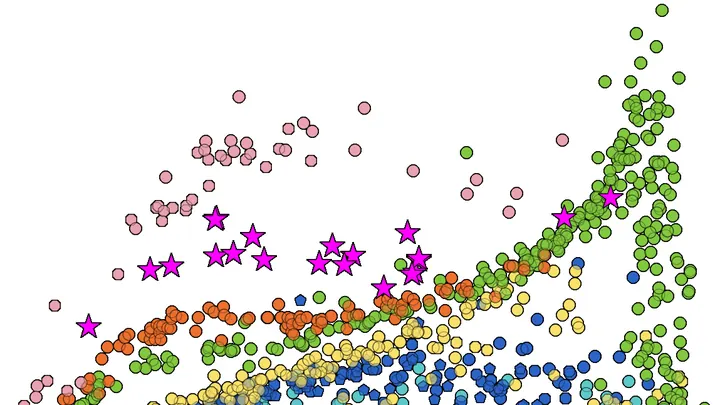
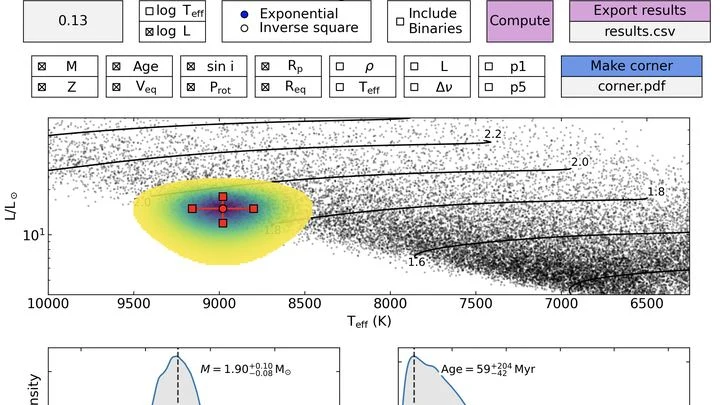
Stars change over time: they burn hydrogen in their cores, become brighter and cooler as they age, and eventually evolve into red giants or white dwarfs. By comparing a star's position on the Hertzsprung-Russell diagram (a plot of luminosity versus temperature) with theoretical models of stellar evolution, astronomers can estimate its age. For clusters of stars, the turn-off point—where stars leave the main sequence—provides a precise age for the whole cluster.
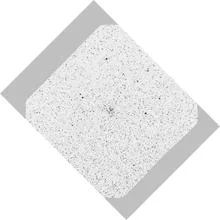
In the stellar family of the Phoenix galaxy, there are five old globular clusters, and the sixth child was long considered a foundling. The object Fornax 6, located just 270 parsecs from the galaxy's center, looked like a random clump of field stars or a compact group of distant galaxies. Astronomers argued over whether it deserved to be called a cluster.
Stars are like spinning tops: they start fast and gradually slow down. This process acts like an hourglass — the slower a star spins, the older it is. Astronomers use this relationship to estimate stellar ages, but they need reference groups of stars with known ages.
A star is not just a distant sun. It's a cradle for planets, and its light carries the birth story of the entire system. The chemical composition of a star is its DNA. Astronomers peer into this DNA to understand why some stars host rocky worlds like Earth, while others host gas giants.
A young star cluster resembles an orchestra before a concert: each instrument tunes up in its own way, and the overall hum seems like chaos. But if you listen closely, you can pick out individual notes.
A galactic disk is like a frozen ripple on water: every disturbance leaves a trace that can be read billions of years later. When a dwarf satellite galaxy flies past or a head-on merger occurs, stars in the disk start to oscillate, like bobbers rocked by a wave.
15 175 107 stars. Each one got an age. But no number is free of uncertainty: a star's age isn't a nail hammered into the timeline: it's a probability cloud, a fog hiding the true value. For galactic evolution, such a timestamp is priceless: without it, the map of the Milky Way remains flat.
A star's age is the key to the galaxy's history. But prying that key from nature is no simple task: unlike a tree, a star doesn't grow annual rings. Yet, its atmosphere holds a chemical code — the ratio of elements that slowly shifted as generations of stars died and new ones were born.
The standard cosmological model ΛCDM, where dark matter and dark energy act as the chief architects of the cosmos, has predicted astronomical data with Swiss-watch precision for decades. Its foundation was laid by three geniuses.
For centuries, astronomers gazed at the night sky, catching the slightest changes in stellar brightness. These uneven sequences, light curves, are like musical staves: each star performs its own unique melody.
In 5 billion years, the Sun, having exhausted its fuel, will start to swell, turning into a red giant. Like a balloon losing air, the star will weaken its gravitational grip, and Earth — a grain of sand on an invisible thread — will drift to a more distant orbit.
A planet glides across a star's disk, and for a moment becomes a flashlight. It blocks a tiny patch of surface, revealing details that otherwise escape our view. That's exactly how astronomers peered into the dark spots on V1298 Tauri, a young twin of our Sun. They were aided by the James Webb Space Telescope JWST and three giant planets in orbit.
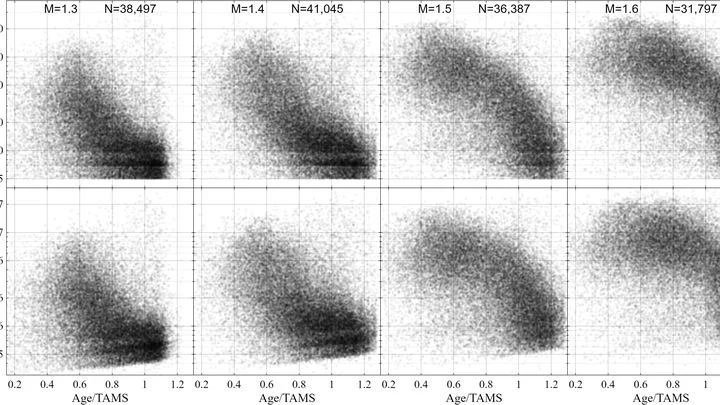
Imagine a person in an old photograph standing in a crowd while spinning — guessing their age would be nearly impossible. That's roughly how astronomers determine the ages and masses of distant stars, and they often get it wrong. For stars slightly heavier than the Sun (from 1.4 to 2.5 solar masses), standard methods like chemical-composition 'clocks' work poorly.
The first two billion years after the Big Bang were an era when the universe resembled a boiling construction pit. Dark matter clumped the gas together, igniting the first stars. It seemed there simply wasn't enough time to assemble massive elliptical galaxies—'dormant' stellar metropolises — from this raw material.
Images from the James Webb Space Telescope have revealed unexpectedly intense light from the first galaxies — colossal star systems that formed shortly after the Big Bang. Imagine a toaster browning a slice of bread in a minute, while an oven takes an hour to bake a loaf — the result is essentially the same.
Globular clusters are dense 'balls' of hundreds of thousands of stars that orbit the center of the Milky Way. Some were born in our Galaxy, others were captured when the Milky Way swallowed dwarf satellite galaxies. They can be distinguished by chemical composition, but astronomers now have a new tool — dynamical age.
A glowing cloud in a telescope looks like a wisp of fog about to dissipate. Planetary nebulae are gas shells cast off by dying stars. Young nebulae are bright and compact, but as they age, they expand, cool, and become increasingly transparent until they vanish into the interstellar medium.
In a vast dark hall, someone invisible plucks the strings. The cosmic gas, the tenuous hydrogen that filled the young universe, resembles stretched strings that can resonate at a radio wavelength of 21 centimeters. This is hydrogen whispering about its temperature.
The fate of a civilization isn't just a matter of luck or disasters. Scientists simulated a thousand years of history under ten different scenarios, accounting for resource consumption, governance, and random shocks. The key metric turned out to be the 'activity coefficient' – the fraction of time when a civilization is technologically alive. At best, this fraction nears 100%; at worst, it drops to 38%.
In the open cluster Trumpler 5, where hundreds of stars move together, one star behaves like a teenager among elders. It pulsates — expanding and contracting, changing brightness every few hours.
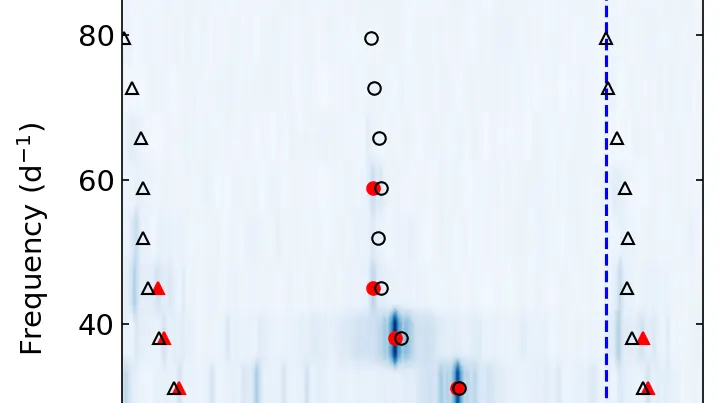
The night sky looks still, but many stars tremble like a drum after a strike. For seven straight years, the TESS satellite stared at the same patches of sky and caught this trembling in 19,151 red giants — old, bloated stars. Previously, far fewer of these 'singing' giants were known, and now the list has grown by 80%.
The Sun is not a perfectly steady lightbulb. Its brightness quivers slightly: it dims a bit, then brightens. For Earth's climate, even slow variations stretched over thousands and millions of years matter. They could have left their mark in the geological record of the last 540 million years.
Astronomer [scientist:A. M.
For a long time, the Universe was seen as a strict baker: it was thought that in every corner, stars were mixed from the same recipe — for each giant star, there were roughly the same number of dwarfs, no matter where they were born.
Globular clusters are dense stellar archives, where the youth of the Galaxy is recorded. But reading this chronicle was hindered by imprecise chronometers: age estimates diverged by a billion years.
The light of every star is its unique passport, but the entries are written in the language of spectra and colors. For old giants, such documents are almost indistinguishable: their spectra overlap, and deciphering the details by hand was practically impossible.
In the star cluster NGC 2158, which is over a billion years old, astronomers have counted how often stars live in pairs. The Hubble telescope stared at the cluster for a long time to catch even the faintest stars: those lighter than one-third of the Sun.
When a bright spot flares up on a star, astronomers want to know how much energy was released into space. They used to picture a flare as a growing campfire: the area of the fire increases, but the heat remains the same. That made calculations simpler, but reality turned out to be different.
A galaxy is like a city where no new houses are being built. Stars are no longer born there, and the old buildings tell you when construction was bustling. Astronomers peered into 14 such 'ghost towns' on the edge of the visible universe: their light has been traveling to us for 11–12 billion years.
Gas clouds in the Milky Way give birth to stars, and the heaviest among them are true giants. Previously, it was thought that such a star ignites almost instantly, like a light bulb. But new research shows that a star grows gradually, like a snowball rolling down a mountain: the longer it rolls, the bigger it gets.
The authors compared two catalogs: bright gas clouds around young stars and the stars themselves.
The galaxy CEERS2-588 flared up like a bonfire fed with an armful of wood all at once. Just 400 million years after the Big Bang, it had already built up a mass of a billion suns and ignited countless stars. But then the fuel ran out, and over the last 10 million years, star formation in it has almost completely ceased.
Two stars circle each other like a pair of figure skaters on ice. Both resemble the Sun, but one shines brighter and has puffed up, while the other remains compact. Astronomers peered into their light using spectrographs, instruments that split light into colors, and found something odd: one star is clearly poorer in heavy elements than the other.
The Gaia space telescope has measured how fast more than a hundred thousand stars spin. It turns out that a star's rotation speed depends on its temperature. For stars cooler than 6500 degrees, the surface moves at 10–20 kilometers per second.
Lunar rocks brought a puzzle: their age is 4.35 billion years, but the Moon itself should have appeared 150 million years earlier. The missing time is hidden in tidal heating. When the Moon hung closer to Earth, Earth's gravity acted like tireless hands: it constantly kneaded and bent the satellite.
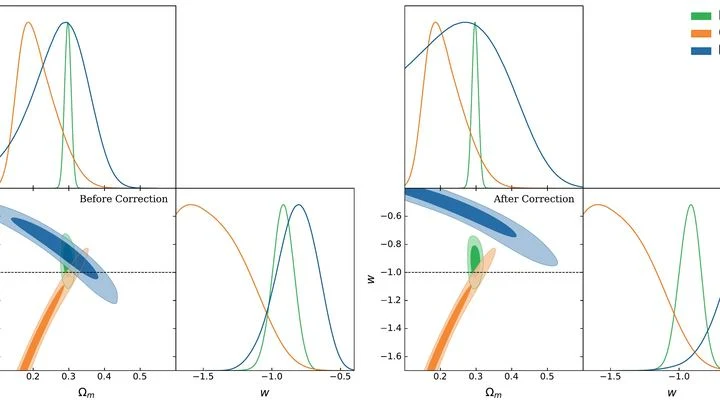
Astronomers use Type Ia supernovae — thermonuclear explosions of white dwarfs — as 'standard candles': their peak luminosity was long thought to be the same everywhere in the universe.