The age of the universe is the time elapsed since the Big Bang, currently estimated to be about 13.8 billion years. This value is derived from multiple independent measurements, including the cosmic microwave background radiation, the expansion rate of the universe, and the ages of the oldest known stars. The age is a cornerstone of modern cosmology, providing a timeline for the formation of galaxies, stars, and planets.
History
The concept of a finite age for the universe emerged in the 1920s and 1930s with the work of Georges Lemaître and Edwin Hubble, who discovered the expansion of the universe. The modern precise value of 13.8 billion years was established in the early 21st century, particularly with data from the Planck satellite.
How it works
The age of the universe is determined primarily by measuring the Hubble constant, which describes the rate of cosmic expansion, and then extrapolating backward in time to the point where the universe was infinitely dense and hot. This calculation is refined using observations of the cosmic microwave background, which provides a snapshot of the universe when it was about 380,000 years old, and by modeling the evolution of the universe's composition and geometry.
In practice
Knowing the age of the universe is essential for testing cosmological models, understanding the formation of large-scale structures, and determining the timescales for stellar evolution and the synthesis of heavy elements.
Fun fact
The age of the universe is not a fixed number but depends on the model of dark energy; if dark energy were different, the universe could be slightly older or younger, but current observations strongly favor 13.8 billion years.
In the first half-billion years after the Big Bang, galaxies grew like crazy. Gas fell in rapidly and collapsed into stars without any resistance. This period is called 'unimpeded star formation.' It's like frying pancakes on a scorching skillet without a lid: splatters fly, but nothing holds them back.
Stars are like spinning tops: they start fast and gradually slow down. This process acts like an hourglass — the slower a star spins, the older it is. Astronomers use this relationship to estimate stellar ages, but they need reference groups of stars with known ages.
In the heart of an old city stands a clock tower whose hands have never been adjusted since it was built. By how far it runs slow, you can calculate how much time has stretched since then. In space, the role of such towers is played by relic galaxies — dense stellar systems that formed in the first few billion years and have since neither merged with neighbors nor given birth to new stars.
Cosmic rays aren't rays in the usual sense: they're fast particles bombarding Earth from all directions. Mostly they're protons and atomic nuclei. Their energies vary widely, from modest to fantastically huge. When such a particle heads our way and the Moon or Sun gets in its path, it gets absorbed.
Imagine a factory capable of producing a million parts per hour, yet it only makes a hundred. That's roughly how our Universe behaves when viewed through the lens of entropy — a measure of disorder that, according to physics, must only increase. The main "machines" of this factory are supermassive black holes.
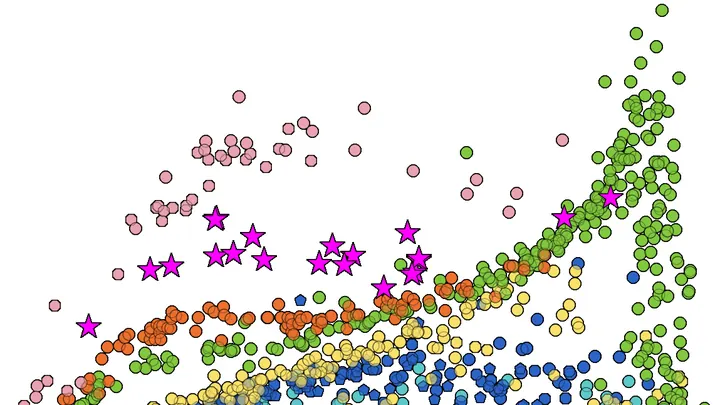
The most massive stars are like overinflated balloons: their envelope stops stretching and instead begins to furiously vent material. At a certain stage, the mass loss becomes so intense that the star stops growing in size. Astronomers see this moment as a kink in the diagram where stars are sorted by luminosity and temperature.
The standard cosmological model ΛCDM (which includes dark energy and cold dark matter) is the score of a cosmic symphony. It describes how space expanded after the big bang. How dark matter clumped together. How galaxies ignited. For a long time, everything played flawlessly.
A galactic disk is like a frozen ripple on water: every disturbance leaves a trace that can be read billions of years later. When a dwarf satellite galaxy flies past or a head-on merger occurs, stars in the disk start to oscillate, like bobbers rocked by a wave.
15 175 107 stars. Each one got an age. But no number is free of uncertainty: a star's age isn't a nail hammered into the timeline: it's a probability cloud, a fog hiding the true value. For galactic evolution, such a timestamp is priceless: without it, the map of the Milky Way remains flat.
A star's age is the key to the galaxy's history. But prying that key from nature is no simple task: unlike a tree, a star doesn't grow annual rings. Yet, its atmosphere holds a chemical code — the ratio of elements that slowly shifted as generations of stars died and new ones were born.
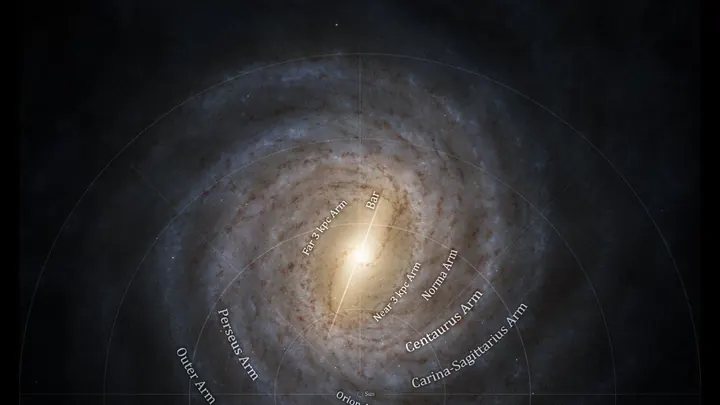
The formation of the Milky Way is a grand cosmic performance, in which mergers of satellite galaxies were woven into a single score. Each event left a trace in the dynamics and chemical composition of stars, much like notes capture the composer's intent.
The standard cosmological model ΛCDM, where dark matter and dark energy act as the chief architects of the cosmos, has predicted astronomical data with Swiss-watch precision for decades. Its foundation was laid by three geniuses.
The universe is like a vast warehouse where a strict inventory was taken long ago. The cosmic microwave background is an ancient record of everything in stock 380,000 years after the big bang. According to it, the fraction of matter in the cosmic 'budget' (the parameter Omega_m) is known with high precision.
A living organism is a machine that constantly channels energy through itself and converts it into heat. This internal cycle is called internal entropy production (a measure of energy dissipation). But about 2.5 million years ago, our ancestors switched on a second loop — an external one. They picked up a sharpened stone, and then a burning branch.
In 5 billion years, the Sun, having exhausted its fuel, will start to swell, turning into a red giant. Like a balloon losing air, the star will weaken its gravitational grip, and Earth — a grain of sand on an invisible thread — will drift to a more distant orbit.
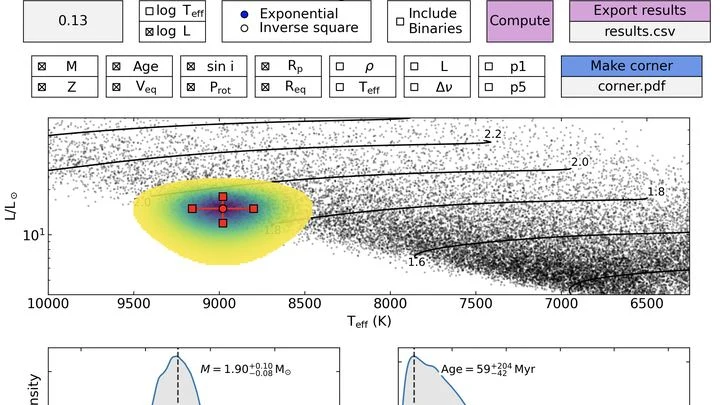
Imagine a person in an old photograph standing in a crowd while spinning — guessing their age would be nearly impossible. That's roughly how astronomers determine the ages and masses of distant stars, and they often get it wrong. For stars slightly heavier than the Sun (from 1.4 to 2.5 solar masses), standard methods like chemical-composition 'clocks' work poorly.
The Universe resembles a dense forest: up close, individual galaxy-trees are visible, gathered into groves, but from a distance everything merges into a solid green canopy. The boundary beyond which the cosmos becomes homogeneous is called the angular scale of homogeneity: it's the size of a patch of sky from which galaxies are distributed evenly.
Eight hundred million years ago, in the main asteroid belt, a giant inkwell shattered. The parent body, over a hundred kilometers in diameter, made of primitive carbonaceous chondrites, suddenly broke apart near the J3:1 resonance with Jupiter.
Immediately after the Big Bang, in the seething cauldron of the cooling Universe, much like in unevenly hardening glass, stresses appeared — hairline cracks in reality, cosmic strings. Picture a tightrope walker balancing on an invisible cable stretched across the abyss of warped spacetime.
Cosmology is going through strange times. On one hand, the standard model with dark matter and dark energy beautifully describes the large-scale structure. On the other, it's cracking at the seams.
Our Solar System isn't an island in the void: it's a sensitive web stretched in a dark cosmic corner. Planets circle their orbits like dewdrops on threads, and we are the spider sensing the faintest tremor. That tremor betrays the approach of the catastrophe astronomers call the Big Rip.
The universe abhors monotony. A century ago, Edwin Hubble and Georges Lemaître gave us an elegant picture: an expanding cosmos, smooth as the surface of an inflated balloon.
The Universe is like an inflating balloon. Quantum mechanics forbids measuring exactly how big it is and how fast it's inflating at the same time. This principle permeates the cosmos: a new equation states that the Universe's expansion and its size are linked by a fundamental uncertainty.
Usually, the story of the universe goes like this: there was nothing, then a bang, and ever since everything has been flying apart. But what if there was no 'nothing'? A group of physicists has shown that the universe could have existed forever: it just sometimes contracts and then expands again, like a spring.
Globular clusters are dense 'balls' of hundreds of thousands of stars that orbit the center of the Milky Way. Some were born in our Galaxy, others were captured when the Milky Way swallowed dwarf satellite galaxies. They can be distinguished by chemical composition, but astronomers now have a new tool — dynamical age.
You are pacing a huge hall in complete darkness. You walk from wall to wall, counting your steps, and suddenly realize that the distances don't add up as they should. It seems as if the floor is not flat but bulging like a hump or hollowed like a bowl. That's roughly what astronomers found when studying distant galaxies and sound waves frozen in the early Universe.
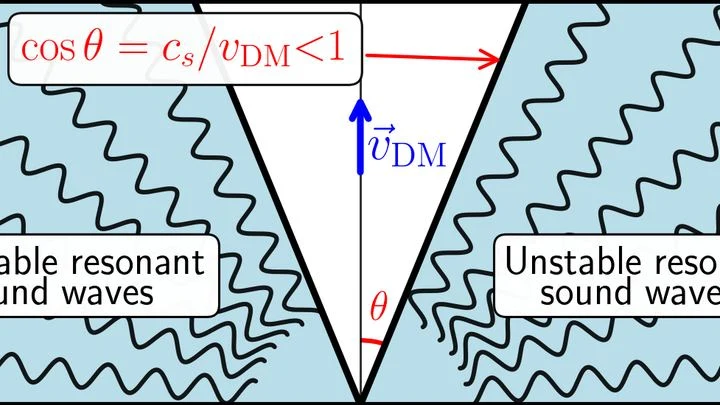
After the Big Bang, dark matter and ordinary matter (mostly hydrogen) went their separate ways in terms of speed. Their gravitational pull acts like a bow gliding across a string: when frequencies match, resonance occurs, and sound waves start to rapidly grow in ordinary matter.
A glowing cloud in a telescope looks like a wisp of fog about to dissipate. Planetary nebulae are gas shells cast off by dying stars. Young nebulae are bright and compact, but as they age, they expand, cool, and become increasingly transparent until they vanish into the interstellar medium.
In a vast dark hall, someone invisible plucks the strings. The cosmic gas, the tenuous hydrogen that filled the young universe, resembles stretched strings that can resonate at a radio wavelength of 21 centimeters. This is hydrogen whispering about its temperature.
About 11 billion years ago, the Milky Way suffered a head-on collision. Not with an asteroid, but with an entire smaller galaxy. It slammed into ours and was torn apart like a puff of flour hit by a fist. Astronomers call this cosmic scar Gaia-Sausage-Enceladus (after the shape of the orbits of its remaining stars).
The fate of a civilization isn't just a matter of luck or disasters. Scientists simulated a thousand years of history under ten different scenarios, accounting for resource consumption, governance, and random shocks. The key metric turned out to be the 'activity coefficient' – the fraction of time when a civilization is technologically alive. At best, this fraction nears 100%; at worst, it drops to 38%.
For 800,000 years, ice ages have occurred every 100,000 years. The rhythm matches the elongation of Earth's orbit. But the orbit changes the flow of solar heat so subtly — as if the conductor barely moved the baton, yet the orchestra thundered. It remained a mystery how this weak signal controls the ice sheets.
Every 1151 years, seven planets of the Solar System, from Mercury to Neptune, find themselves at almost the same points in their orbits. Their positions scatter by less than a degree, as if the celestial mechanism is wound to the same tune. This rhythm was discovered by comparing planetary positions over 2600 years using precise tables of celestial motion.
The night sky looks still, but many stars tremble like a drum after a strike. For seven straight years, the TESS satellite stared at the same patches of sky and caught this trembling in 19,151 red giants — old, bloated stars. Previously, far fewer of these 'singing' giants were known, and now the list has grown by 80%.
Other galaxies are just ancient snapshots, but we watch the Milky Way live. Comparing data over 30 years, scientists found that the Galaxy’s center is, like, speeding up: the supermassive black hole got heavier, swallowing the mass of a large asteroid each year; the stellar bar (a huge beam of billions of suns, like the…
The Sun is not a perfectly steady lightbulb. Its brightness quivers slightly: it dims a bit, then brightens. For Earth's climate, even slow variations stretched over thousands and millions of years matter. They could have left their mark in the geological record of the last 540 million years.
Astronomer [scientist:A. M.
For a long time, the Universe was seen as a strict baker: it was thought that in every corner, stars were mixed from the same recipe — for each giant star, there were roughly the same number of dwarfs, no matter where they were born.
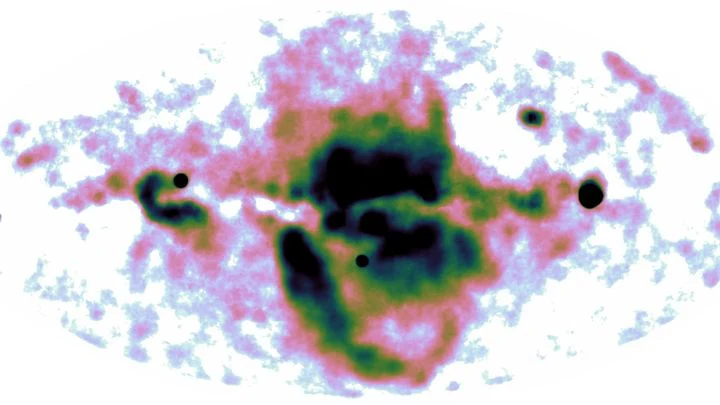
In 2020, the eROSITA X-ray telescope discovered a pair of enormous bubbles looming above and below the disk of our Galaxy. These clouds of gas heated to millions of degrees are the aftermath of a colossal energy release from the center.
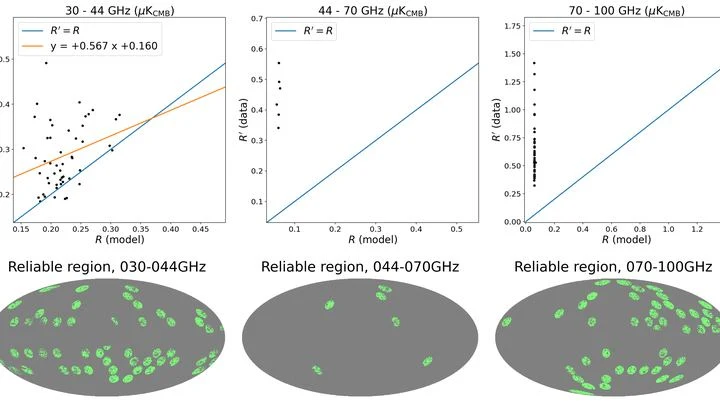
Astronomers are trying to capture the radio echo of the Big Bang — a faint glow that fills the entire universe. But the receiver is choking with noise: our Galaxy is packed with glowing interstellar dust, whose emission can easily be mistaken for a signal from the distant past.
Globular clusters are dense stellar archives, where the youth of the Galaxy is recorded. But reading this chronicle was hindered by imprecise chronometers: age estimates diverged by a billion years.