An open cluster is a group of stars born together from the same giant molecular cloud, typically containing from a few hundred to a few thousand members. These stars are loosely bound by gravity, so they drift through the disk of a galaxy together for hundreds of millions of years before gradually dispersing. Open clusters are found almost exclusively in the spiral arms and disk of galaxies, where gas and dust are dense enough to form new stars.
History
The first open cluster cataloged was the Pleiades, known since antiquity, but the concept of a physically related group of stars was established by the French astronomer Messier in the 18th century. The term 'open cluster' came into common use in the early 20th century as astronomers distinguished these loose groups from the denser, more tightly bound globular clusters.
How it works
Open clusters form when a large cloud of gas and dustcollapses under its own gravity, fragmenting into many individual stars that share a common motion through space. The cluster's gravity holds the stars together, but it is weak compared to the tidal forces from the galaxy's overall mass distribution. Over time, encounters with giant molecular clouds and the differential rotation of the galaxy pull the cluster apart, scattering its stars into the general stellar population.
In practice
Open clusters serve as natural laboratories for studying stellar evolution, since all their stars share the same age and chemical composition, allowing astronomers to test models of how stars change over time.
Fun fact
The Hyades cluster, the nearest open cluster to Earth, is so spread out that its stars are currently passing through the constellation Taurus, and the cluster's core is already dissolving.
A resident of a bustling city center one day packs a suitcase and moves to a quiet suburb. The same happens to galactic clusters, except instead of a suitcase, they have stars, and instead of a move, they have billions of years of drifting across the disk.
Berkeley 36 is an open cluster, that is, a group of stars born together from a single cloud.
A resident of a bustling city center one day packs a suitcase and moves to a quiet suburb. The same happens to galactic clusters, except instead of a suitcase, they have stars, and instead of a move, they have billions of years of drifting across the disk.
Berkeley 36 is an open cluster, that is, a group of stars born together from a single cloud.
An old city gains new suburbs. In the center, narrow streets where life has nearly stopped, while on the outskirts construction is booming. That is what a spiral galaxy looks like when its core stars have long aged and new stars are still being born in the outer disk.
Deep inside a neutron star, where matter is compressed to the density of an atomic nucleus, neutrons form a superfluid and protons form a superconductor. A neutron vortex is a quantized vortex in the superfluid, akin to a miniature whirlpool that cannot stop spinning.
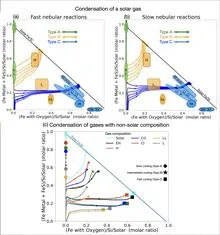
Three cabinets full of rocks. In one, metallic grains and the gray mineral enstatite; in the second, the same grains but with rusty streaks; in the third, layered clays swollen with water. All three sets were pulled from meteorites that fell to Earth: chondrites. They were born in the same gas-and-dust disk around the young Sun, yet somehow turned out so different.
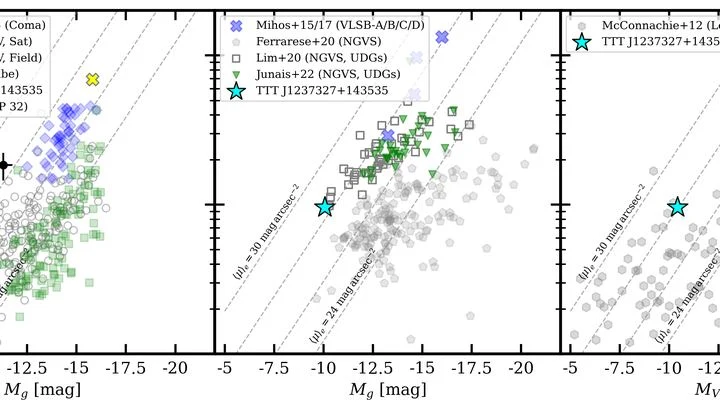
The night sky only looks black: telescopes reveal millions of galaxies, but some are so dim they blend into the background. Astronomers caught just such a "nearly invisible" one by chance while observing the Virgo Cluster with the two-meter telescope at Teide Observatory.
The galaxy is named TTT J1237327+143535.
Faint galaxies scattered across the Perseus cluster are like ghosts among their bright neighbors. They are so diffuse that distant objects shine through them, and they contain hundreds of times fewer stars than our Milky Way.
Two stars circle each other like dancers who come together and drift apart. Over time, one swells, and its outer layers spill onto its neighbor. The star that receives foreign matter looks no different from a single star, but its surface remembers everything.
Around a just-ignited star swirls a vortex of dust and gas. This vortex, the protoplanetary disk, grows by accreting material from the surrounding cloud.
In the furnace of star formation, the heat reaches 900 degrees Celsius, like a glowing blast furnace. It is in this hellish heat that cosmic crystals are born. Astronomers have for the first time caught the moment when crystalline dust appears right during an accretion flare (when the star gobbles up surrounding gas) at the very young star EC 53, still cocooned in dense gas.
Galaxy NGC 4254 lies 1.5 million light-years from the center of the Virgo cluster. It drags a long stream of cooling hydrogen — a sign that it's plowing headlong into the hot gas. Losing cold fuel quenches the birth of new stars.
A gas disk with a mass of four hundred thousand suns encircles the black hole at the center of the Milky Way. Its gravity works like a gravitational rudder: slowly but inexorably turning the orbits of binary stars, driving them into the region where tidal forces tear the pair apart.
In the spiral galaxy Fireworks Galaxy — 6410 stellar nurseries. That's how many regions where massive stars are being born right now were identified by an algorithm on old ultraviolet radiation images from the Edwin Hubble. These aren't just blobs in a picture — each has a clear boundary, like a country on a contour map.
A young star cluster resembles an orchestra before a concert: each instrument tunes up in its own way, and the overall hum seems like chaos. But if you listen closely, you can pick out individual notes.
89 milliseconds. That's how long a vortex avalanche lasts that abruptly speeds up the rotation of the Vela pulsar — one of the most famous 'glitching' pulsars. Pulsars are rapidly spinning neutron stars born in the collapse of supernovae.
Two cities endure a series of fires. In one, the wind carries ash far beyond the outskirts, leaving the sky clear. In the other, ash settles as a dense veil, painting sunsets crimson. Roughly the same thing, just on a galactic scale, happens with supernova explosions, the final flares of massive stars.
A galactic disk is like a frozen ripple on water: every disturbance leaves a trace that can be read billions of years later. When a dwarf satellite galaxy flies past or a head-on merger occurs, stars in the disk start to oscillate, like bobbers rocked by a wave.
In 2016, astronomers saw something incredible: a distant star, named Icarus, flared up for several weeks, crossing the abyss of space. Gravitational lensing, an effect predicted by Einstein, had kicked in: a massive object bends spacetime and focuses light like a giant magnifying glass.
The formation of the Milky Way is a grand cosmic performance, in which mergers of satellite galaxies were woven into a single score. Each event left a trace in the dynamics and chemical composition of stars, much like notes capture the composer's intent.
In the quiet of cold molecular clouds, where interstellar gas under gravity condenses into dense clumps, the birth of massive stars is one of the great puzzles of astrophysics.
The James Webb Space Telescope peered into an era when the universe was less than a billion years old and spotted strange objects—'little red dots.' These are black holes with masses of millions of suns, but in very compact, chemically pristine galaxies. Standard scenarios can't grow such heavyweights that early.
The cosmic spectacle unfolds on the stage of Galaxy галактики Centaurus A. In the lead role: a supermassive сверхмассивная чёрная дыра with a powerful jet that pierces space for hundreds of thousands of light-years.
In the heart of a dense star cluster, a true forge reigns: here stars, like glowing blanks, collide and merge under gravity, and these mergers are not a catastrophe but an opportunity. Each strike of the stellar hammer transfers spin to the future black hole.
Imagine an ancient manuscript, where a new story is written over an old text. Over time, the upper layer wears thin, and lines of the past show through. That’s exactly how globular clusters, the oldest stellar systems in the Universe, are structured, like a palimpsest.
In the young Universe, about ten billion years ago, galaxies resembled endless fields after a thunderstorm: everywhere, giant — thousands of light-years across — clumps of star formation were boiling up, where young stars were born with unbridled energy. Today, these patches are an almost vanished species: in nearby galaxies, raucous hotbeds are rare.
Remember the sensational comet 1I/‘Oumuamua — the first object to come to us from another star? Its hyperbolic trajectory left no doubt: it was a wanderer from the interstellar void. But astronomers wondered: could some of these visitors not be strangers at all, but our own, escaped from the Solar System millions of years ago?
When we peer deep into space, we see the past. Edwin Hubble’s law turns redshift into a time machine: light from galaxy UDS 12999 traveled to us for 7.6 billion years — more than half the age of the Universe.
A detective story unfolded in the GWTC-5 catalog. Hundreds of signals from merging black holes, captured by the detectors of Rainer Weiss and his colleagues, held the secret to the origin of the most massive and rapidly spinning stellar-scale objects.
At the center of a tiny galaxy lies a dense clump of stars and dark matter. This clump, called a soliton, is not frozen in place: it quivers and oscillates like jelly on a plate.
Imagine a forest planted in a single day. At first glance, all trees look alike, but their cross sections tell different stories: some grew on clean soil, others on the ashes of ancient fires.
In nuclear physics, the belief long reigned that two neutrons cannot form a bound state — they attract too weakly and immediately fly apart. However, on the surface of neutron-rich nuclei, where the matter density drops to a thousandth of normal nuclear density, the situation changes dramatically.
Stars are born in cold clouds of cosmic dust and hydrogen. Inside these cocoons, protostars — the cores of future suns — were long thought to be just hot clumps. But it turns out many of them are powerful accelerators: they shoot out narrow jets of gas that, slamming into surrounding matter, produce invisible gamma-ray light.
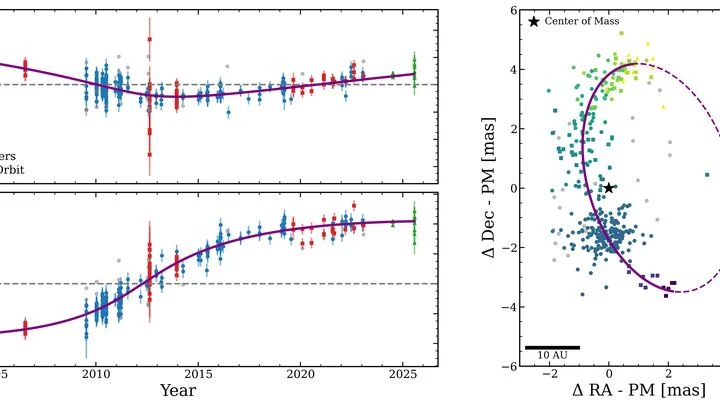
For 23 years, Hubble and James Webb have peered into the heart of Omega Centauri, a globular cluster where millions of stars crowd into a space just 150 light-years across. In this stellar beehive, the motion of the stars betrayed an invisible partner: a main-sequence star (one that has not yet left the main evolutionary branch) seemed to be tugged in a dance with an unseen weight.
A planet the size of Neptune wandered too close to its star. The star begins to pull the planet's outer layers onto itself — gas streams off the planet like water from an overflowing bucket. This process is called Roche-lobe overflow (astronomers use this term for the boundary beyond which a star can tear material away from a planet).
The Universe is singing. Not in the usual sense: its symphony is recorded in tiny density variations from which galaxies and ourselves grew. After the Big Bang, space was almost uniform, but quantum fluctuations during inflation left a faint pattern — slightly more matter here, slightly less there.
The stellar halo of the Milky Way is a galactic palimpsest: an ancient manuscript where earlier layers lie hidden beneath the visible text. For a long time, the Gaia-Sausage-Enceladus (GSE) structure was thought to be the final entry in this manuscript, the scar of a single catastrophic merger.
In an orchestra, each musician plays their own part, but at a certain moment all instruments pause on a single note. Cosmic rays behave somewhat like this — particles flying toward us from distant stars.
In the heart of the Eagle Nebula, about 7000 light-years away, three giant pillars of gas and dust rise — the Pillars of Creation. Their shape is familiar to many from Hubble Space Telescope images. Now, Webb's infrared camera has allowed us to peer inside these dense cocoons where stars are born.
For a long time, a void yawned in the family of ultra-dense remnants of dead stars. Neutron stars, swift city-sized tops, rarely weigh more than two Suns. Black holes start at about five solar masses. Between them lies a 'gap' where for decades no object could be found.