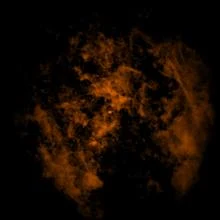
Gaia is a space observatory operated by the European Space Agency (ESA) that precisely measures the positions, distances, and motions of over a billion stars in our galaxy. By repeatedly scanning the sky, it builds an incredibly accurate three-dimensional map of the Milky Way. This data allows astronomers to detect the subtle 'wobble' of a star caused by the gravitational pull of an orbiting companion — be it a planet, a brown dwarf, or another star.
History
The Gaia mission was launched in 2013, succeeding the earlier Hipparcos satellite (1989–1993). The concept was developed through the 1990s and 2000s, with Gaia's design finalized in the mid-2000s. Its first data release was in 2016, with subsequent releases in 2018, 2020, and 2022.
How it works
Gaia uses two identical telescopes that observe the sky from a fixed angle, spinning slowly to scan the entire celestial sphere. It measures stellar positions with microarcsecond accuracy, equivalent to seeing a coin on the Moon from Earth. By tracking the same star over many years, it detects tiny periodic shifts in its position — the wobble — which reveals the presence and mass of unseen companions. It also measures stellar velocities and brightness, providing a comprehensive kinematic and photometric dataset.
In practice
Gaia's data is used to map the Milky Way's structure, study stellar evolution, and discover exoplanets and brown dwarfs. It also provides the reference frame for astronomical observations and helps calibrate cosmic distance scales.
Fun fact
Gaia's measurements are so precise that it can detect the gravitational influence of a small planet on its host star from thousands of light-years away, and it has already found over 200,000 potential new celestial objects.
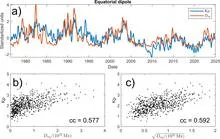
The Sun breathes, and that breath has a magnetic rhythm. Every 27 days, the visible surface of the star makes a full rotation, and with it, its magnetic field, like an invisible ribbon wrapped around the star.
Gamma rays are the most energetic light in the Universe. But one part of them, the medium-energy range, long remained invisible: instruments couldn't catch them, leaving a gaping hole in the sky. Scientists call it the "MeV gap," named after the unit of energy these rays carry.
The new camera works like a three-layer detective.
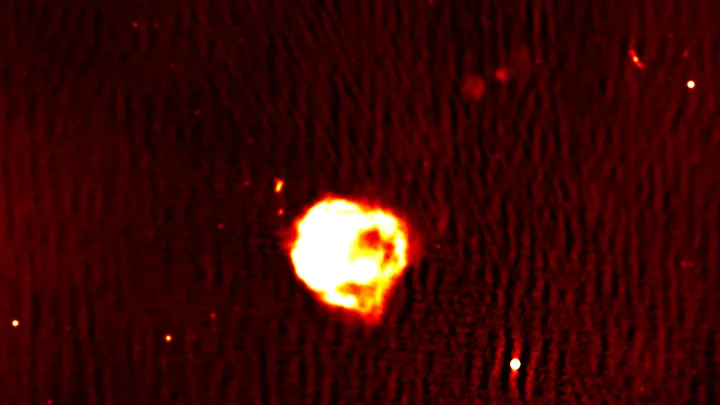
From 1987 to 1991, astronomers last measured how Jupiter's icy moons reflect radio waves. Then came a long pause. In 2011–2024, researchers aimed a radar beam at Europa again: this time using the 70-meter antenna at Goldstone and the Green Bank Telescope.
Ice is nearly transparent to radio waves, like clear window glass is to light.
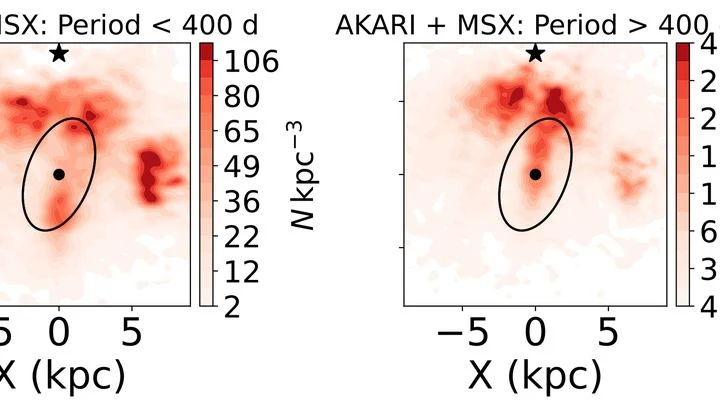
Red giants in the center of the Milky Way resemble distant lighthouses that brighten and dim. Their light pierces through dense dust, but standard distance-measuring methods fail here: the stars are too bright and unstable, and dust distorts the picture.
Astronomers found a workaround.
A pot of boiling porridge: bubbles burst, steam escapes, and everything gets mixed up. Massive stars in giant gas clouds behave in much the same way. Their radiation and stellar winds blow out enormous cavities, molecular bubbles, scattering material all around.
15 175 107 stars. Each one got an age. But no number is free of uncertainty: a star's age isn't a nail hammered into the timeline: it's a probability cloud, a fog hiding the true value. For galactic evolution, such a timestamp is priceless: without it, the map of the Milky Way remains flat.
The universe sounds with silence. The lion's share of matter — about 85%—remains invisible, manifesting only through gravity. Back when Vera Rubin Vera Rubin showed that galaxies spin as if wrapped in unseen mass.
The formation of the Milky Way is a grand cosmic performance, in which mergers of satellite galaxies were woven into a single score. Each event left a trace in the dynamics and chemical composition of stars, much like notes capture the composer's intent.
The light of a distant star is no perfect beacon. Passing through the gravitational field of another star, it bends, splits, and magnifies, creating a fleeting Einstein ring in the sky. This is how gravitational microlensing manifests, predicted by Fritz Zwicky back in the 1930s.
At the centers of many galaxies lurk black holes — regions with gravity so strong that even light cannot escape. Stars often orbit them, and sometimes one of those stars is a pulsar, a cosmic lighthouse sending out strictly periodic radio pulses. When such a pulsar moves behind a black hole, its signals reach us with a delay.
In absolute silence, you need to hear a feather drop. But someone keeps rustling a plastic bag. For the space-based LISA observatory, that 'rustling' will come from charged particles in space.
Using James Webb, astronomers 'fished out' a third giant planet from the murky dust disk of the star β Pictoris. Two others were already known, but this one was hiding in the bright light, like a fish in muddy water.
The stellar halo of the Milky Way is a galactic palimpsest: an ancient manuscript where earlier layers lie hidden beneath the visible text. For a long time, the Gaia-Sausage-Enceladus (GSE) structure was thought to be the final entry in this manuscript, the scar of a single catastrophic merger.
A lighthouse blinks every few seconds, but then begins to slowly brighten and dim over the course of a year. That is exactly what about a third of red giants do — huge stars in the late stages of life. Their normal pulsations take days or weeks, but on top of that, long secondary periods are visible: months and years.
At night, a distant streetlamp seems motionless, but if you walk closer and look carefully, you might notice it swaying slightly in the wind. That's roughly how astronomers hunt for planets around other stars: they measure how a star shifts ever so slightly under the gravitational tug of its invisible companions.
The Gaia space telescope measures star positions with an accuracy of a microarcsecond, like spotting a coin on the Moon from Earth. In 2022, it noticed that the bright star HD 12800 was wobbling slightly, as if tugged by an invisible companion. Astronomers hypothesized that a planet orbits the star.
But a wobble can be deceiving.
In a constellation where new stars are born, one of them behaves like a faulty lightbulb: sometimes shining steadily, sometimes dimming by a factor of several. Astronomers have been monitoring the star Gaia-GIC-1 for several years and now understand that its blinking is the shadow of a huge dust cloud that periodically passes in front of it.
The light of every star is its unique passport, but the entries are written in the language of spectra and colors. For old giants, such documents are almost indistinguishable: their spectra overlap, and deciphering the details by hand was practically impossible.
When two galaxies collide, their central black holes begin a long dance of approach. Until they merge into one, we can see a pair of quasars — bright beacons that ignite as the black holes consume gas and dust. Such pairs in the sky are like two lighthouses standing close together, each shining from its own harbor.
Two spotlights placed side by side: from a distance, their light blends into one patch, and it seems there's a single source. The same happens in space: about 10–20% of faint stars are actually close pairs of identical stars. Individually, they can't be resolved, but together they shine noticeably brighter than a single star with the same parameters.
An aging star sheds its outer layers, leaving behind a dense, hot core the size of Earth — a white dwarf. If remnants of planets, asteroids, or comets orbit nearby, they heat up and begin to glow in the infrared. That extra light is like a warm spot on a cold floor.
The Sagittarius galaxy plunged into the disk of the Milky Way and passed through again and again, like a stone thrown into a still pond. Each strike left ripples: waves and warps in the star field.
Wide binary stars are like two dancers holding hands but standing at opposite ends of the hall. Their bond is weak, and any passerby can break them apart. Astronomers found 26 such pairs and tested how tightly they hold on.
It turned out that 12 pairs dance by Newton's rules: their orbits can be calculated like those of planets around the Sun. But three pairs move too fast.
Sometimes you find a movie ticket from three years ago in the pocket of an old jacket. You can't reconstruct the time from it, but you can figure out where the owner went. The same goes for hot subdwarfs — tiny stars in the late stages of life that shine mostly in ultraviolet. Their light is like that ticket: it tells you about the past, but reading it is tricky.
The Gaia space telescope has measured how fast more than a hundred thousand stars spin. It turns out that a star's rotation speed depends on its temperature. For stars cooler than 6500 degrees, the surface moves at 10–20 kilometers per second.
The scorching gas streaming from the Sun is not a continuous flow but rather a soup of charged particles. In this soup, waves constantly boil up: electric fields flare and fade like ripples on water from a tossed stone. One such wave is the ion-ion acoustic wave.
Sun-like stars rarely spin alone. Many of them dance with invisible partners — brown dwarfs: objects bigger than planets but too lightweight for steady stellar burning. In their cores, hydrogen fusion flickers, only to fade fast, never matching the stability of the Sun.
The night sky looks like a scattering of identical sparks. But hidden among them are true giants — red supergiants. These stars are hundreds of times wider than the Sun and shine so brightly that they can be seen from enormous distances. You'd think there'd be no better beacons for a map of the galaxy.
At the center of the Milky Way, 27,000 light-years from Earth, lives the supermassive black hole Sagittarius A*. It weighs in at four million Suns. It does not flare brightly like quasars; instead, it smolders almost imperceptibly. For a long time, astronomers debated whether it blows a wind. Now we have the answer: it does.
The Solar System takes 210 million years to complete one orbit around the center of the Milky Way. The last time we were on this same side of the Galaxy, early dinosaurs were roaming the Earth. That number, 243.72 km/s, has now been refined thanks to rare stars that streak through the Galaxy like cannonballs.
Deep in the Siberian taiga, there are a hundred light traps: each about the size of a small table, but together they cover a square kilometer. At night, these traps gaze at the sky, catching faint flashes of light born when cosmic particles slam into the atmosphere. The setup is called TAIGA-HiSCORE, and it usually works as a giant "eye" for such particles.