Neutrino Strikes a Proton: The Most Precise Measurement Yet express
An invisible stream of particles passes through your body every second. These are neutrinos — tiny messengers from distant stars and earthly reactors. Catching them is nearly impossible: they fly through matter like a bullet through fog. But physicists have learned to set traps for them.
In the NOvA experiment, the trap is a detector weighing hundreds of tons, filled with a special liquid. Inside it are many hydrogen atoms — the simplest kind: one proton, one electron. When a muon antineutrino hits a proton dead-on, two particles are born: a muon (a heavy cousin of the electron) and a neutron. Over two years of operation, the detector recorded 35,509 such collisions. That's like counting shooting stars and amassing a whole army.
The new measurement gives a number: 0.538 × 10⁻³⁸ square centimeters. This is the area that a neutrino "sees" on a proton. It seems tiny, and it is. But now it's known to four significant figures. Previously, impurities from heavy nuclei in the detector got in the way. Now scientists have subtracted their contribution using separate control datasets. The main uncertainty left is the neutrino flux itself, which is currently measured less precisely.
Such a precise result is like a newly sharpened tool. With it, we can test how well we understand the weak interaction — one of the four forces of nature. And in the future, if the neutrino flux becomes better known, this same measurement will allow us to refine it without additional experiments. So one hunt helps another.
Original abstract
as written by the authors arXiv:2608.12293v1
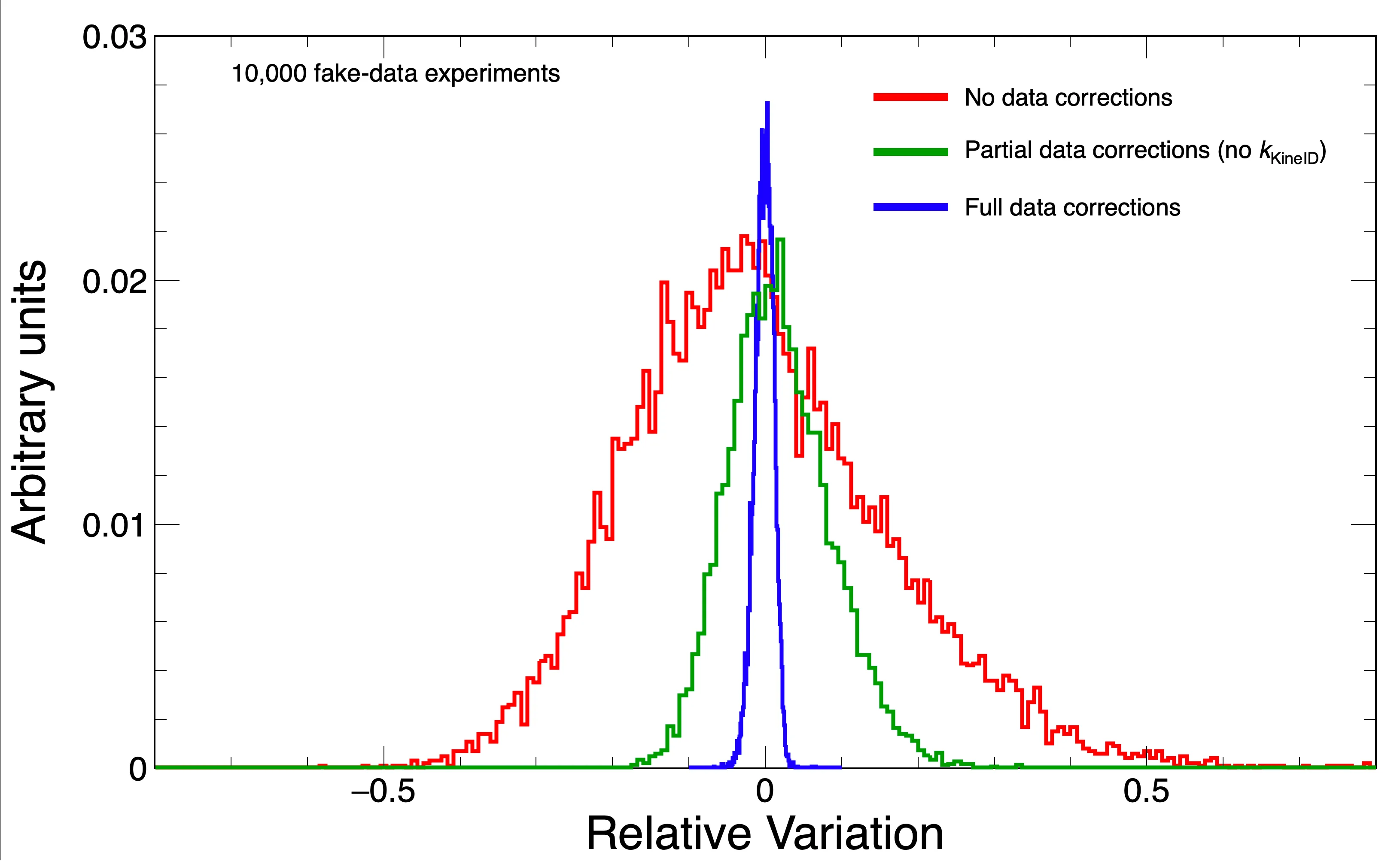
We report a measurement of the total cross section for muon antineutrino charged-current quasi-elastic scattering on hydrogen, $$\bar u_\mu {\rm H} \to \mu^+ n$$, in the NOvA near detector using a $$1.2\times10^{21}$$ proton-on-target exposure in the NuMI beam. A selection based on topological and kinematic constraints yields 35,509 signal events in the hydrogen-rich ($$10.8\%$$) detector, providing the highest statistics of (anti)neutrino--hydrogen interactions measured to date. Backgrounds from (anti)neutrino interactions on heavier nuclei are constrained using dedicated data control samples, significantly reducing the related systematic uncertainties. We obtain a value $$\sigma (\bar u_\mu {\rm H} \to \mu^+ n) = 0.538 \pm 0.009 ({\rm stat}) \pm 0.010 ({\rm syst}) \pm0.055 ({\rm flux}) \times 10^{-38}$$ cm$$^2$$ for the total cross section at an average energy of 1.9 GeV, the most precise total cross-section measurement of this process to date. The combined statistical and non-flux systematic uncertainty is more than four times smaller than the flux uncertainty, allowing a future use of this measurement to constrain the absolute $$\bar u_\mu$$ flux.
Through the nail of your pinky finger, billions of neutrinos from the Sun pass every second, but over a lifetime, only one or two will ever get stuck in your body.
In Stanisław Lem's novel "Solaris," the planet's ocean communicates with humans via neutrinos, which pass freely through any barrier.