Neutron detection is essential in nuclear physics, security, and astrophysics, but neutrons are electrically neutral and interact only via nuclear forces, making them notoriously hard to catch. Detection relies on indirect signatures: neutrons collide with atomic nuclei, producing charged particles or gamma rays that can be measured. Modern techniques include helium-3 proportional counters, scintillators with lithium-6 or boron-10, and water-based detectors that exploit neutron moderation and capture.
History
Neutron detection dates back to James Chadwick's 1932 discovery of the neutron, but practical detectors emerged during the Manhattan Project. Helium-3 detectors became standard in the 1950s, and modern efforts focus on alternatives due to helium-3 shortages.
How it works
When a neutron enters a detector, it may scatter off hydrogen nuclei in water or plastic, losing energy and becoming thermalized. It is then captured by a nucleus like helium-3, lithium-6, or boron-10, which undergoes a nuclear reaction emitting charged particles or gamma rays. These signals are converted into electrical pulses, and pulse-shape discrimination helps separate neutron events from gamma background. Cryogenic detectors operate at very low temperatures to reduce thermal noise and enhance sensitivity for rare events.
In practice
Used in nuclear non-proliferation monitoring, neutron radiography for industrial inspection, and astrophysical neutrino detectors that rely on neutron tagging.
Fun fact
A single neutron can be detected by the flash of light it produces when captured in a boron-loaded scintillator, even though the neutron itself leaves no direct ionization track.
An aluminum sphere the size of a large globe sits in a neutron beam and answers each hit with a precise note. Inside the sphere there is nothing but nitrogen and eleven tiny steel balls, each the size of a pinhead. When a neutron enters the sphere, it knocks a particle out of a nitrogen atom, and that jolt turns into an electrical signal.
A neutron confined in a nucleus behaves differently from a free one. Its gluon cloud, which holds quarks together, compresses like a spring under load. Previously, this could only be assumed, but now physicists have directly observed the effect for the first time.
At Jefferson Lab, an electron beam struck liquid deuterium, knocking photons out of the nuclei.
The antiproton beam hits the plate, and each impact bursts into a shower of charged particles. In the GBAR experiment at CERN, this picture is captured not by a sophisticated detector but by an ordinary industrial camera without a lens, pressed against the vacuum window from the outside.
A sculptor shapes mountains from magnetic fields and heat, but the stone resists. A neutron star, the ultra-dense remnant of a supernova explosion, in a binary system pulls matter from its companion star. This infalling matter heats the star's crust unevenly, while the magnetic field tugs from within.
A billiard ball hangs in midair. Tiny peas shoot at it from a blowgun. Each hit is barely perceptible, but if the ball is very light and barely trembles from heat, you can make out individual nudges. That's essentially the setup: a glass sphere the size of a bacterium levitates in a vacuum while a narrow beam of xenon atoms flies at it.
An invisible stream of particles passes through your body every second. These are neutrinos — tiny messengers from distant stars and earthly reactors. Catching them is nearly impossible: they fly through matter like a bullet through fog. But physicists have learned to set traps for them.
Three billiard balls scatter across the table after a strike: their trajectories depend only on the initial push. But in the world of atomic nuclei, things are more complex: particles sense each other on the fly, even if they are not bound together. For a long time, physicists could only measure pairwise interactions, while what happens when three meet remained behind the scenes.
Solar neutrinos are tiny particles born in the Sun's core by the trillions every second. They pass through Earth almost without noticing it, and for a long time they were considered absolutely stable. But perhaps they too can "age"—decaying imperceptibly, vanishing on their way to us.
In 1998, physicists caught neutrinos doing something astonishing: the particle changes its type on the fly. That is only possible if it has mass. This became the only laboratory proof of physics beyond the Standard Model. But exactly how much a neutrino weighs remains a mystery.
A huge pool of clear liquid is hidden deep underground. Inside, there is nothing but a pristine 'broth' that flashes with faint light when an invisible particle flies through. This is the JUNO detector—20,000 tons of liquid scintillator built to hunt for neutrinos.
The main enemy of such a hunt is not darkness but its own noise.
In boron neutron capture therapy (BNCT), the patient receives an injection of the isotope boron-10, which selectively accumulates in tumor cells. The tumor area is then irradiated with a beam of thermal neutrons.
Deep inside a neutron star, matter is squeezed so tightly that familiar protons and neutrons give way to new players. Hyperons are born there — particles that harbor a strange quark.
In the first seconds after the Big Bang, the Universe left us not only light but also something far more elusive — the relic neutrino background. This echo of creation permeates every cubic centimeter, yet we barely notice it.
Dark matter detectors are essentially incredibly sensitive microphones, capable of hearing a whisper amid the roar of a rock concert. Their job is to catch the rare nudges from hypothetical dark matter particles, which are thought to occasionally collide with atomic nuclei of ordinary matter.
An invisible fence blocks the strait. You can't climb over it or dive under it: it's not made of steel, but of a stream of particles penetrating the water column. That's one way to describe the idea of detecting nuclear submarines by their antineutrino emission.
A neutral-atom quantum computer is like a library where books not only need to be read but also quickly returned to the shelf. Slow readout of results is like a sluggish librarian holding up the entire queue. Scientists have found a way to speed up this process by adding helpers.
From 2016 to 2018, at the Large Hadron Collider at CERN, protons collided at energies of 13 teraelectronvolts, as if two peas were accelerated to speeds where their impact spawns a whole swarm of new particles.
Deep beneath the Apennine Mountains, in a tank holding three tons of liquid xenon, something gives a barely perceptible shudder every few days. It's a solar neutrino, a ghostly particle born in the Sun's thermonuclear furnace, that has traveled 150 million kilometers through empty space and solid rock to finally collide with a xenon nucleus.
When heavy nuclei collide in accelerators, a multitude of particles is produced, and physicists want to understand how electric charge moves through this chaos. Two trains crash into each other: the passengers (quarks) scatter, but their luggage (charge) may end up far from the crash site.
Deep beneath our feet, within the planet's bulk, radioactive elements are slowly decaying. This process spawns tiny particles — geoneutrinos. They pass through the crust, mantle, and core, barely interacting with anything.
A detector that hunts for rare particles is like an ear trying to catch a whisper in a noisy room. The quieter the signal, the harder it is to tell apart from random noise. In the NUCLEUS experiment, such detectors, cryogenic calorimeters, are cooled to near absolute zero so they can pick up even a faint pulse of heat from a single particle.
Inside the Sun, invisible nuclear transformations occur every second. One of them is the birth of boron-8: a beryllium-7 nucleus captures a passing proton and momentarily becomes a new element. This step kicks off a chain that ends with the emission of a neutrino — a particle capable of passing straight through Earth.
A gamma-ray spectrum looks like a picket fence: each line is the precise energy a nucleus released as a photon. But sometimes ghosts appear in that fence — faint lines shifted by the same amount from the main ones. Such a shift could mean that part of the energy went into creating a light particle we cannot yet see directly.
A dark matter detector is like a super-sensitive microphone listening for silence. It picks up tiny heat jolts, phonons, that occur when a particle grazes a crystal. But instead of silence, the instruments have been hearing noise for years: a slew of weak signals below a few hundred electronvolts.
A customs officer can't take a suitcase apart to see what's inside. They shine X-rays through it and, from the shadows on the screen, tell: here's metal, here's organic matter. In much the same way, an inspector for future nuclear disarmament treaties should be able to check a warhead — without opening it or seeing its secret internals.
Neutrons are better suited for this than X-rays.
The Large Hadron Collider doesn't just smash protons: it also collides entire atomic nuclei. When two nuclei smash together at tremendous speed, they create a tiny blob of matter so hot that protons and neutrons melt into a 'soup' of quarks and gluons.
When a star like the Sun runs out of hydrogen, it swells into a red giant, and helium piles up in its core. At some point, the helium ignites — in a few seconds, it releases as much energy as the star had radiated over thousands of years. This is a helium flash.
A thin crystal of hexagonal boron nitride is a relative of graphite, but transparent and insulating. Occasionally, single defects appear in its lattice: a boron or nitrogen atom is missing, leaving a trap for electrons. Such a trap can absorb light and re-emit it, like a tiny flashlight.
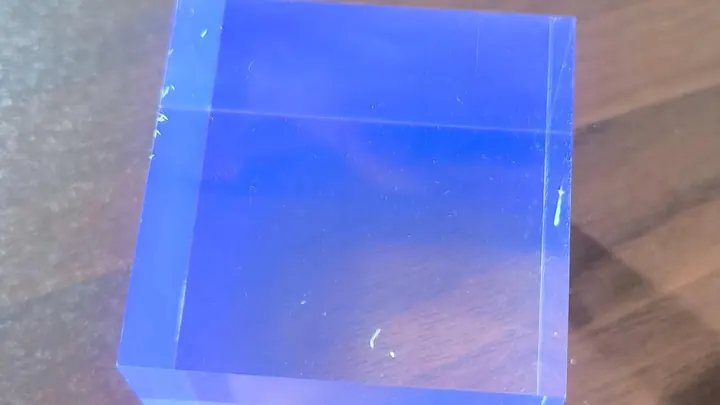
Neutrons leave no trace in ordinary glass: they pass right through, like light through a window pane. But some materials flash a faint burst of light when a particle hits them. That's how a scintillator works: a substance that turns invisible radiation into visible light.
The new transparent glass SG101 is one such material.
A firefighter with a thermal imager can see the source of a fire through smoke. But how do you see a radiation source that has no smell, no glow, and no heat? Gamma cameras solve this problem: they capture gamma rays emitted by radioactive materials and overlay their 'trace' onto a regular photograph. The result is an image showing that the source is, say, behind the far door.
A dense piece of plastic the size of a coin flashes when an invisible particle hits it. That's how scintillators work — materials that turn radiation into faint light. They're usually made from fragile crystals or expensive polymers. But now there's a simpler option: plain polyurethane, the stuff used to mold furniture foam and shoe soles.
In a field stands a tank of water that usually catches particles from space. Now it keeps an eye on how much moisture is in the soil underfoot. The water in the tank acts as a trap for neutrons — tiny particles that fly out of the soil when cosmic rays hit it. The drier the ground, the more neutrons escape, and the more often the tank registers them.
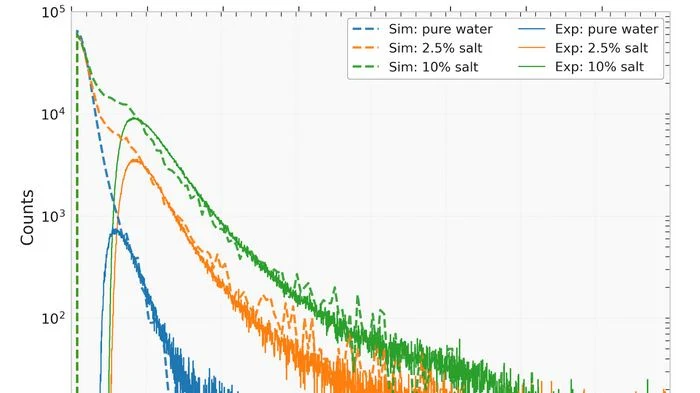
In a tank of pure water, particles traveling faster than light in that medium leave bluish flashes, like a plane breaking the sound barrier creates a sonic boom. From these flashes, you can tell what kind of visitor passed through: a gamma quantum or a neutron. This is no idle task: at borders and warehouses, you need to quickly distinguish a harmless radioactive cargo from weapon-usable material.
Deep inside a dying star eight times heavier than the Sun, a quiet fever begins a few days before the final explosion. The star's core contracts and heats up, releasing neutrinos — tiny particles that barely interact with matter. This stream is like a faint whisper before a loud cry: the supernova hasn't flashed yet, but it's already sending a signal of its imminent demise.
Light, regardless of its source, consists of photons — elementary particles, quanta of the electromagnetic field. The simplest light detector, such as a photometric illuminance meter, operates in a binary mode: it merely registers whether photons hit it or not, giving a 'yes/no' answer.
Inside a seven-meter spectrometer that looks like a tall column, fragments of a decayed neutron are born. To catch them, you need silicon wafers the size of a dining table and as thick as a finger.
Heavy water (the kind where ordinary hydrogen is replaced by its beefier cousin, deuterium) was subjected to an electric current. Palladium settled on the cathode, and in this modest electrochemical bath, detectors repeatedly caught something unexpected: traces of slow neutrons.
In the first moments after the Big Bang, space boiled. A superheated substance permeating the world gave rise to giant bubbles of a new phase – much like a liquid produces vapor. Collisions of these bubbles accelerated particles to energies unimaginable in Earthly accelerators.