Neutrinoflux is the rate at which neutrinos pass through a unit area per unit time, typically expressed in neutrinos per square centimeter per second. It quantifies how many of these nearly massless, weakly interacting particles stream from a source like the Sun, a supernova, or a nuclear reactor. Because neutrinos barely interact with matter, measuring their flux provides a direct probe of processes deep inside stars or the early universe that are otherwise invisible.
History
The neutrino was proposed by Wolfgang Pauli in 1930 and detected by Clyde Cowan and Frederick Reines in 1956. The first solar neutrinoflux measurement by Ray Davis (1960s-70s) revealed a deficit that led to the discovery of neutrino oscillations, earning a Nobel Prize in 2002.
How it works
Neutrinos are produced in nuclear reactions (e.g., fusion in the Sun) and travel almost unimpeded through space. To measure flux, detectors use large volumes of material — water, ice, or liquid scintillator — where a rare neutrino interaction creates a detectable signal, such as a flash of light (Cherenkov radiation) or a charged particle track. By counting events and accounting for detector efficiency and size, physicists infer the incoming flux. The low interaction probability means detectors must be enormous and shielded from background radiation.
About 100 billion solar neutrinos pass through every square centimeter of your body each second, yet you never feel a thing — they interact so weakly that only about one per lifetime would be absorbed.
Units by system: SI: per square meter per second · CGS: per square centimeter per second
The Sun is a giant nuclear reactor that continuously sends us light and heat. But it also has another, almost silent postal service: every second, tens of billions of neutrinos, ghostly particles born in the thermonuclear furnace, fly through a square centimeter of your palm. Most of them leave no trace.
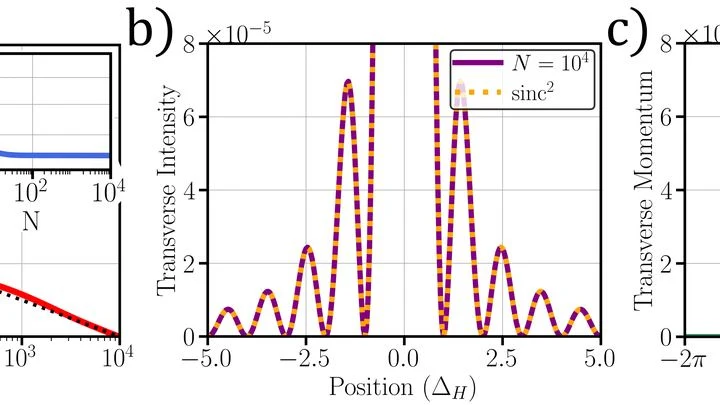
Imagine a packed dance floor where dancers glide without any friction — passing through each other without a touch. That's a superfluid. In a neutron star's crust, neutrons could behave this way, but a rigid lattice of ions gets in the way, like suddenly sticking the dance floor full of pillars.
The neutron is a particle with no electric charge, making it tricky to catch: it slips through instruments like a bullet through fog. In typical experiments, it gets just one pass through a crystal, and all measurements must fit into that instant.
A new idea is to make the neutron loop inside a trap, like a ball bouncing between two walls.
In 2017, the IceCube detector caught a neutrino from the distant galaxy TXS 0506+056. It was like hearing a phone ring from across the ocean: the signal came from where the most energetic particles in the Universe are born. At the same time as the neutrino, astronomers spotted a gamma-ray flare, and two to three years later, radio waves. Why was the radio late?
The dust around the young star CVSO 1942 flared up like a light bulb switched to full power. In 2024, the James Webb Space Telescope (JWST) peered into a transitional disk, a ring of gas and dust where planets are still being built, and saw that in mid-infrared light (wavelengths shorter than 10…
When an X-ray burst erupts on a neutron star, its atmosphere heats up to millions of degrees. The light we catch with telescopes passes through this dense layer of gas, and gets dramatically altered along the way. The spectrum no longer looks like that of an ideal radiator: some colors get amplified, others dim.
A magnetic compass in a test tube sounds like a magic trick, but it's pure physics. In a solution of fumarate (a salt of malic acid), carbon-13 nuclei behave like tiny spinning tops.