Memory from a Cesium Vapor express
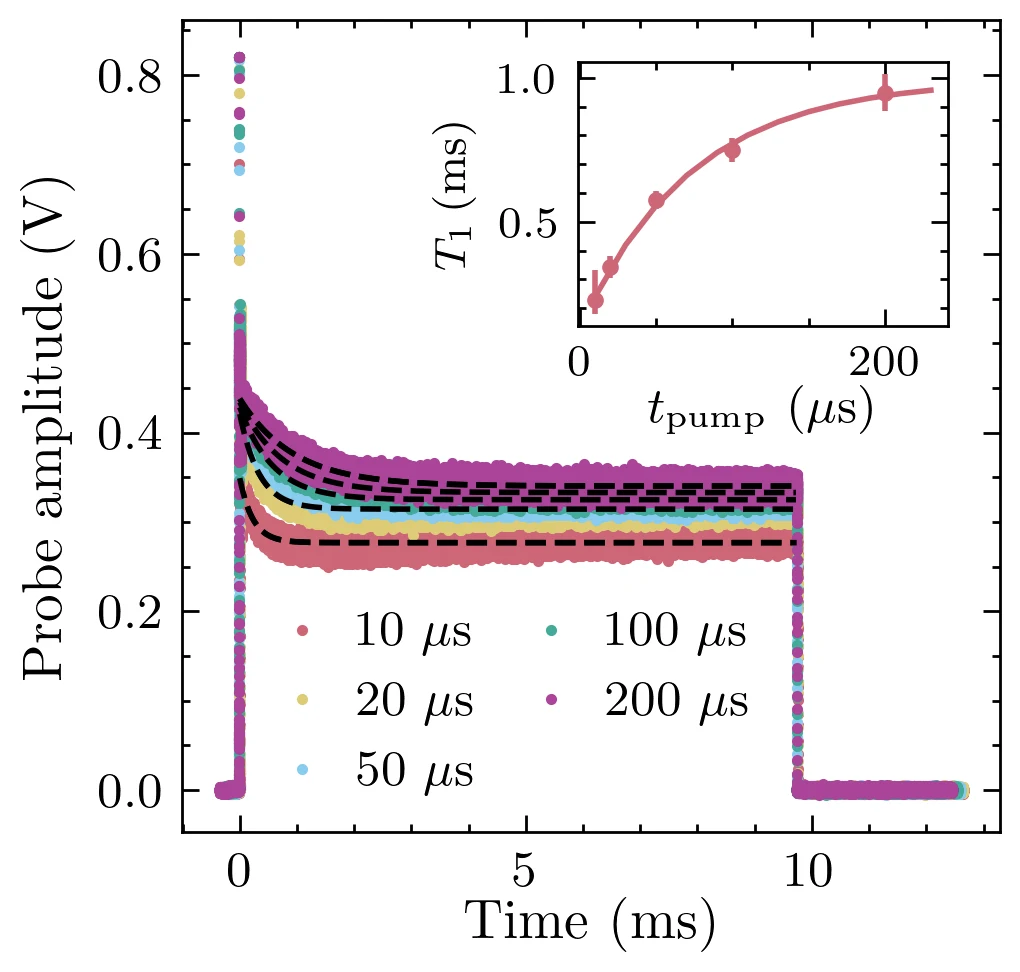
A beam of light enters a glass cell filled with cesium vapor and changes the internal state of the atoms: this is how information is recorded. A moment later, another beam reads it out by how the atoms absorb light. It's not a hard drive, but rather a notebook that turns its own pages.
Eight such "pages" are created by an acousto-optic deflector — a device that bends light with sound. Each page stores up to 3.8 bits. The whole setup works as a reservoir computer: data gets mixed in the atomic cloud, and the system finds patterns on its own. On the XOR test (the logical "exclusive or" operation), the computer made errors in only 2% of cases.
The main result is showing for the first time that optical memory from free atomic vapor can serve as the foundation for computing. Next steps are to speed up writing and extend data lifetime, so such a computer can handle long signals, like speech or video.
Original abstract
as written by the authors arXiv:2608.17807v1
We present an optical random access memory (ORAM) based on warm cesium (Cs) atomic vapor and demonstrate its operation as the physical substrate of a reservoir computer. Information is stored in the hyperfine population distribution of a Cs ensemble via optical pumping and retrieved through differential probe absorption. Spatial multiplexing via acousto-optic deflection provides eight addressable memory rails able to store up to 3.8 bits of information per rail. Employing this platform as a temporally multiplexed reservoir, we achieve a kernel rank ($$\mathrm{KR}= 8.8 \pm 0.4$$), and a minimum bit error rate of $$0.02 \pm 0.01$$ on the Exclusive-or (XOR) benchmark. We find the limited memory lifetime constrains the achievable temporal depth, encouraging further research into fast addressable memories. This constitutes the first demonstration of a free-space, optically writable atomic RAM as a substrate in an optical reservoir computing system.
Cesium is a metal that melts in your hand: its melting point is just 28.5°C. In the cell, it exists as vapor at room temperature.
In Greg Egan's novel "Permutation City," a mind is stored in a cloud of quantum states, an idea that echoes storing data in atomic vapor.