Rubidium vapor is a gas of rubidium atoms used in atomic physics as a sensitive medium for measuring temperature, magnetic fields, and light properties. When laser light passes through the vapor, rubidium atoms absorb specific wavelengths depending on their thermal motion and energy states. The resulting absorption spectrum acts as a precise thermometer, because the Doppler broadening of spectral lines directly reflects the velocity distribution of the atoms, which in turn depends on temperature. This makes rubidium vapor a standard tool for non-invasive temperature sensing in gases and for studying fundamental light-matter interactions.
History
Rubidium vapor spectroscopy dates back to the early 20th century, with the first detailed studies of rubidium's optical spectrum following its discovery in 1861. The modern use of rubidium in atomic clocks and laser cooling emerged in the 1980s, building on the development of tunable diode lasers.
How it works
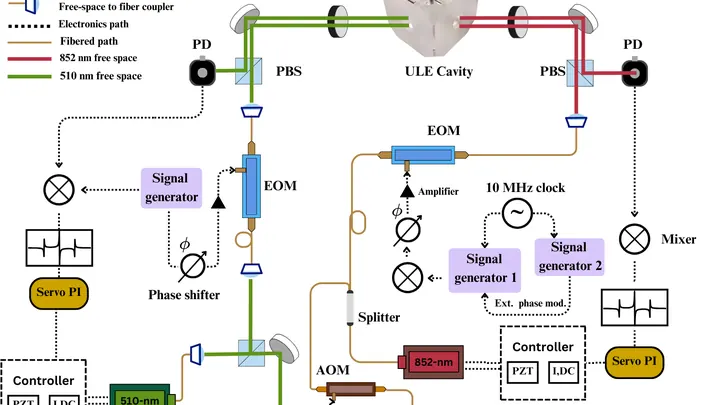
Rubidium atoms have a single valence electron, making their optical transitions strong and well understood. A laser tuned to a rubidium absorption line is sent through a cell containing the vapor. Atoms moving toward the laser see a blueshifted frequency and absorb at a slightly different wavelength than those moving away, creating a Doppler-broadened absorption profile. By measuring the width and shape of this profile, the temperature of the vapor can be deduced. In more advanced setups, the vapor is used in magneto-optical traps or as a medium for slowing light, where its narrow resonances enable precise control of photon propagation.
In practice
Rubidium vapor is used in atomic clocks, magnetometers, and as a medium for slow-light experiments; it also serves as a standard calibration source for laser frequencies and as a thermometer in gas-phase experiments.
Fun fact
Rubidium vapor is so sensitive to magnetic fields that it is used in magnetoencephalography to detect the faint magnetic fields produced by human brain activity.
Miners took canaries underground not for their songs. The bird would fall off its perch before the miner noticed carbon monoxide. In ultrahigh vacuum, the canary's role is played by a cloud of one hundred thousand lithium or rubidium atoms.
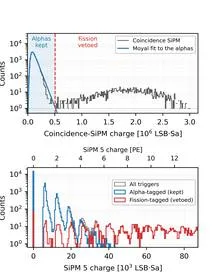
The stage is bathed in icy light, and on it stand silicon spectators. Each is an array of tiny avalanche diodes capable of spotting a single photon, but only if the surrounding temperature drops to 165 K.
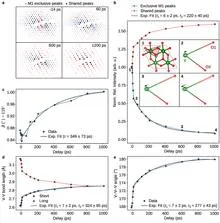
The camera captures not a race but a dance of atoms. In vanadium dioxide, the transition from an insulating to a metallic state occurs within trillionths of a second, yet until now no one had seen exactly how the vanadium and oxygen atoms move. Now, ultrafast electron diffraction has captured this route frame by frame.
In a Paris laboratory, light was made to flow around an obstacle the way water flows around a rock in a stream. But this water is special: it feels no friction.
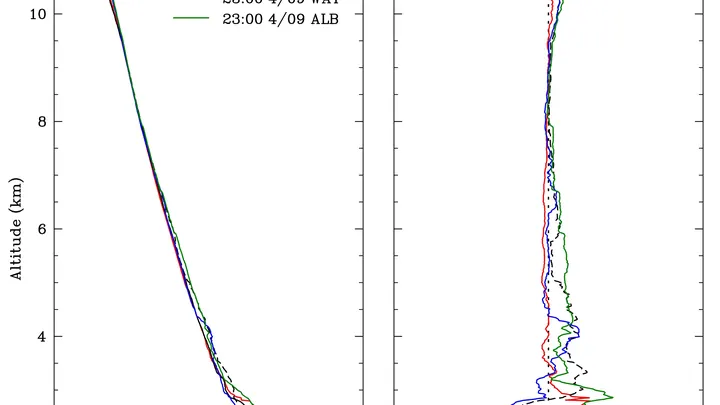
Every second, thousands of passenger aircraft in the sky transmit radio signals: that's how air traffic controllers track where each flight is. These signals don't travel in a straight line: air of varying humidity bends them like a lens. If you can measure that bending, you can work out where the air is drier and where it's more humid.
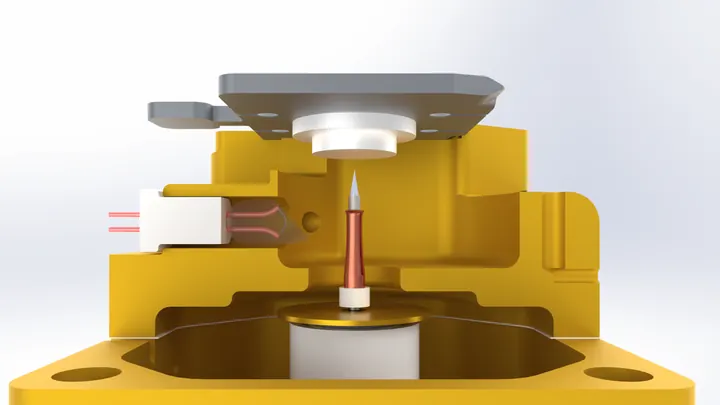
Inside a microscope that sees individual atoms, it's cold and silent: the temperature is around -268°C, and the interior is in perfect vacuum. To place individual iron atoms on such a stage, you usually need a direct 'corridor' from the evaporator to the sample. But in the coldest instruments, that corridor is blocked by thermal shields, making deposition a puzzle.
A beam of light enters a glass cell filled with cesium vapor and changes the internal state of the atoms: this is how information is recorded. A moment later, another beam reads it out by how the atoms absorb light. It's not a hard drive, but rather a notebook that turns its own pages.
Eight such "pages" are created by an acousto-optic deflector — a device that bends light with sound.
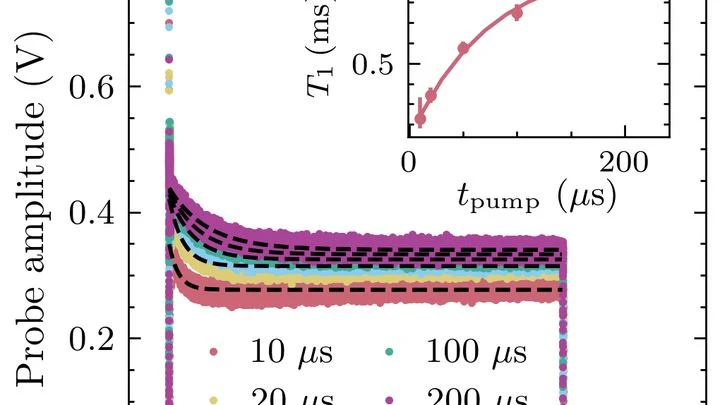
A laser beam passes through a glass cell filled with cesium vapor. The atoms in the vapor dart around chaotically, like a crowd at a train station: each one enters the beam, spends a moment there, and flies back out. Their internal state, something like the orientation of a tiny magnet, changes under the influence of light. If all atoms were identical and stationary, the signal would be steady.
A radio receiver the size of a palm can measure signal power more accurately than expensive lab benches. Inside, there are no coils or antennas, just a glass head and a cloud of rubidium atoms cooled to near absolute zero.
Radiation therapy is a precision strike on a tumor, but every shot must be calibrated to within a millimeter and a fraction of a second. The problem is that existing dosimeters are either bulky, or they distort the beam themselves, or they require pauses for readout.
In a room, air touches the skin, and we feel its temperature. But if your body suddenly accelerated at a colossal rate, heat would come even from absolute emptiness. This is not fiction but a strict consequence of quantum field theory: for an accelerating observer, the vacuum becomes a warm bath.
The vacuum is not as empty as it seems. If an observer moves with acceleration, the vacuum around them heats up: this was predicted by William Unruh back in the 1970s. The effect is akin to black hole radiation, but in flat space.
In a small Petri dish sits a droplet of liquid the size of a pinhead. An ordinary scanner wouldn't even notice it: the signal is too weak. But bring a tiny magnetic field sensor close to the droplet, and the picture changes.
Light from a bulb or even a regular laser resembles a crowd at a subway exit: people move haphazardly, sometimes dense, sometimes sparse. Physicists call this behavior shot noise — random fluctuations in the number of particles arriving per second.
A laser beam as faint as a whisper of light has stirred a thorium-229 nucleus into a higher energy state. Most nuclei demand a blast of energy, but thorium-229 has such a tiny energy gap that even this gentle nudge works.
An aluminum pot on the stove melts at 660 degrees Celsius — everyone knows that. But what happens if you heat aluminum a hundred times hotter? The liquid starts to boil, and here's the puzzle: at what exact temperature does that happen?
A red-hot piece of metal in a furnace is like a frying pan on the stove: the hotter it gets, the faster heat travels to your hand if you touch it. But at temperatures where the metal is close to melting, measuring that speed is very tricky: sensors don't make good contact, heat escapes into the air, and the glowing sample confuses the instruments.
This new method sidesteps those obstacles.
An ordinary aluminum pot on a stove doesn't emit molecules you can catch with light. But if you take aluminum and an aluminum salt, heat them together in a small oven, you get a stream of aluminum fluoride molecules, like steam from a kettle's spout, except instead of water droplets, tiny particles fly out.
An ordinary antenna picks up radio waves, but there are fields it barely feels. We're talking about slow electric fields: those that change once a second or less. For them, physicists built a sensor from a beam of rubidium atoms.
Dark matter is an invisible mass holding galaxies together. Its nature remains unknown, but one likely candidate is the axion — an ultra-light particle that barely interacts with matter. To catch it, physicists built a hybrid trap.
Inside a glass capsule the size of a pea, rubidium atoms float. A laser beam puts them into a special state — Rydberg — where the electron flies far from the nucleus, making the atom extraordinarily sensitive to external fields.
Radio waves that oscillate less than once per second pass through the earth and water with almost no loss. Such signals are used to communicate with submarines and to search for minerals. But a conventional antenna for them would need to be hundreds of meters long, and its sensitivity leaves much to be desired.
Gas is nearly invisible, but it has a temperature, and you can read it from how the gas 'shadows' the thermal background. In the experiment, a camera looks at a warm screen through a jet of carbon dioxide. If the gas is cooler than the background, it appears as a dark spot; if warmer, it appears bright.
In a sealed glass bulb the size of a finger, metallic vapor boils. The main component is cesium, but one percent rubidium hides within. A laser beam at 795 nanometers finds this impurity and makes it glow.
Rubidium alone would give a weak signal: atoms quickly fly through the beam.
At 0.1 K, just three-tenths of a degree above absolute zero, matter stops following the usual rules. Helium becomes superfluid: it flows without friction, seeps through cracks, and behaves like one giant quantum liquid. Seeing what happens inside such cold is a challenge at the edge of possibility.
When a planet passes in front of its star, some starlight filters through its atmosphere. Gases in the atmosphere block certain colors and let others through, like the colored glass of a stained-glass window. By seeing which colors are dimmed, you can figure out what the air of a distant world is made of.
An ordinary comb parts hair into even strands. A laser 'comb' does the same to light: it emits not one color but thousands, spaced at exactly equal frequency steps. Such a tool has already helped measure time to billionths of a second and peer inside atoms.
Two laser beams cross at a tiny angle, and an invisible lattice appears in a cloud of rubidium atoms: some atoms are excited, others are not. Then this lattice begins to melt, like a pattern in the sand under the wind. Atoms collide with surrounding gas molecules and drift apart.
The speed of this blurring depends directly on the surrounding gas.
A cage of sixty carbon atoms, shaped like a soccer ball, lets small molecules slip inside. Carbon buckyballs, fullerenes, pack into a crystal like oranges in a crate, leaving gaps between them. At 570 degrees Celsius and 30 atmospheres of pressure, hydrogen seeped into those gaps.
A distant red object usually means one thing: we're seeing a dust veil over a scorching disk falling into a black hole. But when the James Webb split its light into shades, a shadow appeared inside — just like steam from boiling water intercepts rays.
A tiny vanadium oxide particle behaves like a window with adjustable transparency: in one state it lets infrared light through, and in another it starts absorbing it. The switch doesn't happen abruptly but smoothly, like turning a dimmer knob to adjust a lamp's brightness.
A thermometer that doesn't lie for years. Ordinary resistance thermometers, even very accurate ones, start to err over time: the material ages, contacts oxidize, and readings drift. The new quantum thermometer works differently: it uses the rubidium atoms themselves as a reference.
Light from an ordinary lamp is chaos: photons scatter in all directions with no order. But if you make many atoms emit light simultaneously and in sync, you get a short, powerful flash, like applause that turns individual claps into a single burst. Such coordinated emission is called superradiance.
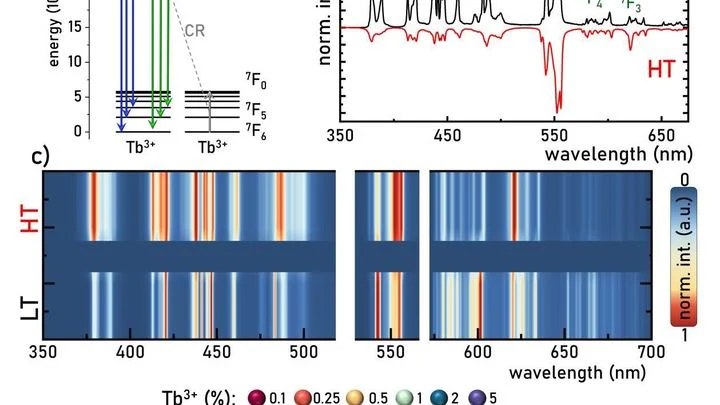
A piece of material glows blue. Heat it up, and the glow turns green, as if someone flipped a switch at a traffic light. That's how the new luminescent thermometer described in the paper works.
Inside the material are terbium ions — a rare-earth metal that knows how to shine. At room temperature, they emit blue light.
A laser beam passes through a glass cell containing rubidium vapor, and by how the atoms absorb light, you can determine their temperature. This is like measuring the speed of cars by the blur in a photograph: the faster the atoms move, the wider the absorption line becomes.
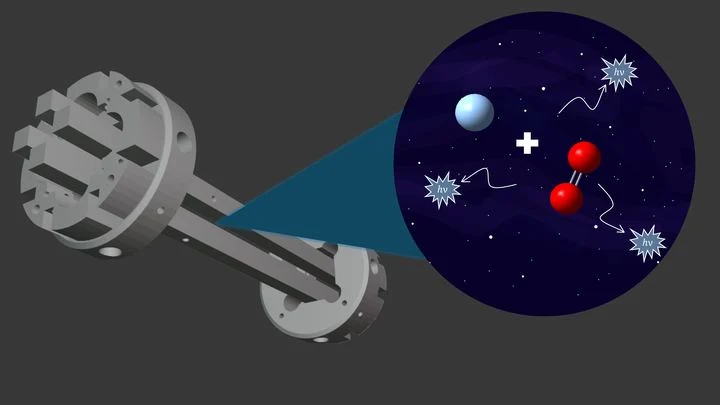
In the cold, sparse clouds of space, particles rarely meet, but sometimes an ion and a neutral molecule pass close enough to stick together. As they do, they emit light, like a muted flash carrying away excess energy. This process is called radiative association, and it is responsible for the formation of many molecules in interstellar space.
Any device, from a toaster to a smartphone, heats up when operating. This is the inevitable result of energy conversion — there's always a heat trace left, like a hot stove burner after cooking.