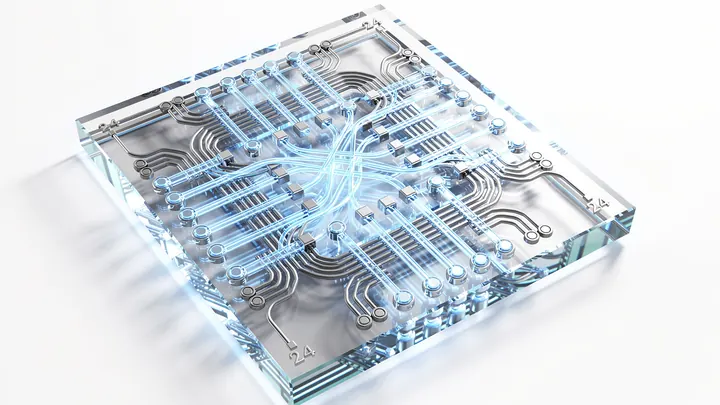
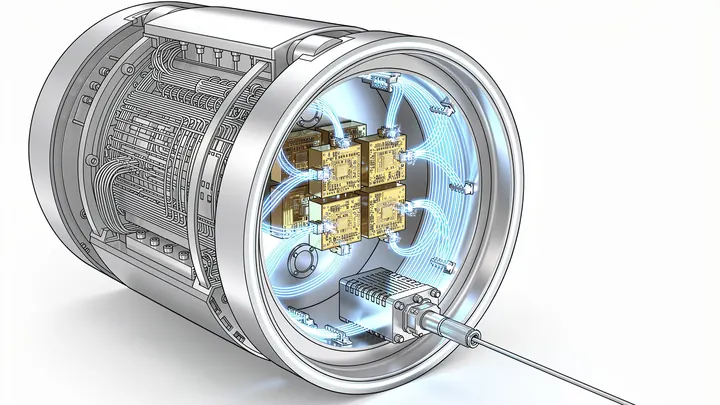
An optical computer is a hypothetical computing device that uses photons for data processing instead of electrons. The idea is to exploit the speed and parallelism of light to overcome the limitations of electronic circuits, such as heat generation and signal degradation. Optical computing could enable faster data transmission and processing, especially in tasks like image recognition and neural networks, where many operations can be performed simultaneously.
History
The concept dates back to the 1960s, but practical implementations have been limited by the difficulty of making compact, efficient optical components. Recent advances in photonic integrated circuits and metasurfaces have revived interest.
How it works
In an optical computer, information is encoded in light beams, and operations are performed using optical elements like lenses, mirrors, and interferometers. Logic gates can be implemented using nonlinear optical materials, where the intensity of one light beam controls the transmission of another. Alternatively, machine learning can be implemented directly in optical systems, where the weights of a neural network are encoded in the transmission properties of a photonic chip.
In practice
Optical computing is being explored for high-speed data processing in data centers, as well as for specialized tasks like matrix multiplication and neural network inference, where it can outperform electronic processors in speed and energy efficiency.
Fun fact
In 2021, a team demonstrated an optical neural network that could recognize handwritten digits with an accuracy comparable to electronic systems, but at the speed of light.
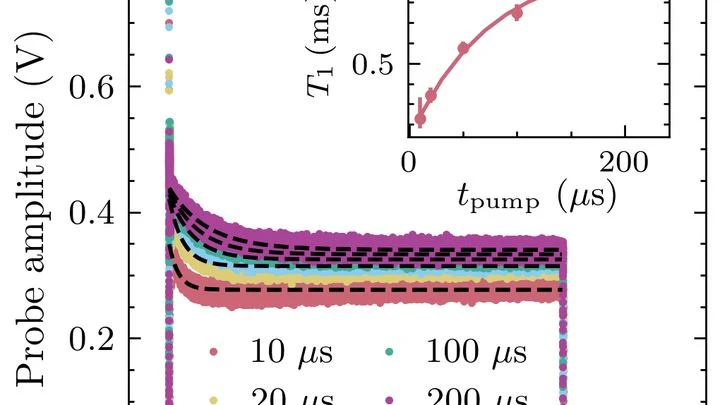
A librarian in a rare-book archive takes a volume from the shelf and puts it back without waking the cat dozing nearby. That is roughly how the new quantum memory works: it catches a photon, tucks it into the mechanical vibration of a tiny silicon bridge, and returns it on request.
A radio telescope with thousands of antennas is like a giant ear that hears the whole sky at once. But an ear cannot draw a picture: signals from every pair of antennas must be multiplied, and in an array of ten thousand elements there are already fifty million pairs. A classical correlator does exactly that, and its complexity grows as the square of the number of antennas.
A beam of light enters a glass cell filled with cesium vapor and changes the internal state of the atoms: this is how information is recorded. A moment later, another beam reads it out by how the atoms absorb light. It's not a hard drive, but rather a notebook that turns its own pages.
Eight such "pages" are created by an acousto-optic deflector — a device that bends light with sound.
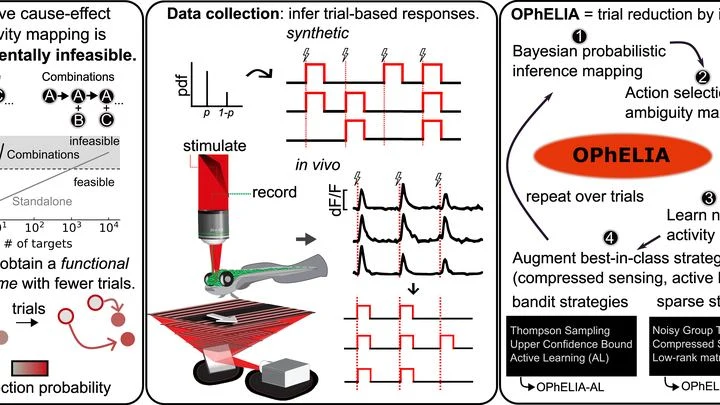
To understand how the brain works, you need a detailed map of neuron connections — the so-called connectome. The traditional approach is like trying to figure out a huge garden irrigation system by opening each tap one by one and watching where the water flows.
Tomographs don't produce ready-made pictures. They collect numerous 'shadows' — projections of innards from different angles or using various signals — and mathematically reconstruct a 3D picture from them.
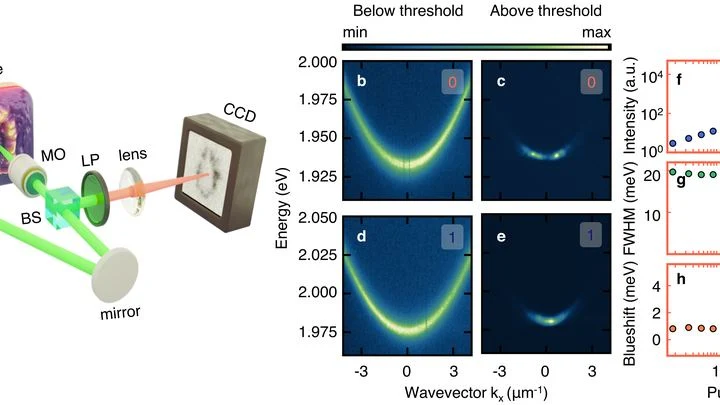
Generative neural networks that create images typically rely on digital randomness. But a team of researchers built a system where randomness is born not in code, but in a tiny optical cavity filled with an organic dye.
An ordinary field-effect transistor is like a faucet with a very sensitive handle: turn it slightly, and water flows. In the cold depths of a quantum computer, where everything is chilled to near absolute zero, such a faucet must open strictly on command.
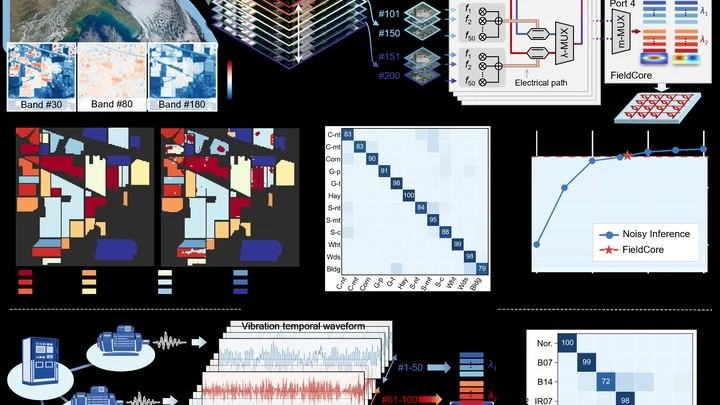
A typical computer shuttles electricity along copper traces, and every operation is a queue: first one thing, then another. Light works differently. In a single beam, you can mix dozens of signals without them interfering, like different voices in a choir, singing at once but each heard distinctly.
The new FieldCore chip uses five such "voices" at once.
An ordinary flash drive stores bits in electron traps, but you can only read them through a separate wire and amplifier. In the new development, the same piece of the semimetal tellurium plays both the role of storage and the light bulb.
An ordinary camera captures light reflected from objects and builds a picture from it. But if the object is hidden behind an obstacle or does not reflect light, radio waves come to the rescue: they pass through walls and fog, and a computer reconstructs the image from scattered signals.
An ordinary lens always refracts light the same way. Its properties are frozen in glass forever. But now there's a surface that changes the game on the fly.
Scientists made an ultrathin film with resonant elements and infused it with liquid crystals — the same stuff used in phone screens.
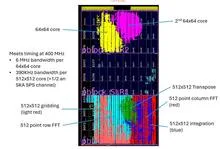
A quantum computer holds atoms in light traps, like marbles in dimples. To read out the answer, you need to photograph each atom and determine whether it's glowing or not. Previously, analyzing such an image took so long that the computer sat idle. Now, engineers have created a specialized board that looks at the photo and instantly finds all the atoms.
Physical systems can compute. If you build a landscape of hills and valleys so that the lowest point corresponds to the answer, the system will roll there by itself, like a ball. The problem is that the bottom is often flat, and the ball crawls around for a long time before settling.
The authors propose nudging the ball to the right place before it even starts.
To understand a mechanism, you have to poke it. A child taking apart an alarm clock doesn't just stare at the gears: they turn the wheel and listen to how the ticking changes. Scientists do the same: instead of passive observation, they feed specially chosen signals into the system and watch the response.
A chef tastes the soup after every pinch of salt and instantly decides what to add next. That's roughly how the new setup for growing thin crystalline films works — except instead of taste, it uses an image from an electron microscope, and instead of a chef, a computer program.
Light passing through ripples on a water surface paints dancing patterns on the bottom of a pool. Engineers have used a similar idea to make light compute. They fabricated a tiny plate with a wavy relief: each ridge and groove deflects rays in its own way. When an image falls on such a surface, the light transmitted through it converges at different points behind it.
Light passing through a lens bends slightly. For an optical computer, this is like a warped mirror for an artist: the image is there, but the details blur. An Ising machine using light beams tackles problems like packing luggage or planning a courier's route.
Light races through a maze of mirrors and beam splitters, but at the end of its journey, it doesn't just flash on a detector: it transforms itself. In the new photonic computer, nonlinear modules have been added to the familiar linear circuits, and now light can perform any quantum operation, not just a subset.
Light from an ordinary bulb is a stream of individual photons, like drops from a faucet. But there is also light where photons come in pairs, like twins walking together. Such grouped light has long been desired for measuring distances and imaging objects hidden around corners. But sources of this light were either too dim, or their flashes too short for ordinary detectors to catch.
Inside every cell, chemical reactions are constantly underway, like a tiny kitchen where protein chefs whip up essential compounds. But seeing exactly how a chef prepares a dish is tricky when you're surrounded by a crowd of other molecules.
Cells breathe. They need oxygen, and they take it from the blood flowing through the tiniest vessels. If blood flow is weak or oxygen is scarce, cells start to suffocate. Doctors need to see this as early as possible. But how do you look inside living tissue without cutting it open?
The new device does it in two ways at once.
A light pulse in an optical fiber is like a starter's pistol shot: short, sharp, and unmistakable against the silence. It is exactly such pulses that the new artificial neuron, built on a silicon chip, produces.
A laser pointer shines a neat spot: all its light waves march in step, like soldiers on parade. Such light is called coherent. But nature and technology also feature another kind of light—'messy' light, where waves are out of sync, like a crowd at a market. It's called partially coherent.
A conventional computer sees the world flat: numbers are just points on a line. But a color image or a 3D scene demands more — four numbers that describe both position and rotation. Such quadruples are called quaternions, and until now electronics handled them clumsily, breaking them apart and reassembling them.
The new chip changes the approach.
A massive refrigerator the size of a wardrobe hums, maintaining an interior colder than outer space. At its heart lies a silicon chip with tiny superconducting loops — qubits. But to make the chip work, dozens of thick copper cables snake from room temperature down to it.
In a dark room, a resonator catches light the way a spiderweb catches dew drops. A laser pulse bursts in, and the mechanical membrane starts to vibrate in sync, leaving a trace in the very fabric of the system. That is how memory is born: not in a silicon cell, but in the dance of photons and phonons.
A superconducting quantum processor is like a microscopic metropolis locked in a cryogenic fridge: streets of superconducting lines, blocks of qubits. Each resident demands silence and cold, but expanding the city inside a single cryostat is like stacking skyscrapers in a cramped courtyard — wires heat the environment, noise builds up, coherence threatens to collapse.
A single quantum processor is like a solo musician. It can play a simple tune, but a symphony requires an orchestra. To solve problems that demand enormous computational power, processors must be networked.