A magneto-optical trap (MOT) is the workhorse of cold-atom physics: a device that uses intersecting laser beams and a spatially varying magnetic field to slow down, cool, and confine neutral atoms, bringing them to temperatures just millionths of a degree above absolute zero. It is the starting point for nearly every experiment that needs a dense cloud of ultracold atoms — from atomic clocks and quantum simulators to studies of Bose-Einstein condensates. The MOT combines two effects: Doppler cooling, where atoms absorb photons from counter-propagating laser beams and lose momentum, and a magnetic field gradient that creates a position-dependent force, trapping the atoms at the center.
History
The magneto-optical trap was first demonstrated in 1987 by Steven Chu and colleagues at Bell Labs, building on earlier work in laser cooling by William Phillips and Claude Cohen-Tannoudji. The three shared the 1997 Nobel Prize in Physics for their contributions.
How it works
The trap uses three pairs of counter-propagating laser beams, each slightly red-detuned from an atomic transition. Because of the Zeeman effect, the magnetic field shifts the atomic energy levels, so atoms moving away from the center absorb more photons from the beam pushing them back. This creates a restoring force that both cools (via Doppler effect) and confines the atoms. The result is a glowing ball of cold atoms, often visible to the naked eye, that can be further manipulated — for example, loaded into optical lattices or magnetic traps.
In practice
MOTs are used to prepare ultracold atomic samples for atomic clocks, quantum computing platforms, and precision measurements, and they are essential for creating Bose-Einstein condensates.
Fun fact
A MOT can cool atoms to temperatures lower than the surface of the Sun is hot — about 10 microkelvin, or 10 millionths of a degree above absolute zero.
Inside a microscope that sees individual atoms, it's cold and silent: the temperature is around -268°C, and the interior is in perfect vacuum. To place individual iron atoms on such a stage, you usually need a direct 'corridor' from the evaporator to the sample. But in the coldest instruments, that corridor is blocked by thermal shields, making deposition a puzzle.
A beam of light enters a glass cell filled with cesium vapor and changes the internal state of the atoms: this is how information is recorded. A moment later, another beam reads it out by how the atoms absorb light. It's not a hard drive, but rather a notebook that turns its own pages.
Eight such "pages" are created by an acousto-optic deflector — a device that bends light with sound.
Earth's magnetic field is not constant: it trembles from the solar wind, from distant thunderstorms, and from the subway running nearby. To notice these tremors, you need an instrument that doesn't tremble itself. Physicists have built such an instrument from ytterbium atoms cooled to nearly absolute zero.
A magnetic top that doesn't fall. A tiny sphere of yttrium iron garnet hovers in midair, held by invisible forces. This isn't a magic trick but a Paul trap — an alternating magnetic field that rapidly changes direction and keeps the sphere from falling, like a juggler tossing balls.
The sphere trembles but doesn't fall.
A radio receiver the size of a palm can measure signal power more accurately than expensive lab benches. Inside, there are no coils or antennas, just a glass head and a cloud of rubidium atoms cooled to near absolute zero.
A laser beam can do more than heat things up: it can also calm motion. When light enters a mirror trap, it exerts pressure on the mirrors, and if you tune the beam's color just right, that pressure becomes a gentle braking force. This is how tiny mechanical vibrations are cooled to nearly absolute zero.
Catching a single molecule in a beam of light and nearly stopping its motion is like trying to hold a dandelion fluff in a gust of wind. A particle that's too hot slips out of the trap, so physicists first tame its thermal jitters with laser cooling.
The authors applied a technique called Sisyphus cooling to strontium hydroxide (SrOH) molecules.
Light flows like an invisible river. If you place an obstacle in the stream, the water whirls into eddies. Likewise, specially designed surfaces create light 'whirlpools' that catch nanoparticles like wood chips.
Throw a ball almost parallel to a wall — it will slide along it before bouncing off. The same happens with a light beam: when reflected at a shallow angle, it shifts by microns. This Goos–Hänchen shift was long considered a mere amusing paradox.
A tiny magnet levitates in a magnetic trap, like a weightless needle. Its magnetized axis is like a stubborn compass needle that is prevented from turning. An invisible wall rises before it. But in the quantum world, particles can seep through barriers — this trick is called tunneling.
Sugar dissolves in tea, and then with a single motion gathers back into the spoon. In an ordinary kitchen, you won't see that — viscosity and disorder get in the way. But in the world of ultra-slow motions, where inertia vanishes, such tricks become reality.
A typical atom trap works like a funnel: laser light and a magnetic field slow atoms down and gather them at the center. But the funnel has a limit: it only catches atoms moving within a certain speed range.
In a thin nickel oxide film, magnetic regions are arranged in strict order like mosaic pieces. A single laser pulse instantly heats the material, and the mosaic falls apart: domains lose their orientation and mix.
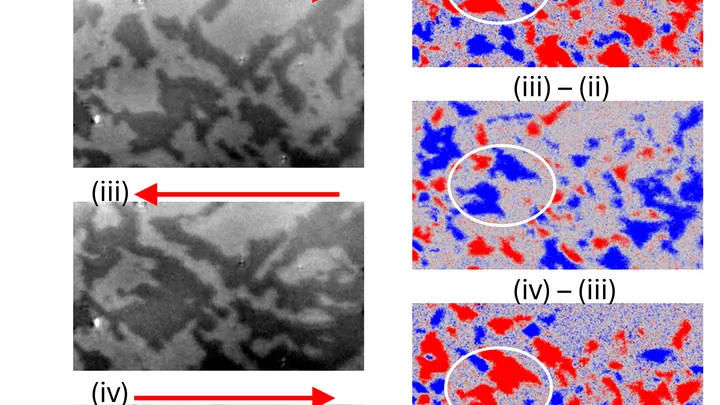
A lithium cobalt phosphate crystal resembles a chessboard, where the black and white squares are regions with opposite directions of the magnetic moments of cobalt ions. These regions are called antiferromagnetic domains, and until now they have been hard to see: conventional methods required complex equipment or damaged the sample.
Ultracold molecules are a promising material for quantum computing, but assembling them into a neat array, like eggs in a carton, is no easy feat. A method has been proposed to load molecules one by one into optical tweezers or lattices directly from a gas. The molecules immediately end up in the calmest state of motion.
A single antiproton, trapped and cooled to near absolute zero, behaves like a tuning fork that needs a very precise strike to produce a clean note. Catching that 'note' directly is nearly impossible — the signal is too weak.
A tiny cloud of 300,000 ytterbium atoms, cooled to near absolute zero, was shuttled along a light track 34 centimeters long, like transporting a fragile cargo over a bumpy road without shaking it apart.
An ordinary lamp won't make an atom glow: it's too weak. But if you slow atoms down to nearly a standstill, even a tiny stream of photons, like rare drops from a pipette, can make them respond with a bright flash.
Light and matter in the tiny world obey laws that are hard to compute even on a supercomputer. Physicists build special "quantum simulators"—setups where cold atoms play the roles of particles and fields. But until now, such simulators could only depict the field in its simplest form: as if it were either present or absent.
A calcium ion in a magnetic trap resembles a tiny ball that constantly trembles from heat. To make it freeze, physicists usually hit it with lasers from several sides. But in the new experiment, a single beam aimed along the trap's axis sufficed.
First, the ion is cooled the usual way — the laser slightly slows its motion, like a headwind slowing a runner.
A grain-of-sand-sized device: a tiny mirror-dish holds a single rubidium atom and collects the glow it emits under a laser beam. The trapped light particles are sent into an optical fiber — the whole setup is precise and stays aligned even when shaken.
A laser beam usually looks like a straight column of light. But if you pass it through a wafer with a pattern thinner than a hair, the beam scatters into thousands of tiny pockets of light. In each pocket, you can suspend a single atom, like a pea in a dimple.
Think of a reliable container instead of a fragile test tube: that's the shift from trapping chemically reactive radicals to holding stable molecules. Until now, magneto-optical traps have only worked with particles that are eager to react at the first collision.
Think of a reliable container instead of a fragile test tube: that's the shift from trapping chemically reactive radicals to holding stable molecules. Until now, magneto-optical traps have only worked with particles that are eager to react at the first collision.
In a dark room, a laser beam draws a bright spot on the wall. Light seems warm and uncontrollable, but for three decades physicists have used it as a conductor's baton, making atoms dance in unison.