A quantummemorycrystal is a crystalline material engineered to store quantum information, typically in the form of qubits. Unlike classical memory, which stores bits as 0s or 1s, quantum memory must preserve the delicate superposition states of qubits, which are easily destroyed by interactions with the environment. Crystals offer a promising platform because they can host 'defects'—specific atomic-scale imperfections—that can trap and isolate quantum states. These defects, such as nitrogen-vacancy centers in diamond, can absorb, store, and release photons carrying quantum information, acting as a quantum buffer or memory.
History
The idea of using solid-state defects for quantummemory gained traction in the early 2000s, with significant experimental breakthroughs in diamond nitrogen-vacancy centers around 2008-2010. The field has since expanded to other crystals like silicon carbide and rare-earth-doped crystals.
How it works
The crystal lattice provides a rigid, stable environment that protects the quantum state from thermal vibrations and other disturbances. A defect center, like a nitrogen atom next to a vacancy in diamond, has an electronic spin that can be used as a qubit. When a photon with the right frequency hits the defect, it excites the spin, transferring the photon's quantum state (e.g., its polarization) into the spin state. The spin can hold this information for a certain 'coherence time' before it decays. To read out the memory, a laser pulse is applied, causing the defect to emit a photon whose state is correlated with the stored spin state, thus transferring the quantum information back to light.
A beam of light enters a glass cell filled with cesium vapor and changes the internal state of the atoms: this is how information is recorded. A moment later, another beam reads it out by how the atoms absorb light. It's not a hard drive, but rather a notebook that turns its own pages.
Eight such "pages" are created by an acousto-optic deflector — a device that bends light with sound.
Building a quantum network node is like teaching a dancer to balance on a carbon thread over an abyss. One leg must spring lightly from the wire, hurling photon-messengers into the external world. The other must grip the rope tightly, guarding precious quantum information.
In diamond quantum devices, there's a tiny defect — the nitrogen-vacancy center (a nitrogen atom plus a vacancy where a carbon atom should be). It acts as a switch that spontaneously flips back and forth: it can carry an extra electron or not, and this determines whether it emits light or not.
An ordinary flash drive in your pocket gets warm even when it's just sitting there. Now imagine memory that, in the cold, uses almost nothing, like a thermos that never cools down. A superconductor carries current without loss at liquid-helium temperatures, but it couldn't store data. The new cell changes that.
A spinning top, set in motion on a perfect surface, topples from the slightest tremor. Likewise, a quantum bit, created at a defect in a diamond, has its state destroyed by magnetic disorder from impurities and external interference.
For the quantum internet, we need to learn how to hold light — much like mail is sorted at intermediate nodes. The technology is based on a thin crystal plate doped with europium ions, a rare-earth element that, incidentally, is responsible for the red glow of smartphone screens.
Six barium ions lined up in a flat hexagon inside a Paul trap, a device that holds charged particles with oscillating electric fields. But a slight change in the shape of the trapping potential made the crystal rearrange: one ion moved to the center, and the other five formed a ring around it.
A quantum computer is like an orchestra where strings and brass play in different languages. Superconducting processors operate with microwave photons in centimeter-scale circuits, while spin qubits, such as nitrogen-vacancy centers, store…
Inside a diamond, you sometimes find tiny flaws — a spot where a carbon atom is replaced by nitrogen, with a vacancy right next to it. Physicists call this an NV center (a nitrogen-vacancy defect). Such a defect acts like a magnetic needle that can store information in its spin.
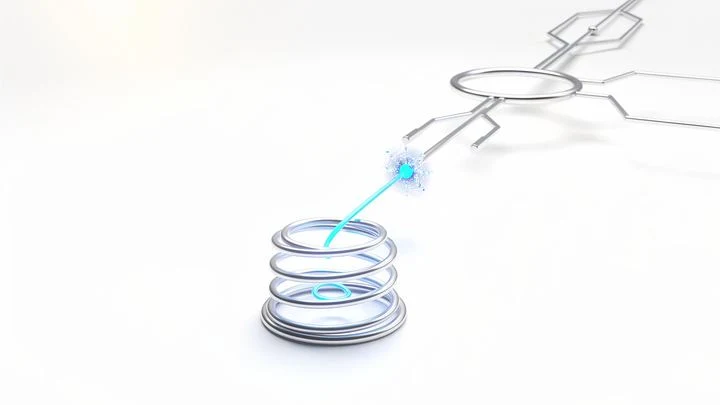
A tiny diamond with defects, nitrogen atoms that replaced carbon, hides an unusual feature. Around each defect, an extra electron spins like a top that can be tilted by radio pulses. On its own, this top is too quiet to reach a superconducting qubit — an artificial atom operating at temperatures colder than outer space.
A superconducting qubit, a tiny loop with zero resistance, crunches problems faster than you can blink. But cut the power, and everything it has calculated vanishes. Like a chef who cooks without writing down the recipe: as long as he's at the stove, he remembers every step, but an hour later — nothing.
The authors of the study propose writing the result into diamond.