Computationalpower is the rate at which a system can perform operations, typically measured in operations per second or, for quantum systems, in the number of qubits and the fidelity of their manipulation. It determines how quickly a computer can solve a problem, from simulating molecules to sorting massive datasets. In the context of quantum computing, computational power is not just about raw qubit count — it also depends on error rates, connectivity, and the ability to maintain coherence long enough to complete a calculation.
History
The concept of computationalpower as a measurable quantity dates back to the early days of computing, with Turing's theoretical model and later benchmarks like FLOPS. Quantum computational power was formalized in the 1980s–90s by Feynman and Deutsch, who proposed that quantum systems could simulate physics more efficiently than classical ones.
How it works
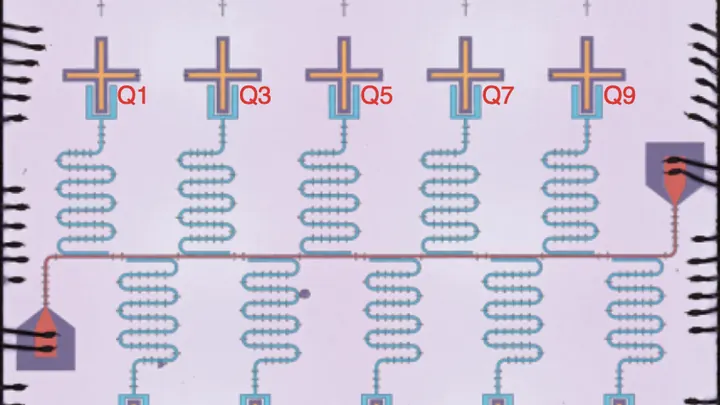
Classical computers scale computationalpower by adding more transistors and increasing clock speed. Quantum computers, however, rely on qubits that can exist in superpositions and become entangled, allowing them to explore many states simultaneously. But this power is fragile: errors from decoherence and imperfect gates can destroy a calculation. Recent research focuses on error correction and mitigation — for example, redistributing errors or using photonic chips to reduce noise — so that the theoretical advantage of quantum parallelism becomes practically usable.
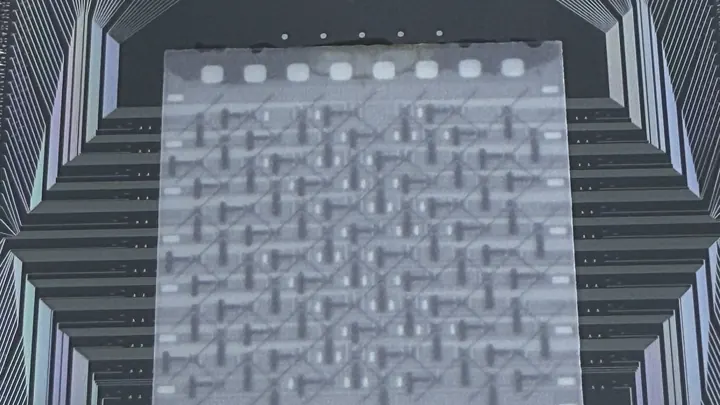
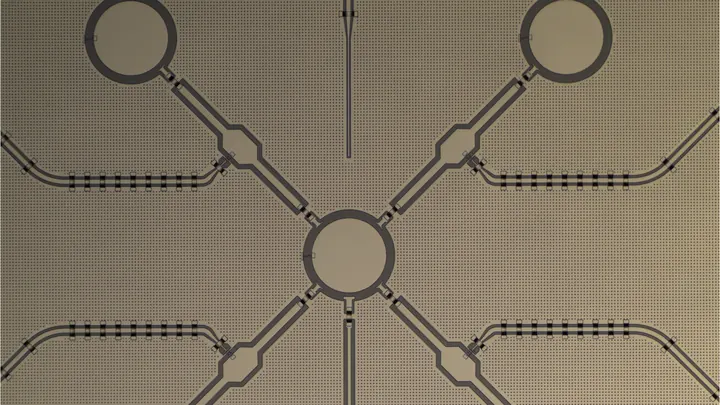
A 60-qubit quantum processor can sort arrays of data using a fundamentally different algorithm than any classical computer, exploiting superposition to evaluate many orderings at once.
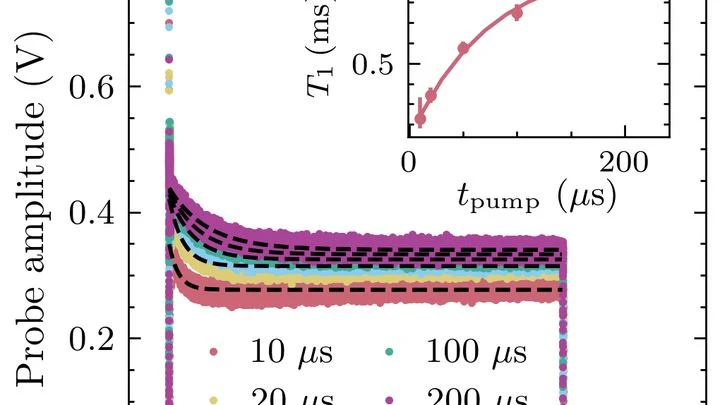
A beam of light enters a glass cell filled with cesium vapor and changes the internal state of the atoms: this is how information is recorded. A moment later, another beam reads it out by how the atoms absorb light. It's not a hard drive, but rather a notebook that turns its own pages.
Eight such "pages" are created by an acousto-optic deflector — a device that bends light with sound.
In 1996, physicists asked: how much noise can a quantum channel withstand before it stops transmitting information? A phone call where every third word is replaced by random noise is still understandable. Up to what level of interference can the listener still grasp the meaning?
A cup of hot coffee sometimes freezes faster than cold tap water. This paradox, known as the Mpemba effect, has long been considered a curiosity of classical physics. Now its quantum counterpart has helped test and tune quantum processors — devices that may one day power supercomputers.
A quantum computer is like an orchestra where each musician-qubit easily loses the rhythm. The slightest noise, and the melody of computation turns into cacophony. To keep the orchestra playing in harmony, you need a conductor who instantly spots wrong notes and corrects them without stopping the performance.
One hundred milliseconds. In that time, after a lightning strike or a short circuit, the power system either returns to normal operation or loses stability. A new-generation Neural Network Oscillations learns to sense this moment, like an experienced tightrope walker anticipating a gust of wind.
A quantum computer is like an orchestra where every musician must hit their note exactly. If one plays off-key, the melody falls apart. The musicians here are qubits, storing information.
The classical neuron is a chamber musician, drawing only one note from each string: it takes a weighted sum of inputs, adds a bias, and passes it through a nonlinearity.
Quantum computing suffers from 'false notes' — errors that arise from the slightest inaccuracy. Now they are eliminated with the precision of tuning a concert grand piano. The idea traces back to the dreams of pioneers — David Deutsch and Peter Shor — of flawless operations.
Tuning a quantum processor is monotonous work: you need to calibrate each qubit — a quantum cell — much like a watchmaker adjusting dozens of tiny gears. Humans get tired and make mistakes.
Two pendulums hang from the same crossbar. A push, and they start swinging, gradually falling into and out of sync. In a topological qubit, Majorana particles, special excitations that can store quantum information, play the role of these pendulums.
An invisible trap made of laser light held 11,000 atoms — a record for quantum engineering. Previously, physicists wrestled with a few dozen of these particles; now the count runs into the thousands. Each atom becomes a qubit — a quantum bit that is both zero and one at once, like a spinning coin balanced on its edge.
Molecules float in a test tube. Their abundance (say, the concentration of some protein) becomes the input signal. And the output isn't just a cloudy solution but a clear yes-or-no answer.
The authors build a chemical cascade that does exactly that.
Before assembling a huge puzzle, you need to stamp out the pieces — otherwise the picture won't come together. In fusion-based quantum computers, the role of such pieces is played by tiny clumps of light — photonic resource states. They are collided and measured to gradually grow the computational fabric.
In the kitchen, the sequence of actions is strictly dictated by the recipe: first chop, then fry, and nothing else. In quantum physics, the role of the recipe is played by causality — one event causes another, and they cannot be swapped. But in recent years, theorists have devised clever scenarios where the order of events seems to 'hang' in uncertainty.
An ordinary rain gauge collects water in a bucket and shows the total volume of precipitation. But the new device is like a sensitive palm that feels every falling drop and keeps count, even when the drops number in the thousands.
That's exactly what physicists have built.
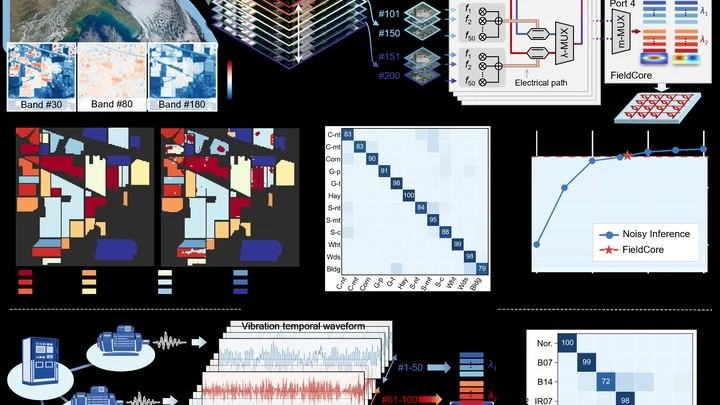
A typical computer shuttles electricity along copper traces, and every operation is a queue: first one thing, then another. Light works differently. In a single beam, you can mix dozens of signals without them interfering, like different voices in a choir, singing at once but each heard distinctly.
The new FieldCore chip uses five such "voices" at once.
Imagine a line of dominoes: when the first one falls, it pushes its neighbor, and a wave rushes down the chain. The boundary between fallen and standing dominoes is a perfect image of a magnetic wall. In microscopic magnetic films, these walls separate zones with different magnetizations.
A quantum computer is like an orchestra where every musician must come in at exactly the right moment. Previously, to play a complex piece, you had to constantly move the instruments around — slow and noisy. The new scheme, called "parity architecture," keeps everyone in place, and the conductor simply changes the notes.
Qubits in a superconducting quantum computer are like tightly stretched strings. When a particle from space or from a radioactive decay flies by, it strikes these strings and they start to vibrate. This vibration disrupts the fragile quantum states, and computations go awry.
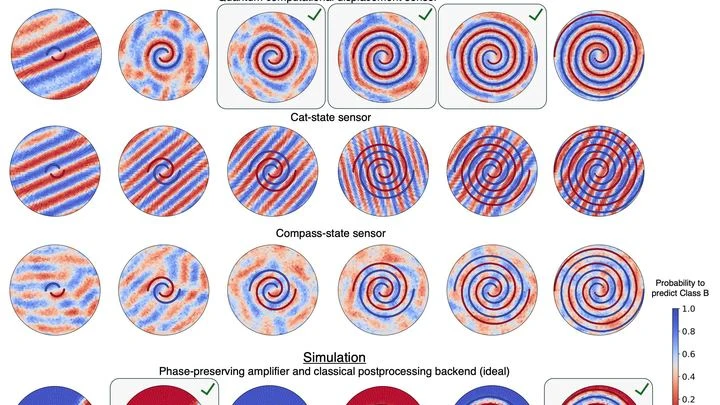
A judge walks into the courtroom but doesn't look at the evidence: he immediately delivers the verdict. That's how the new quantum sensor works: it doesn't measure the signal but directly decides which class it belongs to.
In conventional quantum sensing, it's all like a detective story: first you gather clues (measure the signal), then you analyze them.
A classical computer sorts data like a person meticulously sifting through grains of sand of different colors. A quantum processor takes its cue from nature: just as a droplet of water splits sunlight into a rainbow, revealing all hues at once, this new algorithm instantly grasps the essence of vast information arrays.
The biggest puzzle in physics is how to reconcile spacetime curvature with quantum mechanics. At the Planck length, billions of billions times smaller than an atom, the rules break down. This frontier was discovered by Max Planck.
Instead of millions of rigidly fixed particles — 10,000 atoms, working as beads on a quantum abacus. Each bead can be both zero and one at the same time. But the key is: if an error creeps into the calculation, the atoms can be physically moved: as if you could rearrange the abacus on the fly so that the glitch doesn't ruin the result.
When two atomic nuclei collide, the outcome depends on their energy and the angle at which the fragments fly apart. Typically, such calculations demand enormous computing power, and accuracy hits a wall due to approximations.
In quantum batteries, charging can be accelerated by shuffling the steps in time, like a deck of cards. Instead of a smooth energy climb, you get abrupt efficiency explosions, like microscopic supernovae inside atoms.
A typical quantum bit is destroyed by the slightest disturbance — heat, magnetic fields. Physicists made a pair of atoms work together so that disorder wouldn't erase the record. Information was encoded not in each atom individually, but in the difference of their states — like the tension of a rope between two buoys.
A water molecule resembles a tiny dumbbell: two hydrogen atoms attach to an oxygen atom at an angle. This dumbbell doesn't stay still: it stretches, compresses, and rotates. Each such motion has its own energy, like steps on a ladder.
IBM's Heron R3 quantum computer handled a task that made a classical method back down. The challenge was finding the ground state, the lowest energy level, of a system of 49 quantum bits.
Like an iceberg, the visible part of the code is the data, while beneath the surface lies a massive foundation of auxiliary particles. They quietly monitor noise and fix errors without touching the information. This approach squeezes many protected logical qubits into a modest number of physical ones.
The experiment ran on a 98-ion processor inside an electric trap.
A quantum computer is like an orchestra where each musician, a qubit, must play its note without missing a beat. But every now and then, a passerby, a particle of radiation from space, bursts into the hall and throws the musicians off rhythm. Such glitches are called error bursts, and they disrupt computations.
A quantum processor is like an orchestra where each musician (qubit) must play their part precisely in time. But in reality, the instruments go out of tune: qubits lose energy, and their interactions get distorted. To tune this orchestra, you first need to record how it sounds right now: that is, measure the noise parameters and couplings.
The quantum world is full of surprises: even simply observing a particle changes its behavior. In a new study, physicists showed that continuously measuring energy can make quantum chaos more pronounced. They used a quantity that indicates how long a quantum state remains similar to itself under repeated measurements.
Quantum computers have gained a built-in self-repair mechanism. The new two-dimensional scheme works like living tissue: each qubit-cell interacts with neighbors by local rules, automatically suppressing random disorder — entropy. Unlike previous methods, it doesn't require constant measurements, which themselves generate errors.
A quantum computer is like an orchestra where each musician plays their own part but sometimes hits a wrong note. To keep the music from turning into cacophony, you need a conductor who corrects mistakes in time. In quantum computing, the role of the conductor is played by error-correcting codes.
The number 551 looks harmless, but finding the two primes that multiply to give it is no easy task. A classical computer tries options one by one, like someone searching for a key on a keyring. A quantum processor works differently: it tries all possibilities at once, but you need a way to steer it toward the right answer.
A quantum computer is like an orchestra where each musician plays their own part. With few instruments, the conductor can manage each one separately. But when there are thousands of musicians, individual commands become overwhelming.
Inside a tiny crystal, sound is trapped like light in a mirrored room. It bounces off the walls and forms standing waves — a multitude of harmonic oscillations, each with its own frequency. Physicists have learned to use these oscillations as qubits — the basic units of quantum information.
When making popcorn, a microwave uses electricity only to heat the kernels. A gas stove heats the entire burner and the air around it. The same difference applies between a photonic quantum chip and a classical supercomputer when solving a problem devised by Scott Aaronson.
A quantum computer is like an orchestra, where each qubit is a musician and the control signals are the conductor. If the conductor waves the baton imprecisely, the musicians fall out of sync. In a real device, signals pass through power amplifiers, like loudspeakers that add noise and distortion.