object

atomic cloud

A collection of atoms cooled to very low temperatures, used here as a physical system to study time.
18 related articles

Description

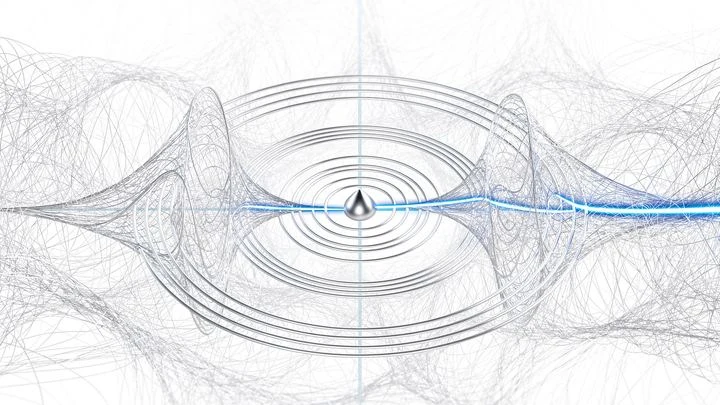
An atomic cloud is a collection of atoms cooled to microkelvin temperatures, typically held in a vacuum chamber by magnetic or optical traps. At these temperatures, atoms move slowly and their quantum wave-like nature becomes prominent, allowing researchers to study phenomena like Bose-Einstein condensation, quantum interference, and precise timekeeping. The cloud acts as a macroscopic quantum system where thousands to millions of atoms behave collectively.

History

Laser cooling of atoms was demonstrated in the 1970s–1980s, with the first Bose-Einstein condensate created in 1995 by Eric Cornell, Carl Wieman, and Wolfgang Ketterle. Atomic clouds have since become a standard tool in quantum physics.

How it works

Atoms are first laser-cooled using Doppler cooling, where photons from counter-propagating laser beams slow the atoms down. Further cooling is achieved through evaporative cooling, where the most energetic atoms are allowed to escape, leaving the rest at lower temperatures. The resulting cloud is confined by magnetic fields or optical lattices, and its properties—density, temperature, and quantum state—are probed by shining light on it and measuring absorption or fluorescence.

In practice

Atomic clouds are the heart of atomic clocks, quantum simulators, and atom interferometers used for precision measurements of gravity, inertial forces, and fundamental constants.

Fun fact

In an atomic cloud cooled to nanokelvin temperatures, atoms move at speeds of only a few millimeters per second—slower than a crawling snail—yet they exhibit quantum interference over macroscopic distances.


Concept graph →

Related articles · 18

Quantum Ratchet: Spins Kickstart Motion in Icy Matter
In 1905, Einstein showed that the chaotic motion of pollen in water results from the jostling of invisible molecules. A century later, physicists have learned not only to observe but also to control motion at the quantum level.
Quantum Gases2026-06-142 minarXiv:2606.15951express
A Liquid of Atoms You Can't Spill
In the quantum world, particles can merge into a single liquid that flows without friction. One of its most mysterious forms is the fractional quantum Hall liquid. In it, electrons or atoms move as a single vortex, and their charge splits into fractions, like a pie cut into perfectly equal slices.
General Relativity2026-06-122 minarXiv:2606.14537express
Dark Matter as a Quantum Droplet
At the center of many galaxies lurks an invisible halo of dark matter: it holds the stars at the edges, keeping them from flying apart. For a long time, it was described as a dilute gas of particles, but new work offers a different view: dark matter might gather into a quantum droplet.
A Proton Beam Instead of an Umbrella
On a scorching afternoon, a stifling haze hangs over the city, and not a single cloud is on the horizon. Usually, in such weather, all you can do is wait for nature to take pity and send some cool relief. But what if shade and rain could be switched on schedule, like a light in a room?
How the Brain Sculpts a Thought from a Cloud
In a grand courtroom, a meeting is in session. Hundreds of translator-neurons simultaneously hear fragments of phrases, and must piece them into a single coherent picture. This is exactly how large brain networks turn scattered signals from the eyes into a unified object image.
Quantum Gases2026-05-221 minarXiv:2605.23881express
Time Crystals: Eternal Ticking Clocks Made of Atoms
A time crystal resembles an eternal clock: its atoms spontaneously perform rhythmic movements. In ordinary clocks, a pendulum is driven by a spring or battery, but here the motion arises without an energy supply — the system simply returns to its initial state at regular intervals. This idea was proposed by Frank Wilczek in 2012.
Quantum Physics2026-05-052 minarXiv:2605.03298express
Molecular Attoscope Captures the Dance of Electrons and Nuclei
In a benzene molecule, electrons buzz around the nuclei like a swarm of bees around a hive. But this swarm doesn't just hum: it pulses: every 856 attoseconds, the electron cloud completes a full oscillation cycle. The hive itself, the carbon nuclei, rocks more slowly, with a period of 36 femtoseconds.
Atomic Physics2026-04-251 minarXiv:2604.23221express
A Two-Tone Light Trap for Atoms
A typical atom trap works like a funnel: laser light and a magnetic field slow atoms down and gather them at the center. But the funnel has a limit: it only catches atoms moving within a certain speed range.
Quantum Gases2026-04-052 minarXiv:2604.04062express
Atoms That Take Their Time to Cool Down
Water in a cup cools down in minutes. Gas in a room spreads evenly in seconds. But if you trap atoms in a tube as thin as a laser beam and give them a good kick, they will take several seconds to "cool" toward equilibrium — an eternity by atomic standards.
Materials2026-03-111 minarXiv:2603.10892express
Freeze to See the Quantum World
Quantum materials are like finicky flowers: they only bloom in the cold. At room temperature, they hide their unusual properties, but when deeply cooled, they become superconductors or change their magnetic behavior. To understand how they work, you need to examine their atoms in the very cold where these properties reside.
Quantum Physics2026-02-281 minarXiv:2603.00400express
Molecules in a Trap: How to Build the Perfect Array
Ultracold molecules are a promising material for quantum computing, but assembling them into a neat array, like eggs in a carton, is no easy feat. A method has been proposed to load molecules one by one into optical tweezers or lattices directly from a gas. The molecules immediately end up in the calmest state of motion.
Quantum Gases2026-02-151 minarXiv:2602.14249express
Atoms on a Conveyor Belt: How to Move an Ultracold Gas in a Third of a Second
A tiny cloud of 300,000 ytterbium atoms, cooled to near absolute zero, was shuttled along a light track 34 centimeters long, like transporting a fragile cargo over a bumpy road without shaking it apart.
Quantum Gases2026-02-041 minarXiv:2602.04948express
Quantum Simulator Assembles Light from Atoms
Light and matter in the tiny world obey laws that are hard to compute even on a supercomputer. Physicists build special "quantum simulators"—setups where cold atoms play the roles of particles and fields. But until now, such simulators could only depict the field in its simplest form: as if it were either present or absent.
Fluid Dynamics2026-01-202 minarXiv:2601.13594express
A Hundred Billion Atoms Show How Acoustic Cavitation Is Born
Ultrasound in a liquid is like shaking a bottle of soda vigorously: shake it, and bubbles appear. In science, this is called cavitation, and the bubbles don't just float around: they are born, grow, and collapse with tremendous force.
General Relativity2025-11-172 minarXiv:2511.13848express
Gravitational Atoms: How Black Holes Give Dark Matter a Voice
Black holes are rarely alone in the cosmos. They are often shrouded in invisible clouds of hypothetical dark matter particles — so light that they feel only gravity, barely interacting with each other or ordinary matter.
Quantum Physics2025-10-172 minarXiv:2510.15724express
Chip Royal: How Optomechanics Tamed Thermal Noise and Turned Phonons into Error-Free Qubits
In the world of microchips, where streams of photons, quanta of light, carry information, a fundamental problem arises: light passing through matter inevitably heats it. This heating spawns thermal fluctuations — chaotic, unpredictable jostling of atoms that disrupts precise device operation.
Light as a Conductor: How Lasers Make Atoms Dance in Unison
In a dark room, a laser beam draws a bright spot on the wall. Light seems warm and uncontrollable, but for three decades physicists have used it as a conductor's baton, making atoms dance in unison.