Platinum Dots Bring Transistor Memory to Life express
A plastic film as thin as a hair, and inside it — platinum dots smaller than a millionth of a millimeter. These dots sit at the boundary between two transistor layers and catch electric charge like a sponge catches water. As charge accumulates, the transistor changes its resistance, and remembers that state.
The device works at room temperature and responds not only to voltage but also to light. Light knocks charge out of the traps, and the resistance changes differently. Thus, a single transistor gets two ways to learn: electrical and optical.
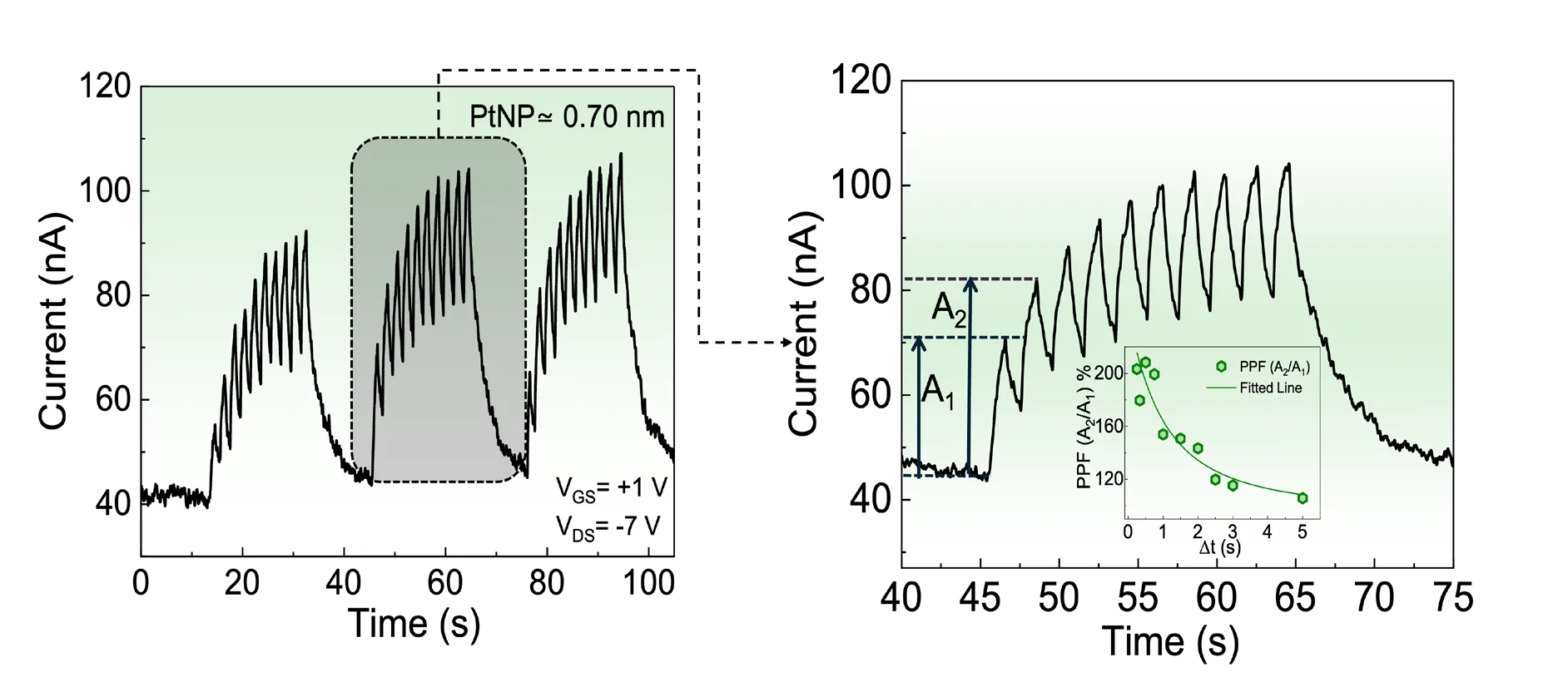
The memory of the plastic transistor resembles human memory. Short-term memory, like remembering a phone number for a minute, is strengthened by repeating the signal. Long-term memory — persists after power is turned off. In this work, both forms of memory are combined in one device.
Such transistors can be printed on flexible substrates like newspapers. They are lightweight, cheap, and bendable. Computers made of them won't replace silicon chips, but they could learn to recognize patterns right in the sensor — without sending data to the cloud.
Original abstract
as written by the authors arXiv:2608.20245v1
Organic transistors are playing an increasingly important role for neuromorphic applications. However, devices that rely solely on ferroelectric switching or on interface traps for their multi-conductance states exhibit limited memory windows. Here, we introduce an ultrathin oxide layer with a uniform distribution of sub-nm platinum nanoparticles (PtNPs) at the interface of a polymer semiconducting and a ferroelectric dielectric in a thin film transistor architecture. The interfacial stack, Al$$_2$$O$$_3$$/PtNP/Al$$_2$$O$$_3$$, provides a viable route for localized charge trapping and de-trapping in a region where it can most effectively influence the channel conductance. The organic transistors display a large memory window (> 20 V) in their current-voltage characteristics. The sub-nm PtNPs give rise to features that are consistent with room temperature Coulomb blockade-like transport, supporting discrete and well-separated levels within the memory window. The devices support multimodal programming using electrical and optical stimuli with both long-term plasticity and enhanced short-term plasticity (STP) phenomena. These results open new directions for implementing STP in the development of neuromorphic computing.
Platinum dots are so tiny that about a hundred thousand of them could fit in a row across a human hair.
In William Gibson's novel Neuromancer, artificial intelligence stores memory in distributed charge traps — similar to the principle of these transistors.