At the end of 1947 at Bell Labs, a team led by William Shockley, along with John Bardeen and Walter Brattain, created the first working point-contact transistor. For this discovery, they received the 1956 Nobel Prize. The operating principle is based on the properties of semiconductor p-n junctions: the current through the junction can be controlled by the injection of minority charge carriers.
History
The first point-contact transistor was invented by John Bardeen and Walter Brattain on December 23, 1947, at Bell Labs under the leadership of William Shockley. Shockley developed the p-n junction theory in 1948 and proposed the bipolar planar transistor. In 1954, the silicon transistor appeared (Texas Instruments). In 1959, Robert Noyce and Jack Kilby independently created the integrated circuit, combining many transistors on a single chip, which marked the beginning of the microelectronics era.
How it works
Modern transistors are predominantly MOSFETs (metal-oxide-semiconductor), where the channel current is controlled by the gate voltage. Miniaturization (Moore's Law) has reached 3 nm technologies, but it faces quantum effects (tunneling through the gate dielectric) and the problem of heat dissipation. Limits of applicability: at the nanoscale, charge discreteness and quantum entanglement begin to manifest.
In practice
The basis of all microprocessors, memory, and amplifiers — from smartphones to satellites.
Fun fact
The first transistor was assembled on a piece of germanium with gold contacts pressed by a spring, and looked like a jumble of metal plates and paper clips. It was the size of a large coin, whereas today transistors in processors are smaller than a virus.
A plastic film as thin as a hair, and inside it — platinum dots smaller than a millionth of a millimeter. These dots sit at the boundary between two transistor layers and catch electric charge like a sponge catches water. As charge accumulates, the transistor changes its resistance, and remembers that state.
A light switch clicks, and the light comes on. But imagine a switch that, with the same press, can either turn on the lamp or leave the room dark. It also remembers what it did last time, and sometimes it seems to flip a coin to decide whether to light up.
This kind of behavior was found in a crystal of black phosphorus — a semiconductor just a few atomic layers thick.
When an orchestra of thousands of musicians plays in harmony, the credit goes not only to each player's talent but also to the invisible work of the conductor.
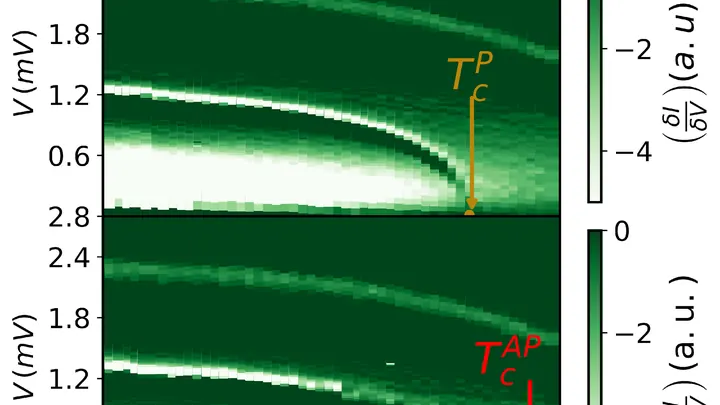
An ordinary flash drive in your pocket gets warm even when it's just sitting there. Now imagine memory that, in the cold, uses almost nothing, like a thermos that never cools down. A superconductor carries current without loss at liquid-helium temperatures, but it couldn't store data. The new cell changes that.
In a dark laboratory where superconducting chips are cooled to thousandths of a kelvin, a qubit spins under the influence of a magnetic field. A regular qubit rotates in one direction. An antiqubit, its mirror twin, rotates in the opposite direction. Together they form a pair that senses the field twice as sharply as any ordinary pair.