Why proteins at cell junctions gather into separate spots and don't merge ✛
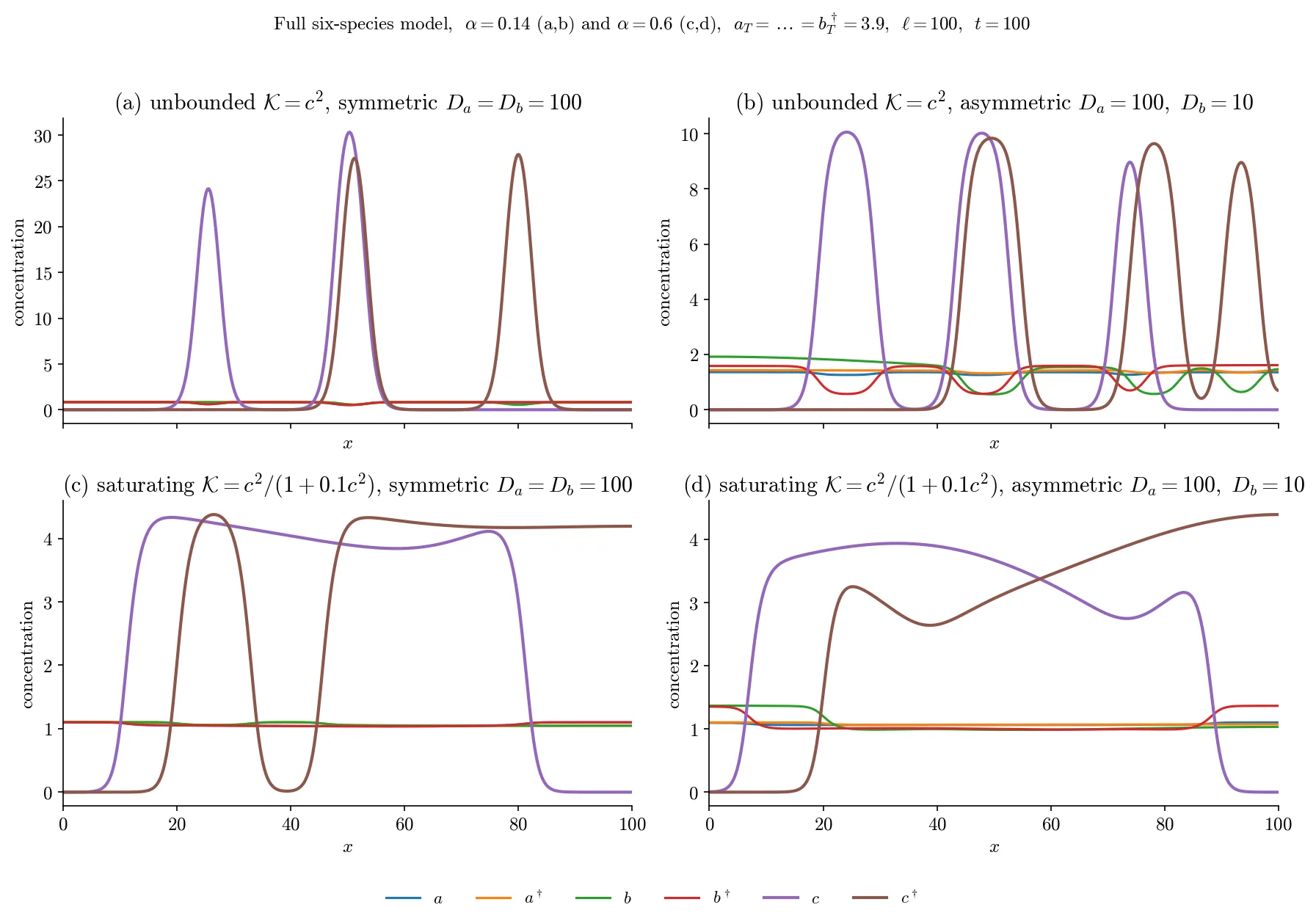
At the boundary between two cells, proteins gather into distinct spots, like ink droplets on paper. Some droplets face one way, others face the opposite. For a long time, it was unclear why these spots don't merge into one big blob and how they decide who goes where. It turns out that two simple rules are at play: the total amount of protein at the contact is constant, and the interaction between spots depends on their orientation.
Imagine two reservoirs of ink sitting on opposite sides of a cell junction. From them flow two types of monomers, fast and mobile. When they meet, they form viscous complexes that barely move. If complexes become numerous, they start attracting even more monomers, a phenomenon called clustering feedback. As a result, the uniform protein distribution loses stability, and distinct spots emerge. But here's the key: if two spots are oriented the same way, they always slowly merge into one. So the number of spots we see is not preset but determined by how much time has passed since they formed.
Now add a second rule: let complexes of one orientation speed up the decay of complexes with the opposite orientation. Then spots of different 'colors' start to repel and move apart. This turns chaotic clustering into sorting: at one end of the contact, complexes of one orientation gather, at the other, the opposite. And here's the most surprising part: controlling the number of spots and separating them by orientation are two independent mechanisms. The cell can tune them separately, like an artist who first decides how many drops to apply, then which ones will face left and which right.
So a simple model with two ink reservoirs explains how molecular interactions create order at the cell boundary. Today, it helps interpret microscope images of protein clusters: knowing how mobile the monomers are, you can predict the number and size of spots. And in the future, the same rules might hint at how a cell chooses its growth direction and how that choice is passed on to the entire tissue.
The width of a single protein punctum in the model turns out to be universal: it does not depend on the amount of protein or the strength of feedback, but only on complex diffusivity and decay rate. This is similar to how the width of a traffic jam does not depend on the number of cars, but only on the reaction speed of drivers.