A pull distribution is a diagnostic tool used in physics and other sciences to check whether the uncertainties assigned to measurements are realistic. It is constructed by taking each data point, subtracting the expected value (the model prediction), and dividing by the uncertainty of that point. The resulting 'pull' values should follow a standard normal distribution (mean 0, standard deviation 1) if the model is correct and the uncertainties are properly estimated.
History
The term 'pull' has been used in high-energy physics since at least the 1980s, though the underlying idea of standardizing residuals is older and appears in statistics as 'studentized residuals'.
How it works
If your uncertainties are too small, the pulls will be larger than 1 on average, producing a distribution that is too wide. If your uncertainties are too large, the pulls will cluster near zero, making the distribution too narrow. By fitting a Gaussian to the pull distribution and checking its width, you can detect miscalibrated errors. A width significantly different from 1 signals that your error estimates need adjustment — a common issue in complex analyses where systematic effects are underestimated.
In practice
It is routinely used in particle physics experiments (e.g., at CERN) to validate the uncertainty estimates in fits to particle masses or cross-sections, and in astronomy for checking the calibration of telescope measurements.
Fun fact
A pull distribution that looks perfect — a clean Gaussian with width exactly 1 — is so rare in real analyses that physicists often become suspicious it was 'too good' and check for hidden correlations.
Two ink reservoirs stand on opposite sides of the cell junction. From them, two types of monomers flow onto the membrane, and when they meet, they form viscous droplets of complexes. The droplets barely move, but the free monomers dart around as fast as perfume molecules in a room.
A glucose meter that doesn't prick your finger but just looks at your wrist: that's the dream for millions of people with diabetes. It's the promise of algorithms that extract glucose levels from the ordinary pulse signal, the photoplethysmogram (the same one that measures heart rate in smartwatches).
A disease outbreak is like a wildfire: the fire runs through dry grass, and its speed depends on wind and humidity. But an infection has its own 'wind'—how often people infect each other. When this rate changes along with the fraction of already infected, the epidemic wave can behave differently.
The optical sky background is a cosmic palimpsest, where light from billions of unresolved galaxies is layered, each layer corresponding to a different epoch. Until now we could only distinguish the brightest "letters"—individual stars and nearby galaxies.
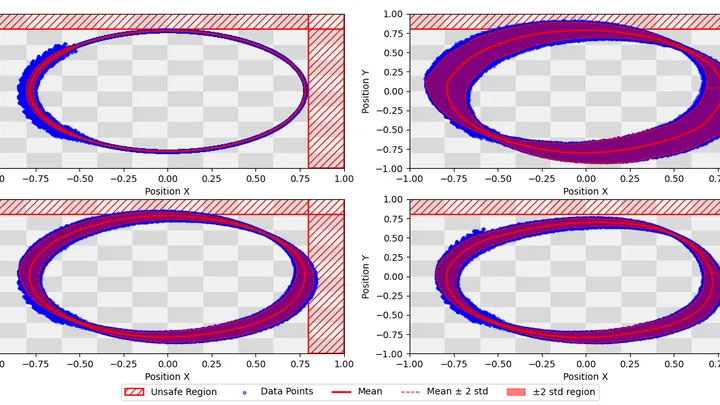
When an unmanned aerial vehicle learns from an experienced pilot, it memorizes not individual maneuvers but entire safe corridors — the trajectories along which the human mentor moved. This approach is called imitation learning: the machine mimics expert demonstrations.
A lab robot counts molecules, and gets it wrong. One tube shows 0, another 12, a third 3, though in reality they all hold roughly the same amount. Such 'raw' numbers are common in biology: DNA sequencing, counting species in a water sample, gene activity. There's plenty of data, but it's sparse and more scattered than simple randomness would predict.
In turbulent air, droplets don't fly in straight lines: they get tossed around like dust motes in a beam of light. Physicists have built a setup that tracks each droplet, which is about a tenth of the thickness of a human hair. A camera captures their motion, and a computer reconstructs their trajectories.
A translator learns not from a dictionary but from speech. They listen to native speakers and pick up rules that are written in no textbook. Similarly, a new method for forecasting complex systems such as climate or turbulence does not require knowing their equations. Instead, it looks at data and learns to predict their behavior.