Clustering versus sorting: how proteins assemble into puncta at cell contacts ✛
Context
Planar cell polarity is a fundamental mechanism that sets cell orientation within tissues. It is preceded by clustering of polarity proteins into discrete membrane subdomains (puncta) with reduced turnover. However, the minimal interactions that nucleate puncta, determine their number, and separate opposite orientations remained unclear. Existing models mostly described alignment and coordination at the cell and tissue level, treating each contact as well-mixed, and thus could not resolve the puncta themselves. This work sits at the interface with studies of mass-conserving reaction-diffusion systems, where mechanisms of wave pinning and coalescence are known, but two independent monomer reservoirs and orientation sorting were not considered. Thus, the article fills a gap between the molecular scale of puncta and tissue-level polarity, offering a minimal model that links clustering and sorting.
Methods
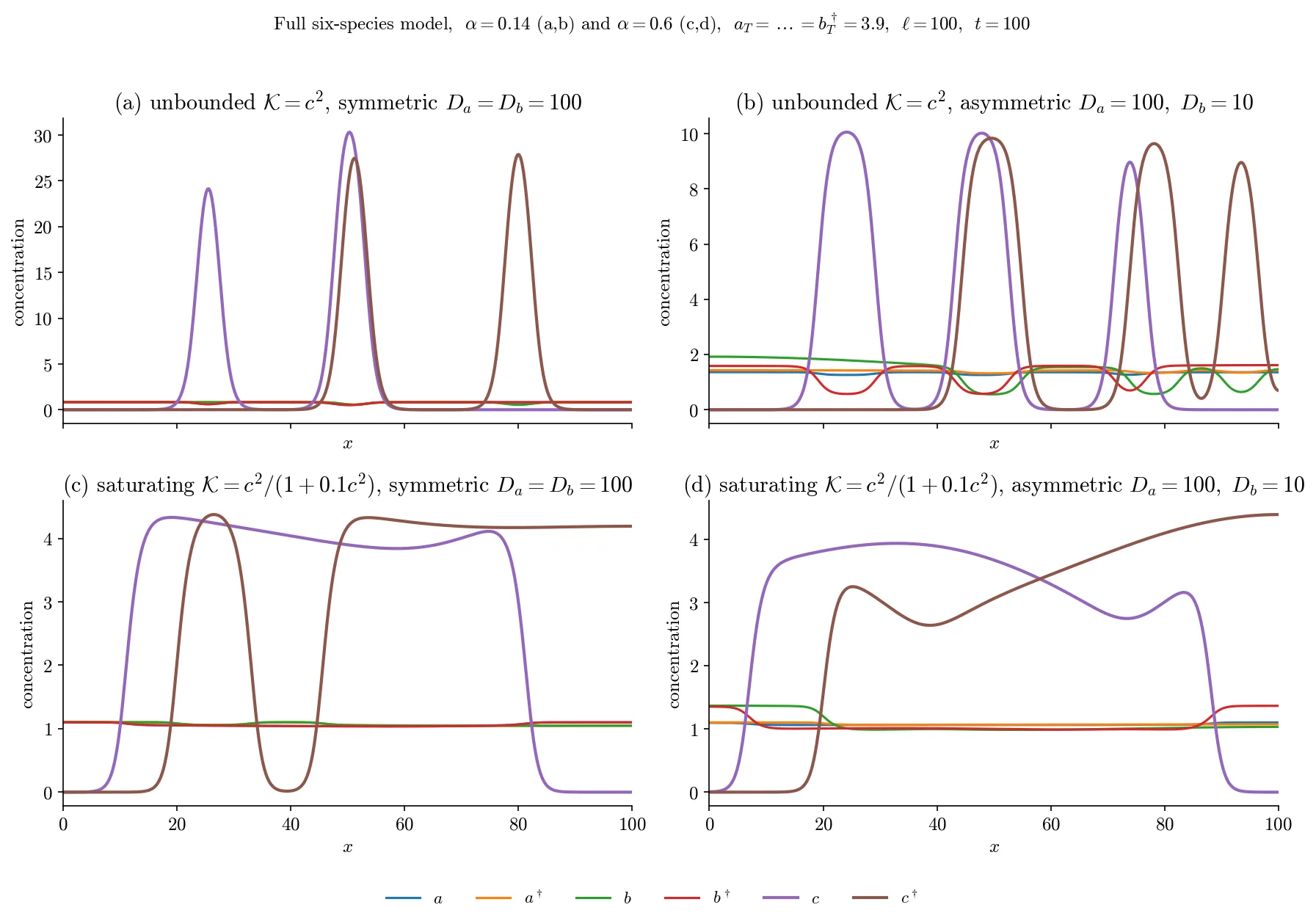
The authors build a one-dimensional reaction-diffusion model on a cell contact with zero-flux boundaries. Two monomer types (A and B) diffuse rapidly and reversibly bind through contact to form trans-complexes of two orientations (C and C†), which diffuse slowly. Feedback enters only through concentration-dependent rates: clustering feedback K(c) enhances binding in the presence of complexes, and cross-modulation V(c†) alters complex decay depending on the concentration of the opposite orientation. Two forms of K(c) are considered: unbounded (c²) and saturating (c²/(1+ρc²)). The system is non-dimensionalized, and analysis includes linear stability of the homogeneous state, fast-monomer asymptotics for a single punctum, spectral methods for arrays of puncta, and numerical simulation using finite differences with a semi-implicit scheme.
Results
The homogeneous state loses stability via a long-wavelength mass-redistribution mode when monomers diffuse faster than the complex and clustering feedback is strong enough. For unbounded feedback, narrow peaks arise with amplitude cmax = 3/(2αāƀ), universal half-width 4 arccosh(√2) ≈ 3.53, and spacing set by the monomer screening length. For saturating feedback, broad plateaus form, with front position determined by the Maxwell construction. It is proven that any array of identically oriented puncta is unstable and coalesces to a single punctum; the coalescence rate for two peaks is λcomp = αā³D/(3ℓ) in the symmetric case, and with unequal monomer diffusivities it is set by the harmonic mean of their diffusion coefficients. The spectrum of a single punctum contains no oscillatory instabilities, meaning puncta do not blink. Introducing positive cross-modulation V′ > 0 turns clustering into sorting: co-localized puncta of opposite orientations separate at rate λpol = 8V′cmax/7, and the sorting criterion is independent of the form of clustering feedback.
Implications
This work differs from neighboring studies by being the first to consider a trans-complex with two independently conserved monomer reservoirs and to analytically link clustering to orientation sorting. Unlike models that either ignore subcellular spatial structure or consider only one conserved species, here it is shown that having two reservoirs leads to a qualitatively new competition law via the harmonic mean of diffusivities. Furthermore, the work provides an exact sorting criterion based solely on the sign of cross-modulation, which had not been established for fully formed puncta. This allows separating control of punctum number and orientational segregation into mathematically independent ingredients.
Future development
The topic could develop toward including explicit molecular players and deriving feedback functions from phosphorylation and endocytosis kinetics. Another direction is moving from a single contact to a whole cell, where contacts must be linked through shared reservoirs and a bias must be introduced to select which orientation dominates at each edge. It would also be interesting to find the minimal mass-conservation breaking that stabilizes regular arrays of puncta while preserving the sorting mechanism.
Impact
The model can be applied to analyzing imaging data of protein clusters at cell contacts, in particular for predicting how punctum number and size depend on monomer mobility. It also provides a basis for building more detailed models of planar polarity that link molecular and cellular scales.
Next steps
The next step is to develop a biophysically mechanistic version of the model with explicit molecular components, where rates K and V are derived from phosphorylation and endocytosis kinetics. Then, one must investigate how molecular self-organization of puncta translates to cell-level polarity through contact coupling and symmetry breaking.
Key open problems
This work is directly connected to the unresolved problem of how molecular interactions generate stable subcellular structures and how these structures are coordinated at the tissue level. In cell biology, the question remains open as to which minimal ingredients are sufficient for the formation and maintenance of protein clusters with reduced turnover, and how these clusters contribute to generating cell asymmetry. This model shows that mass conservation and the sign of cross-regulation are key, but full understanding requires experimental parameter measurements and testing predictions about kinetic selection of punctum number.
The knowledge machine's view
This section is addressed to the author of the paper and their colleagues. Neighbouring works were found by meaning-based search across our archive, not by word overlap. We do not review: we show the field around the work.
What the work does
This work develops a one-dimensional mass-conserving reaction-diffusion model for the clustering of planar cell polarity proteins into puncta at cell contacts. The model includes two types of monomers that reversibly bind into trans-complexes of two orientations, with feedback through concentration-dependent rates. It is shown that clustering arises via a long-wavelength mass redistribution mode, the morphology of puncta depends on the form of feedback, arrays of uniformly oriented puncta are unstable, and cross-modulation of complex turnover leads to orientation sorting.
Where its strength is
Separating clustering and sorting into mathematically independent ingredients (the clustering feedback K(c) and the cross-modulation V(c†)) is a strong result, as it allows these processes to be studied in isolation. Also valuable is the conclusion that the number of puncta is determined kinetically rather than by a wave-like mechanism, which links the model to the observed variability in puncta numbers.
Where it could go next
- It might be interesting to see how the proposed clustering mechanism relates to the observed dynamics of planar polarity proteins in living tissue: nearby in the archive is a review of work on how cells build the growth boundary, which examines the spatial organization of proteins at cell contacts.based on: How Cells Build a Growth Boundary arXiv:2603.28630
- Another avenue is this: a study on how cells choose body shape discusses the role of planar polarity in morphogenesis; perhaps your clustering model could be integrated into a larger-scale description of tissue polarity to link molecular puncta with cellular coordination.based on: How Cells Choose a Body Shape arXiv:2603.07082
- The archive also contains a review of work on how proteins bend membranes; since clustering of polarity proteins may affect local membrane curvature, it might be worth considering the coupling between your clustering mechanism and membrane deformation.based on: Proteins bend the membrane the way a spoon bends the film on milk arXiv:2601.15477
Worth trying
- Test whether the separation of clustering and sorting holds when a weak coupling between them is introduced, for example, by making K depend on both orientations.
- Apply the model to a two-dimensional geometry of the cell contact to see how puncta shape and arrangement change when realistic geometry is taken into account.
- Compare the predicted dependence of puncta number on protein density with quantitative data on puncta in cells with different expression levels of polarity proteins.
Why this may matter
If the proposed mechanism for clustering and sorting is confirmed in biological systems, it would provide a minimal framework for understanding how molecular interactions at cell contacts generate tissue polarity, and could aid in interpreting mutations that disrupt puncta.
Nearby works in our archive
- How Light Reveals the Fibers of Tissuesimilarity 0.54
- How a cell quickly assembles DNA copiessimilarity 0.52
- Light Twists into Vortices Inside Tumorssimilarity 0.51
- How Cells Build a Growth Boundarysimilarity 0.51
- How Cells Choose a Body Shapesimilarity 0.50
- Proteins bend the membrane the way a spoon bends the film on milksimilarity 0.50
The archive is sparse around this work: the closest review is only 0.54, against a usual 0.64. It looks like few have drilled nearby.
The width of a single protein punctum in the model turns out to be universal: it does not depend on the amount of protein or the strength of feedback, but only on complex diffusivity and decay rate. This is similar to how the width of a traffic jam does not depend on the number of cars, but only on the reaction speed of drivers.
Key numbers
- universal punctum width: 3.53 (in units of complex diffusion length)
- threshold density for unbounded feedback: nf = 1.5*(12/(αℓ))^(1/3)
- punctum drift coefficient at contact: 8/7
- punctum drift coefficient far away: 5
- coalescence rate of eight puncta compared to two: an order of magnitude faster