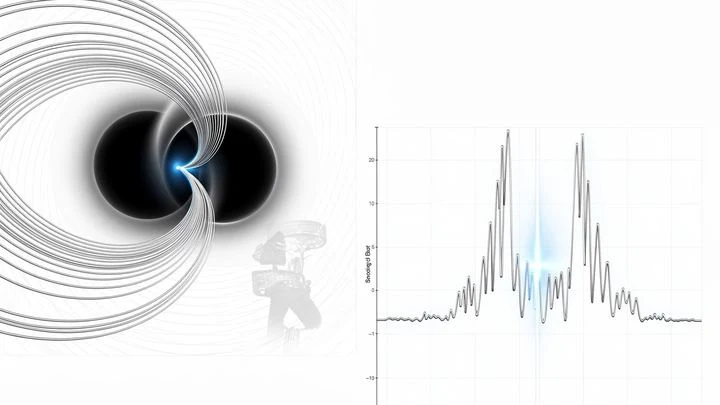
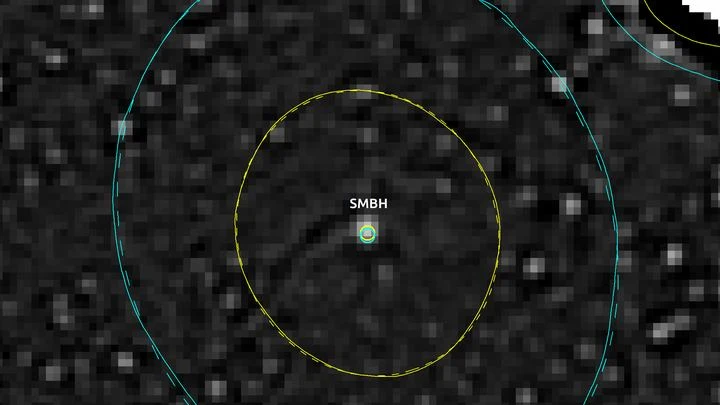
In galaxy clusters, the hot gas between galaxies should cool over time, condensing and forming new stars. But observations show that this cooling is largely prevented: the gas stays hot, and star formation is suppressed. The self-regulating mechanism is the process that explains this balance. It involves a supermassive black hole at the cluster's center, which acts as a thermostat for the entire cluster.
History
The concept emerged in the late 1990s and early 2000s from X-ray observations of galaxy clusters, which showed that cooling flows were much weaker than expected. It was developed through theoretical work and simulations by astrophysicists studying active galactic nuclei feedback.
How it works
As hot gas cools, it flows inward toward the central black hole, feeding it. This accretion of matter releases enormous energy in the form of jets and radiation, which heats the surrounding gas. The heated gas expands and stops flowing inward, cutting off the black hole's fuel supply. This negative feedback loop keeps the gas temperature and the black hole's activity in a stable equilibrium.
In practice
This mechanism is used in cosmological simulations to model galaxy formation and evolution, helping predict how galaxies and clusters grow over cosmic time.
Fun fact
The energy output from a single supermassive black hole can be so large that it heats gas across a region millions of light-years wide, affecting the entire cluster.
At the center of nearly every large galaxy sits a supermassive black hole. It doesn't just devour infalling gas; it also blasts some of it back out in powerful jets. These jets act like giant pistons, shoving the surrounding gas and heating it. Astronomers have long suspected that this is how black holes keep galaxies from cooling into cold star factories.
A harbor lives by the tide schedule. Water rises and falls, and with it everything changes: the level at the dock, the composition of the sediment on the bottom, even the salinity in the far corners. A galaxy works similarly, except instead of water it has gas, and instead of the Moon, it has its own stars and neighboring clouds.
Two ink reservoirs stand on opposite sides of the cell junction. From them, two types of monomers flow onto the membrane, and when they meet, they form viscous droplets of complexes. The droplets barely move, but the free monomers dart around as fast as perfume molecules in a room.
At the center of an ultra-compact dwarf galaxy, a very dense stellar system spanning tens of light-years, there is a vacuum cleaner at work. But instead of dust, it sucks in gas shed by dying stars. This gas does not fly off in all directions; instead, it spirals into a funnel, a rotating disk that gradually settles onto the black hole.
Light from a distant galaxy reaches us through its own dust. This dust is not a smooth haze but ragged clouds, like wisps of cotton. Old models treated it as a uniform mist, and then the galaxy didn't add up energetically: too much light disappeared in the ultraviolet and too little came back in the infrared.
Astronomers did what a cook does when they dice a potato instead of tossing it in whole.
A detective story unfolded in the GWTC-5 catalog. Hundreds of signals from merging black holes, captured by the detectors of Rainer Weiss and his colleagues, held the secret to the origin of the most massive and rapidly spinning stellar-scale objects.
The heart of many galaxies is a supermassive black hole. It doesn't just sit at the center; it occasionally flares brightly as it swallows surrounding gas.
The focus is on a black hole, but not an ordinary one. It carries a magnetic monopole and is surrounded by a dilaton — a field that blurs the familiar boundaries of space. The authors tested how stable such a system is to thermal jolts.
A magnetic monopole is a hypothetical particle with a single magnetic pole.
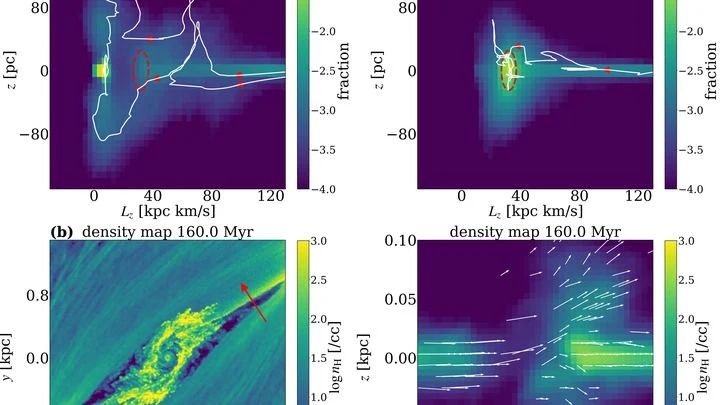
Cosmic black holes at the centers of galaxies are like giant banyan trees: their aerial root‑filaments stretch for kiloparsecs to harvest nourishing matter. For decades astronomers have debated: how does cooling gas from cluster atmospheres fall into the sphere of influence of a supermassive hole?
Dark matter is the invisible scaffold of the universe. It doesn't shine, but its gravity holds stars in galaxies. In some models, dark matter particles can collide and exchange energy, like molecules in warm air.
A river flows toward a whirlpool, but a dam with a notch blocks the way. Most water piles up before the dam, but some, gaining height, leaps over it and falls straight into the funnel. So it is with gas in a galaxy: it streams toward the center but hits a ring of stars and gas, like a dam. Usually, everything stops there, swirling into a dense vortex.
A copper crystal is squeezed in diamond anvil cells. As pressure mounts, a battle unfolds inside the material between two states: one prepares electrons for superconductivity, the other hinders their pairing. Scientists tracked this struggle using ultrashort laser pulses.
In cold clouds of interstellar gas, long, dense filaments stretch out. Inside them, like overcrowded incubators, future stars are maturing. For a long time, it was thought that within such filaments, everything was governed by gravity: matter smoothly flows toward the centers, where density increases and eventually a star ignites.
A pot of boiling water sits on the stove: the higher the heat, the hotter the water and the more steam escapes. Hot gas in galaxy clusters behaves much the same way. But in small galaxy groups, this "steam" leaks out faster than you'd expect from the temperature alone.
A gas cloud the size of a small galaxy is falling into the Milky Way at hundreds of kilometers per second. Such clouds are called high-velocity clouds, and until now no stars had been found in them — only gas. Now, in one of them, named Complex H, astronomers have spotted a pair of young star clusters.
Ice on a warm frying pan doesn't just melt: it starts to move. A thin layer of water forms beneath it, and the piece glides as if on oil. The speed of this sliding depends on how quickly heat travels through the water film and how steep the incline is.
Water in a pot, when heated, doesn't boil: it turns into ice. That's roughly how ultracold atoms behave in an optical lattice — a light-based crystalline grid that holds atoms in place. Scientists simulated this system on a computer to understand how order changes as temperature rises.
The James Webb Space Telescope peered into the galaxy cluster AS1063 and spotted tens of thousands of globular clusters — dense stellar "knots" scattered throughout the cluster. Their positions matched the map of invisible mass, which is constructed from the bending of light from distant galaxies.
A galaxy cluster is like a busy intersection where galaxy-cars race through a headwind of hot gas. This wind, called ram pressure, strips galaxies of their cold gas — the fuel for star formation. Astronomers from the SAMI survey traced how this happens in hundreds of galaxies across eight nearby clusters.
A city at night looks quiet from above, but life bustles in its neighborhoods: streets are blocked off, construction is underway, and equipment hums in basements. That's roughly how astronomers now see the galaxy cluster SPT-CL J2215-3537, located so far away that its light has traveled for more than 8 billion years.
At the heart of the galaxy cluster RXCJ1558.3-1410, an invisible drama unfolds. Hot gas there is cooling, but something prevents it from collapsing and birthing new stars. Astronomers pointed a radio telescope at this cluster and saw a faint glow — a mini-halo.
The usual way to freeze a living cell is like trying to put a spacesuit on it: you first need to get a protective substance inside, but while it's crossing the membrane, the cell can burst from salt imbalances or get poisoned by the chemicals.
The James Webb Space Telescope is watching TRAPPIST-1—a tiny red dwarf with seven Earth-sized planets in orbit. And it sees something unusual: bright flares on this star barely reach 3500–4000 degrees. For comparison, a typical solar flare heats up to 9000–10000 degrees.