Sequencing is the determination of the nucleotide sequence of DNA or RNA. Modern methods include Sanger sequencing (with dideoxynucleotides and capillary electrophoresis) and high-throughput technologies (NGS), such as Illumina (synthesis with reversible terminators), pyrosequencing, and nanopore sequencing. The principle is based on base complementarity and detection of a signal from the incorporation of each nucleotide into the growing chain.
History
In 1977, Sanger proposed an enzymatic method for DNA sequencing using dideoxy analogs; simultaneously, Maxam and Gilbert developed a chemical method. In the 1990s, automation with capillary electrophoresis accelerated the process. The breakthrough was the advent of NGS in the 2000s (454, Solexa/Illumina), which allowed parallel sequencing of millions of fragments. The latest technologies (PacBio, Nanopore) read single molecules in real time.
How it works
General scheme: DNA is fragmented, adapters are ligated to the ends. In Illumina technology, fragments hybridize on a flow cell and are amplified by bridge PCR, forming clusters. Then sequencing-by-synthesis occurs: reversible terminators with fluorophores are added, after each cycle an image is taken, the terminator is removed, and the cycle repeats. Image analysis converts signal intensity into a nucleotide sequence. In nanopore sequencing (Oxford Nanopore), a DNA strand is passed through a protein pore and the change in ionic current, specific for each nucleotide, is measured.
A stain is found at a crime scene. The expert takes a swab, and a few hours later the instrument outputs a list of proteins that made up the fluid. Previously, a rapid test could be wrong if multiple fluids were present: blood mixed with saliva, and the strip gave a false result.
The end of a chromosome is like a parking spot at the entrance to a building: it has to be occupied, or the cell will take it for damage and start repairing something that was never broken. In yeast, the role of parking attendant goes to the protein Cdc13. It recognizes the telomere, the terminal stretch of the chromosome, and latches onto it.
Two ink reservoirs stand on opposite sides of the cell junction. From them, two types of monomers flow onto the membrane, and when they meet, they form viscous droplets of complexes. The droplets barely move, but the free monomers dart around as fast as perfume molecules in a room.
In a print shop, every page of a book used to be set by hand. One mistake, and the whole print run is at risk. RNA sequencing of the brain looked much the same until recently: each sample demanded hours of manual work, and short reads, like torn scraps of pages, could not be pieced together into the full text of a gene. Now there is a production line that reads every page from start to finish.
In an orchestra that has been playing the same symphony for years, the musicians gradually start to drift: each one plays on their own, yet the notes remain the same. That is roughly what happens to cells as they age. Scientists have come up with a way to measure this discord, that is, how faithfully each cell follows the shared program of gene expression.
Two different microphones are recording the same concert. One microphone stands by the stage and mostly picks up the loud sounds from the front row; the other hangs from the ceiling and hears the whole hall, but with the bass muffled. If you compare the recordings, you can figure out how much of the noise in them comes from the microphone and how much from the orchestra itself.
A single DNA molecule, squeezed into a tiny metal slit, trembles and flickers under the laser. Its signal is not a clear string of letters but a chaotic mix of flashes and shadows. Deciphering this noise is like trying to make out a whisper in a crowded room.
The new neural network works like an attentive interpreter.
A single DNA molecule, squeezed into a tiny metal slit, trembles and flickers under the laser. Its signal is not a clear string of letters but a chaotic mix of flashes and shadows. Deciphering this noise is like trying to make out a whisper in a crowded room.
The new neural network works like an attentive interpreter.
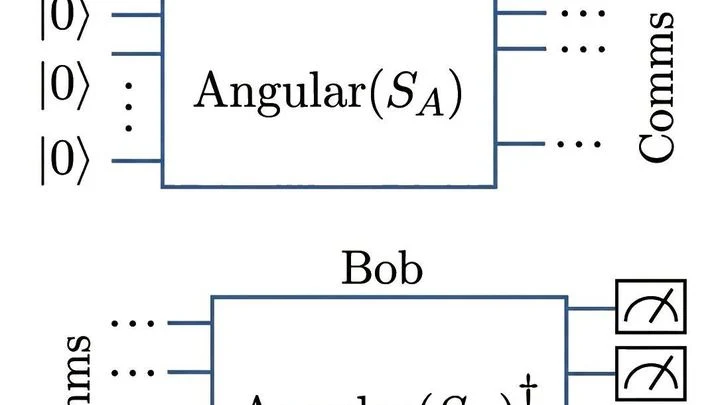
A quantum computer is like an orchestra where each musician, a qubit, plays their part but keeps hitting wrong notes. To keep the music from turning into cacophony, you need a conductor who instantly hears the off-key notes and corrects them.
A huge orchestra without a conductor. Each musician is a gene, and the melody is the cell's complex work. Previously, looking at a tissue photo, a computer tried to guess each instrument's part individually. It didn't know that violins usually play with violas, and trumpets with trombones. The program just output a list of notes, without sensing the harmony.
Two ropes glued along their length naturally twist into a double helix. That's how DNA works — except the glue is hydrogen bonds between bases, and the stiffness comes from the chains themselves.
A protein slides along the DNA strand like a key along a keyring, searching for its lock. One wrong turn and a gene stays switched off. To know where a protein will grip firmly, you need to measure the strength of that grip — the binding energy.
When biologists measure the activity of thousands of genes, they usually just see a list of coincidences, like two ingredients in a soup that often end up together. The standard method looks for such pairwise connections but doesn't show who influences whom.
A new approach, like a detector of dark matter, uncovers hidden threads of causation.
Data on gene activity usually looks like a long string of numbers, like a rainbow stripe (spectrum) with no visible connections. In the scVision model, these numbers are turned into a meaningful picture — not a list of ingredients, but a photo of a finished dish.
The cells of an organism are like twin chefs sharing a kitchen. They have the same cookbook (DNA), but when copying the recipe to a cheat sheet and assembling the dish, random errors occur. This unpredictability, entropy, means that in identical cells, protein levels are sometimes high, sometimes low.
You get a report: one 'letter' in your gene has been swapped. But what does that change? A protein isn't a flat string: it's a dense tangle, where each loop sits in its own pocket. A change deep inside that tangle is like a crack in the foundation, while one on the surface is like a scratch on the facade.
Think of a massive cookbook: each recipe is a protein, and the finished dish is its job in the cell. To whip up a complex treat, you often need to mix several ingredients and let them 'set' into the right shape. Until now, scientist-chefs could only guess how someone else's recipes would fold.
An electron dives into a crystal, changing its energy as it goes. In an ordinary lattice, it encounters a sequence of allowed bands and forbidden gaps — this is the ABC of semiconductors. But in a quasicrystal, the pattern of atoms never exactly repeats.
The crumpled DNA thread in the cell nucleus is not a chaotic knot, but an intricate melody played on a polymer string. Modern experiments Hi-C, like highly sensitive microphones, capture the echo of contacts between distant genome regions, turning spatial organization into a two-dimensional probability matrix.
A hefty multi-volume reference book is the human reference genome. And the short sentence fragments scattered across the table are millions of sequenced DNA reads. The job of a navigator like BWA-MEM is to find the exact spot in the reference for each fragment.
Imagine a flashlight that only lights up when you're near a road sign: that's roughly how drug discovery works when scientists follow genetic clues. A team of researchers examined over 26,000 target-disease pairs: combinations of a protein that a drug acts on and the disease it treats.
Two road crews are paving a street from opposite ends. They move toward each other, and how well they coordinate determines when the street is finished.
A torn telephone wire is a nuisance, but a torn DNA is a catastrophe. A double-strand break, when both strands of the helix snap at the same spot, threatens the cell with death or transformation into cancer. Fortunately, the cell has its own 'glue': special proteins that gather into a droplet right at the accident site.
A translator doesn't learn a language from a textbook but by listening to live speech and immediately seeing what people do in response to words. That's exactly how the new method C3P reads bacterial DNA. Standard genomic models try to learn the rules by simply "rereading" billions of letters of the genetic code, and often get confused.
Imagine a huge garage with hundreds of parking spots. You're driving a tiny car, a future drug molecule, and you want to find the one free bay where it fits perfectly. But these bays aren't concrete; they're woven from DNA or RNA chains, and no one has posted the parking rules.
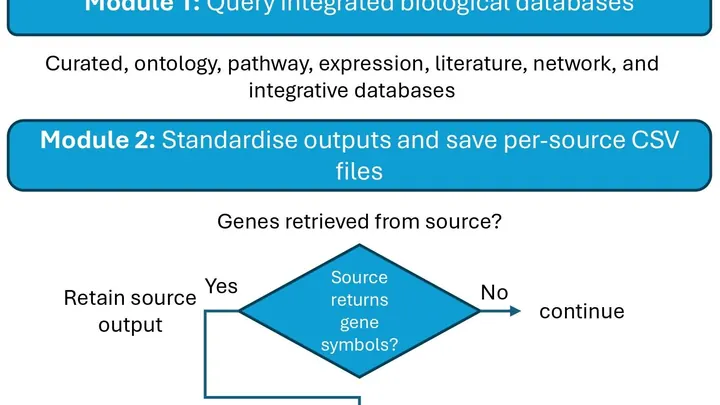
Assembling a puzzle when the pieces are scattered across 13 boxes with different numbering systems: that's roughly what it's like to search for genes linked to a specific disease. The data exist, but they're hidden in databases with their own interfaces, formats, and even descriptive languages.
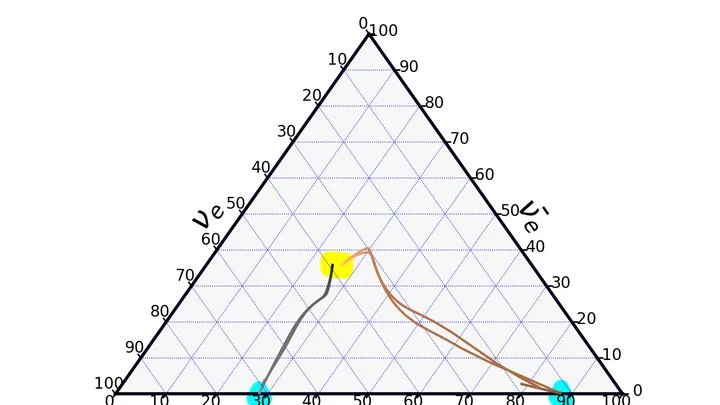
A pot of soup simmering with three ingredients. The chef adjusts the proportions on the fly, and the progress is tracked by the position of a point on a triangular scale. That's roughly how physicists tackle neutrinos from a supernova explosion.
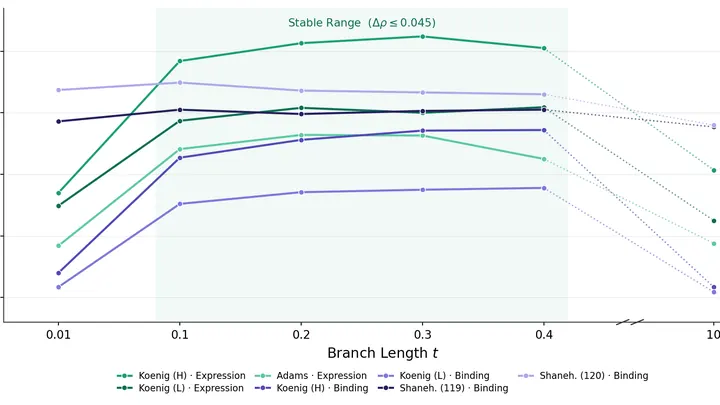
DNA is a long carbon necklace made of four types of beads. Biologists often need to compare two strands to find differences. Normally this requires a lengthy brute-force search. Researchers came up with a clever trick: encode each bead as an arrow that rotates based on its neighbors. The idea came from language models, where words also 'know' context.
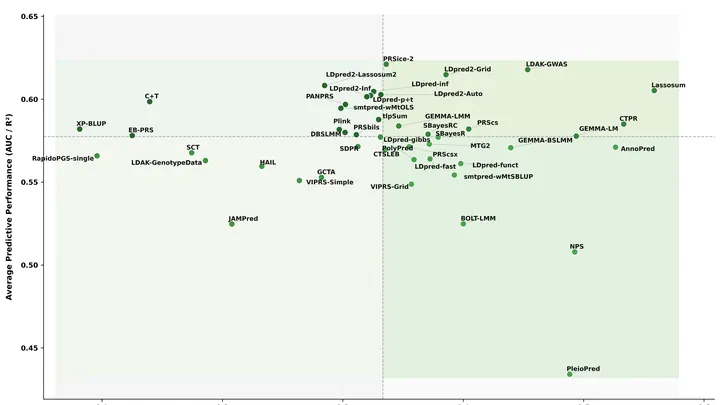
Geneticists read DNA like a long list of letters. From it, they compute a "polygenic risk score" — a number that shows how much higher or lower a person's chance of getting a disease, like diabetes, is compared to average.
In a particle accelerator, nuclei shatter into fragments like a porcelain cup dropped on the floor. Each fragment flies through silicon wafers, which register the impact and its strength. But to distinguish a real signal from random noise, you need a threshold: below it, readings are considered interference.
Alzheimer's disease is like a tangled ball of yarn: thousands of genes are intertwined, and it's hard to tell which ones snap first. Previously, scientists looked for important genes by simply counting how many connections each node in the network had. But that approach is like judging a person by the number of acquaintances they have — the most sociable isn't always the most influential.
An antibody is a protein that catches viruses and bacteria. When an enemy enters the body, immune cells start trying out different antibody variants, as if testing different keys against a lock. Beneficial changes are kept, harmful ones are discarded. Over a few weeks, this process yields an antibody that fits its target perfectly.
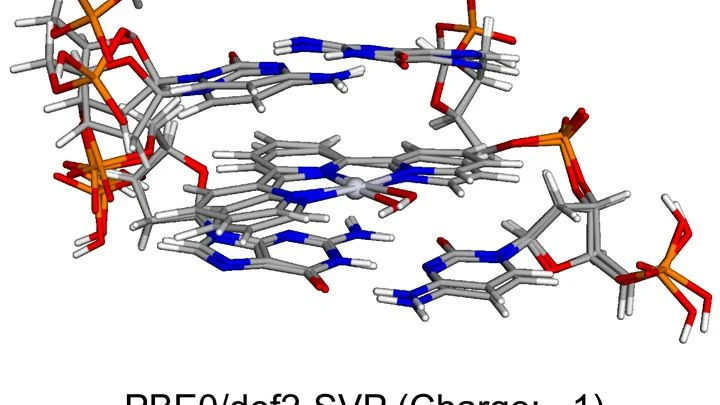
Standard chemotherapy hits the whole body like carpet bombing: both cancerous and healthy cells suffer. Scientists are hunting for more precise weapons — molecules that light up when they slip into a cancer cell's DNA, revealing its location. Such glowing probes could help doctors spot tumors early and even destroy them with pinpoint accuracy, leaving neighboring tissue untouched.
A cell is like a kitchen where thousands of recipes (genes) are collected in one thick book (DNA). The chef-protein Klf4 flips through the pages and decides which recipe to cook today. But how does it find the right line among billions of letters? Previously, researchers thought the protein looked for a short 'password'—a few consecutive letters.
In every cell lives a tireless scribe — an enzyme that copies the long thread of DNA. It moves along it like a read head over a tape, building a new strand alongside. It picks letters by strict rule: opposite A it always places T, opposite G it places C. But sometimes, very rarely, its hand trembles, and a different letter slips in.
Genetic diagnostics is like comparing two photos taken with different cameras. If one camera slightly shifts the colors, the image will show "defects" that don't exist in reality.
You need to sift through millions of keys to find the one that unlocks the lock of a disease. Each key is a molecule, and the lock is a protein in our body. Checking each key manually is impossible, so chemists use computer models that predict how a molecule will behave in reality. Until recently, accurate calculations took hours or days on powerful computers. The new tool AceFF does it in seconds.
Every cell is a miniature tuning fork. A sharp magnetic pulse makes it 'ring', and the decay of that sound depends on what's inside: viscosity, density, composition. A tiny diamond with a structural defect acts like a hypersensitive microphone, picking up magnetic echoes from individual cells.