Oblique Drop Impact: How Direction Decides the Fate of a Splash ✛
A raindrop slides on the wind and hits the ocean not straight down but at an angle. At that moment, its energy splits into two channels: one pushes the water forward along the flight path, the other presses it downward into the depths. Which channel proves stronger determines what happens at the surface: a quiet submergence, a fan of spray to one side, or a crown that shatters in all directions.
The researchers recreated such impacts on a computer, accelerating a virtual drop to 8 meters per second and varying its impact angle from nearly horizontal to vertical. It turned out that the surface responds in one of five scenarios. If the drop hits weakly, it simply sinks. If the impact is stronger but glancing, spray flies only forward, as if the drop drags a trail behind it. With a more vertical impact, the trail breaks into side jets, and with even greater force, the liquid throws out a crown that breaks into dozens of small droplets.
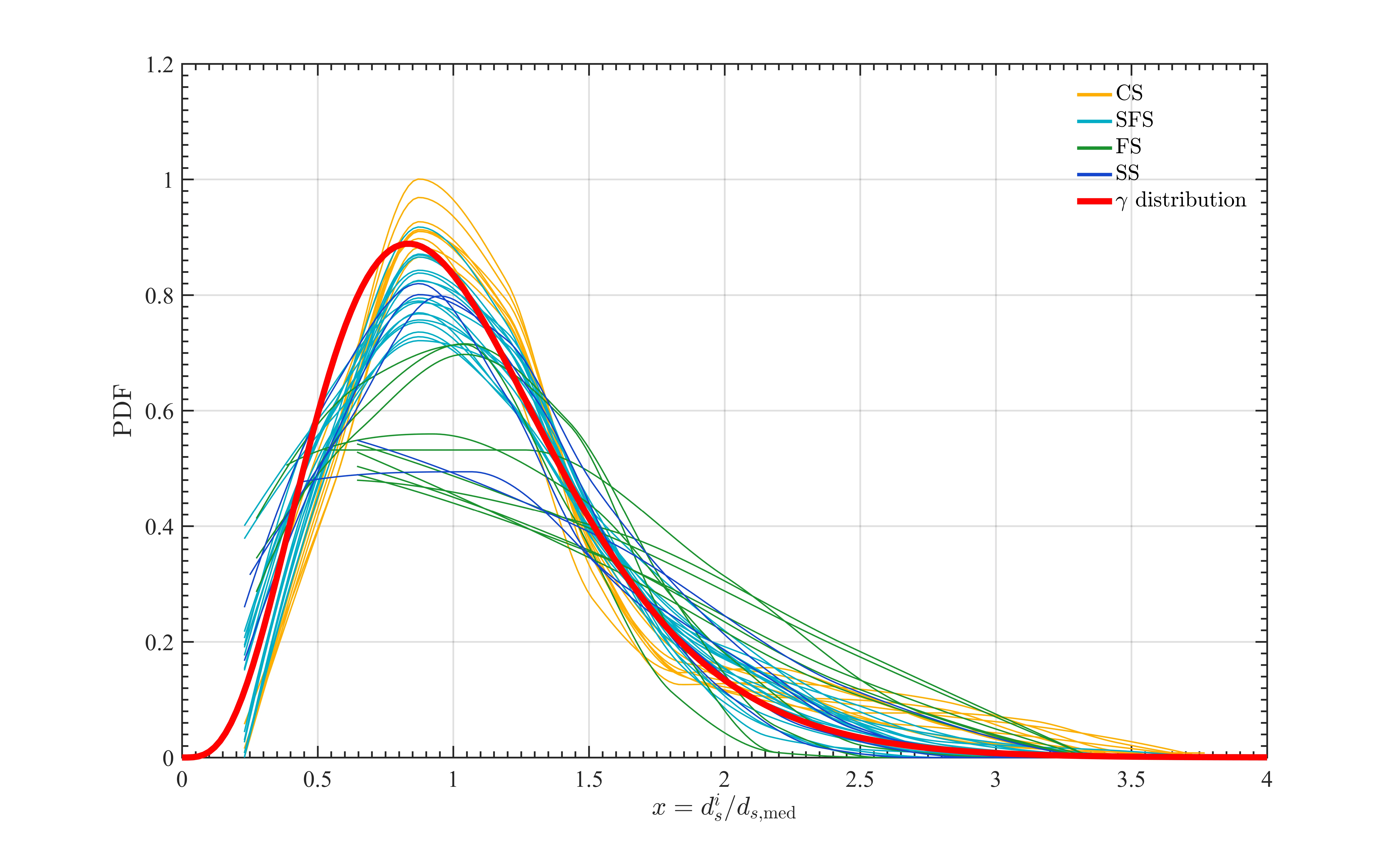
The most interesting events happen after the crown breaks. The small droplets that detach from it are not random in size. The stronger the impact, the smaller they are: the diameter decreases according to a strict law, as if the liquid divides itself into ever thinner slices. The number of droplets grows even faster, and this is not a coincidence but a consequence of the fact that the mass ejected from the crown hardly changes.
A hundred years ago, engineers designing steam turbines puzzled over how water droplets erode blades. Today, the same physics determines how much salt enters the air after a storm and how quickly the ocean absorbs carbon dioxide. An oblique drop falling into water turns out to be a key to processes of planetary scale.
At the most violent impacts (We > 2000), the droplet can create a bubble dome and eject tiny droplets even before the crown forms. In the ocean, such droplets, when evaporating, leave salt particles that become cloud condensation nuclei.