Dutchman Willebrord Snellius in 1621 recorded tables for angles and found a law relating sines. Later Descartes published it in 1637. The essence: the 'slower' light is in a medium, the more it refracts. Analogy: a column of soldiers marching diagonally from asphalt onto sand — the rank stepping on sand slows down, and the line turns.
History
Willebrord Snellius experimentally discovered the law in 1621, using geometric constructions. The first printed account was given by René Descartes in 1637 in his treatise 'Dioptrics'. Pierre Fermat later derived the law from the principle of least time, laying the foundations of geometric optics.
How it works
Used to calculate ray paths in lenses, prisms, waveguides. The law is valid for linear isotropic media and monochromatic radiation. It breaks down in anisotropic crystals (birefringence), in nonlinear optical effects, and at boundaries with significant diffraction.
In practice
Manufacture of eyeglass lenses, camera lenses, microscopes, and telescopes; fiber optic cables for the internet; explanation of rainbows and mirages.
Fun fact
Thanks to total internal reflection — the reverse effect — light can run along a curved stream of water, just like through a wire.
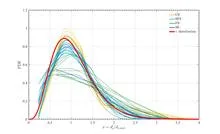
A wave packet is like a traveler who either loses steam and spreads out along the way, holds a steady pace, or gathers into a fist. In a 50-meter flume with water 5 meters deep, scientists tracked how a bell-shaped group of waves behaves when its height is changed but not its width.
A raindrop slides on the wind and hits the ocean not straight down but at an angle. At that moment, its energy splits into two channels: one pushes the water forward along the flight path, the other presses it downward into the depths. Which channel proves stronger determines what happens at the surface: a quiet submergence, a fan of spray to one side, or a crown that shatters in all directions.
The merger of two neutron stars is not just a collision. Even before they touch, they deform each other through tidal forces, and this deformation depends on how 'soft' or 'stiff' the matter inside is. Stiff matter resists more; soft matter changes shape more easily.
In the brain's white matter, the signal travels along axons — long neuronal processes wrapped in an insulating myelin sheath. Water fills the space inside axons and outside, in the narrow gaps between fibers.
In the intricate dance of active turbulence, where invisible engines spawn chaos, a soft droplet takes on the role of a detective. Its shape is not merely an outline but a sensitive cipher: it reads the hidden signals of its environment.
A lump of sugar drops into hot tea, a spoon stirs a few times, and the sugar disappears. But how exactly does it spread through the churning liquid? Physicists have peered into this process with unprecedented detail: they simulated turbulence on a grid of 8192³ points. If you were to split every millimeter of the cup into a hundred cells, you'd get a similar resolution.
An ordinary light sensor answers the question "how much light" but not "where did it come from." To do that, you need lenses, mirrors, or entire arrays. In a new study, researchers propose a sensor that determines the direction of a light beam on its own, without any optics.
Entangled photons are like two couriers marching in lockstep: their quantum states, particularly polarization, are synchronized so that measuring one instantly determines the state of the other, even at a distance. In a material, this synchronization gets disrupted.
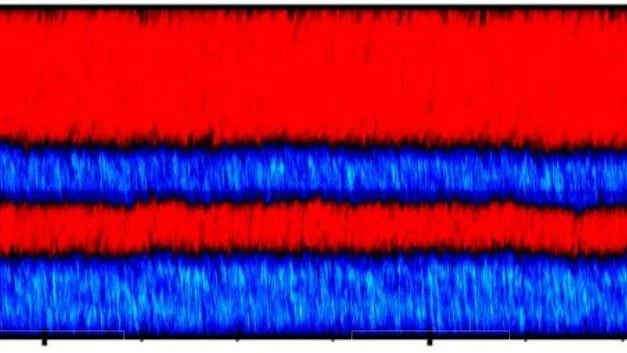
A pot of water heated from below is a simple example of turbulence. Hot fluid rises, cold fluid sinks, and the flow spontaneously breaks into rotating cells that look like horizontal rolls. In a new study, physicists took a wide rectangular container (ten times longer than its height) and tracked how many such rolls appear.
The ocean is like a layered cake: warm, light water on top, cold, heavy water below. Between the layers, at the interface, invisible waves roam. They don't lift crests like a storm; instead, they slowly rock the entire water column, as if someone were shaking a giant aquarium from within.
A gravitational-wave detector catches not only the roar of mergers but also the quiet splash when a star or gas cloud dives into a supermassive black hole. Such a dive, like a stone falling into a well, generates waves at all frequencies at once—and in that spectrum lies encoded the nature of the well itself.
The galaxy NGC 1560 is a modest island of stars and gas ten million light-years away. Its rotation curve, first measured in 1991, became an icon for those seeking an alternative to dark matter. The plot of rotation speed versus radius shows bends that seem to exactly mirror the bends in the distribution of ordinary matter.