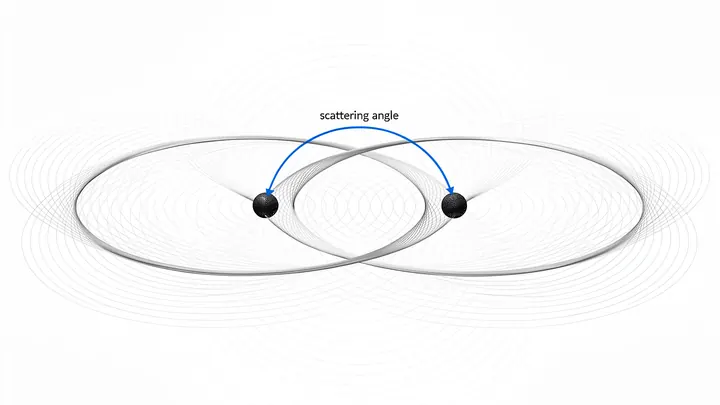
The scatteringangle is the angle between a particle's initial direction of motion and its direction after a collision with another particle or a potential field. It is a fundamental observable in physics, encoding information about the forces and structure of the scattering target. In particle physics, measuring scattering angles reveals the internal structure of protons and nuclei; in astrophysics, it helps trace the paths of cosmic rays; and in materials science, it is used to probe crystal lattices.
History
The concept dates back to Ernest Rutherford's 1911 gold foil experiment, where the scatteringangles of alpha particles revealed the existence of a tiny, dense nucleus. The theoretical framework was later formalized in quantum mechanics by Max Born and others.
How it works
When a projectile approaches a target, the interaction potential deflects it. The scatteringangle depends on the impact parameter (how 'off-center' the collision is), the energy of the projectile, and the shape of the potential. By measuring the distribution of scattering angles (the differential cross-section), physicists can infer the potential and the target's properties. For quantum scattering, the angle distribution also shows interference patterns due to wave nature.
In practice
Scatteringangles are used in medical imaging (e.g., X-ray diffraction), in particle accelerators to identify new particles, and in neutron scattering to study the structure of materials.
Fun fact
In Rutherford's experiment, most alpha particles passed straightthrough with zero scatteringangle, but a tiny fraction bounced back at angles greater than 90 degrees—a result that was 'as surprising as if a cannonball rebounded from a sheet of paper.'
A drying puddle of mud becomes covered with cracks, like an old painting with craquelure. At first the cracks meet at nearly right angles, forming a rough grid. But if the mud is wetted again and allowed to dry, the pattern changes: cracks begin to meet in threes, at an angle of 120 degrees, like a honeycomb.
Why this happens remained a mystery for a long time.
A raindrop slides on the wind and hits the ocean not straight down but at an angle. At that moment, its energy splits into two channels: one pushes the water forward along the flight path, the other presses it downward into the depths. Which channel proves stronger determines what happens at the surface: a quiet submergence, a fan of spray to one side, or a crown that shatters in all directions.
Toss a handful of sand onto a table — the grains scatter equally in all directions. But if a magnet is hidden under the table and the sand is iron, the trajectories get trickier: an invisible structure overlays the chaos. That's roughly how molecular motion works inside a living cell.
Three billiard balls scatter across the table after a strike: their trajectories depend only on the initial push. But in the world of atomic nuclei, things are more complex: particles sense each other on the fly, even if they are not bound together. For a long time, physicists could only measure pairwise interactions, while what happens when three meet remained behind the scenes.
A black hole is not an absolutely black bag. In 1974, Stephen Hawking showed that it glows — faintly, but continuously. This radiation is born not inside, but outside, right at the boundary from which even light cannot escape.
A new study sharpens the picture.
In the scorching core of a star, two helium nuclei approach each other like two dancers on a crowded stage. Their dance is alpha scattering, the basis of stellar helium burning. How smoothly they twirl determines how quickly the star burns its fuel.
Previously, this dance was described in simplified terms.
When black holes approach and then fly apart — without merging, just grazing each other's gravitational fields — they become ideal projectiles for testing the laws of gravity. In extreme fields, where time dilation reaches monstrous magnitudes, any crack in the theory would flash dazzlingly bright.
A flashlight beam in fog breaks into thousands of faint specks. Each speck is light that has bounced off countless water droplets before reaching your eye. To make sense of this mess, physicists construct a special table — the scattering matrix. It records how each incoming ray turns into a set of outgoing ones.
An atomic nucleus usually has a well-defined shape — elongated like a melon or flattened like a pumpkin. But silicon-30 behaves differently: it seems unable to make up its mind.
Two particles cling to each other like climbers on the same rope and fly toward a wall. When they hit, will they bounce off together, or will the rope snap? What does it depend on? Physicists considered the simplest case: everything happens on a single line, the particles attract only when they occupy the same point, and the wall is perfectly rigid.