Oblique Drop Impact: How Direction Decides the Fate of the Splash ✛
Context
This work sits at the fringe of neighboring research: nearby studies on droplets focus on microplastics in rain, soft particles in turbulence, or gel droplets on glass. None of them examines oblique droplet impact on a deep pool from the perspective of splitting inertia into components. The authors fill this gap by building on classic experiments of normal impact and recent work on oblique impact onto thin films, but they extend the analysis to a deep pool, which is closer to real ocean conditions.
Methods
They used the open-source code FluidX3D, which implements the lattice Boltzmann method with a free surface. Water droplets with diameters of 2.0–4.1 mm were launched at an angle onto a deep pool (depth four times the droplet diameter) at speeds from 1 to 8 m/s. A grid with a step of 10 μm resolved secondary droplets as small as about 50 μm. For each case, they tracked crown morphology, formation of finger-like jets, and detachment of secondary droplets. Validation was performed against experimental images from Liu (2018) for three different impact conditions.
Results
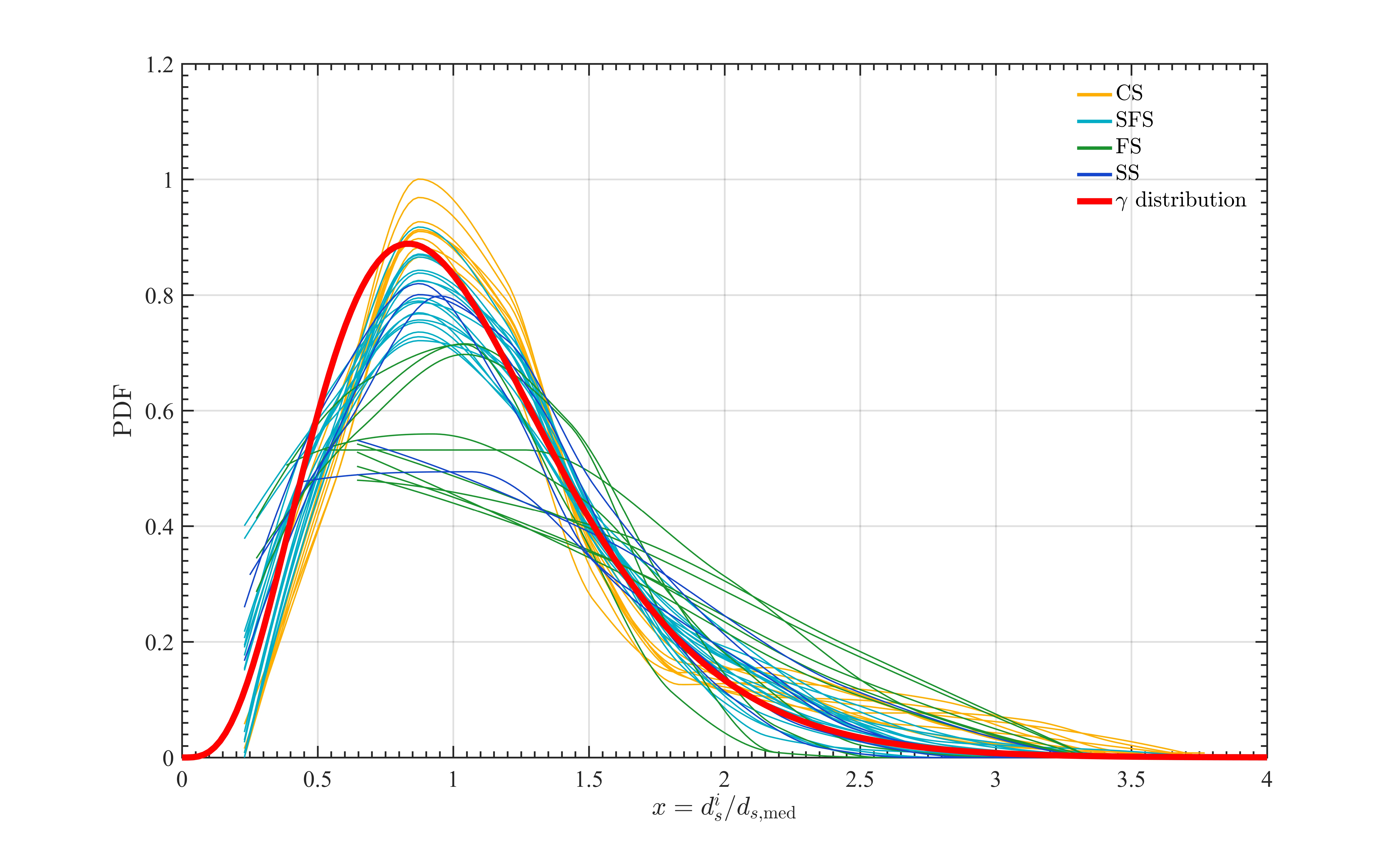
In the We–θ plane, they identified five regimes: deposition, forward splashing (only downstream), side splashing (only to the sides), forward-side (both), and crown (around the entire impact point). The transition from deposition to forward splashing is described by the parameter Ks = We cos θ with a critical value around 120. This threshold is derived from the competition between downstream crown-edge inertia and capillary retreat at the Taylor-Kulik velocity. The transition from forward to forward-side splashing is governed by the normal Weber number with a threshold of We_N ≈ 318. Statistics of secondary droplets showed that their size distribution is positively skewed and resembles a gamma distribution. The median droplet diameter follows the law ds,med/D ~ We^(-3/5). Using second-order velocity structure functions, the authors showed that the characteristic velocity fluctuation at the scale of the median droplet obeys Kolmogorov scaling. Substituting this scaling into the capillary-inertial balance condition yields the observed exponent -3/5. Combined with an almost constant mass fraction transferred to secondary droplets, this leads to the law Ns ~ We^(9/5), explaining the experimentally observed dependence.
Implications
Unlike neighboring studies that focus on other aspects of droplets (microplastics, soft particles, gel droplets), this research is the first for a deep pool to link macroscopic splash regimes to the separation of inertia into tangential and normal components. Furthermore, it provides a physical explanation for the 9/5 exponent in the law for the number of secondary droplets, which was previously purely empirical. This allows transferring criteria developed for thin films to more realistic ocean conditions.
Future development
The topic could evolve toward accounting for wind shear, water salinity, and the presence of surfactants, which alter surface tension. It would also be interesting to investigate the influence of turbulence in the pool and the interaction of multiple droplets, which is closer to real rain.
Impact
The results could improve models of gas exchange and transport of heat, carbon, and microplastics across the ocean-atmosphere interface, as well as refine remote sensing of rain cells from radar data.
Next steps
Conduct laboratory experiments with high-speed imaging to verify the predicted thresholds Ks and We_N in a deep pool. Extend the range of Ohnesorge numbers to test the universality of the scalings.
Key open problems
In droplet hydrodynamics, an open question remains how exactly the crown and ligaments fragment into secondary droplets. This work shows that the capillary-inertial balance at the droplet scale works across different regimes, but it does not explain why the size distribution has a gamma-like shape rather than a universal one. Also unresolved is the influence of turbulence in the receiving liquid on the splashing process.
The knowledge machine's view
This section is addressed to the author of the paper and their colleagues. Neighbouring works were found by meaning-based search across our archive, not by word overlap. We do not review: we show the field around the work.
What the work does
The authors numerically studied oblique droplet impact onto a deep pool over a wide range of Weber numbers and impact angles, identified five splashing regimes, and described the transitions between them using tangential and normal inertial parameters. Based on statistics of secondary droplets, they derived the scaling laws ds,med/D ~ We^(-3/5) and Ns ~ We^(9/5), explaining them from the balance of capillary and inertial forces with Kolmogorov scaling of velocity fluctuations.
Where its strength is
For the first time, this work links splashing regimes in a deep pool to the separation of inertia into tangential and normal components, and provides a physical explanation for the 9/5 exponent in the secondary droplet number law through capillary-inertial balance and turbulent fluctuations.
Where it could go next
- It might be interesting to compare the obtained regimes and secondary droplet laws with droplet behavior on thin films or other surfaces, where curvature and film thickness effects may alter splashing thresholds.based on: A Drop Strikes Differently arXiv:2603.18615
- A related study on the influence of rain on microplastic transfer from the surface to the air could benefit from your results on oblique impact and secondary droplet generation to refine mechanisms under real wind and wave conditions.based on: How Rain Launches Microplastics into the Air arXiv:2603.15896
- Our archive includes a study of gel droplets on glass, examining the interaction of liquid with an elastic network; adapting your approach to non-Newtonian or elastic droplets could broaden understanding of splashing in complex fluids.based on: Gel Droplets on Glass: A Dance of Liquid and Elastic Network arXiv:2604.16811
Worth trying
- Test whether the critical value Ks ≈ 120 holds for droplets with different diameters and fluid properties (viscosity, surface tension).
- Apply the same inertia-separation analysis to impact onto an inclined solid surface or a thin film to see how regime thresholds change.
- Use your methodology to model oblique impact of droplets containing solid particles (e.g., sand or microplastics) to assess their transport in secondary droplets.
Why this may matter
The results may be useful for predicting spray generation from rain over the ocean, which is important for heat, gas, and aerosol exchange between the ocean and atmosphere, as well as for the transport of contaminants from the water surface.
Nearby works in our archive
- The Rain That Counts Its Dropssimilarity 0.51
- Bubble Catapult: How Bubble Curvature Controls the Jetsimilarity 0.49
- How Rain Launches Microplastics into the Airsimilarity 0.49
- Spin from Bend: How Curvature Twists Soundsimilarity 0.48
- How the Electron's Shape Controls Gamma Lightsimilarity 0.48
- Gel Droplets on Glass: A Dance of Liquid and Elastic Networksimilarity 0.47
- A Drop Strikes Differentlysimilarity 0.47
The archive is sparse around this work: the closest review is only 0.51, against a usual 0.64. It looks like few have drilled nearby.
At the most violent impacts (We > 2000), the droplet can create a bubble dome and eject tiny droplets even before the crown forms. In the ocean, such droplets, when evaporating, leave salt particles that become cloud condensation nuclei.
Key numbers
- critical value of Ks: 120
- critical normal Weber number: 318
- range of Weber numbers: 41–1790
- range of impact angles: 10°–90°
- exponent in the law for number of droplets: 9/5