The impact parameter is the perpendicular distance between a body's initial velocity vector and the center of a gravitational source, such as a star or planet. It is a key quantity in scattering problems, describing how 'off-center' a collision or flyby is. In gravitational physics, the impact parameter determines the trajectory's shape: a small impact parameter leads to a strong deflection or even a bound orbit, while a large one results in a nearly straight path. It is also used in nuclear and particle physics to describe the geometry of collisions between particles.
History
The concept was introduced in the context of classical scattering theory in the 18th and 19th centuries, notably by Pierre-Simon Laplace in celestial mechanics. It was later applied to atomic and nuclear scattering by Ernest Rutherford in 1911, who used it to explain the gold foil experiment.
How it works
In a two-body gravitational encounter, the impact parameter b, along with the relative speed and masses, sets the angular momentum of the system. For a given initial speed, a smaller b means the body passes closer to the source, experiencing a stronger gravitational force and a larger deflection angle. The relationship is quantified by the Rutherford scatteringformula (adapted to gravity), which gives the scattering angle as a function of b. In general relativity, the impact parameter also determines the closest approach and whether a photon or particle is captured by a black hole; the critical value for photon capture is related to the photon sphere.
In practice
It is used to design gravitational assist maneuvers for spacecraft, to predict the trajectories of near-Earth objects, and to analyze particle collisions in accelerators and cosmic ray interactions.
Fun fact
For a black hole, the critical impact parameter for photon capture is about 2.6 times the Schwarzschild radius, meaning light passing closer than that is inevitably swallowed.
A raindrop slides on the wind and hits the ocean not straight down but at an angle. At that moment, its energy splits into two channels: one pushes the water forward along the flight path, the other presses it downward into the depths. Which channel proves stronger determines what happens at the surface: a quiet submergence, a fan of spray to one side, or a crown that shatters in all directions.
A light ray passing by a massive body slightly changes its direction, like a stream of water bending around a rock in a creek. In the solar system, there are many such "rocks": planets, their moons, asteroids. And each one, with its own gravity, bends the path of light coming from distant stars.
A thrown stone arcs through the air and falls. A planet orbiting a star is the same stone, but it falls forever, looping around the star in a closed curve. In Newton's world, that curve is a perfect ellipse, and the planet returns to the same point each orbit. In reality, the orbit slowly rotates: its closest point to the star, the perihelion, shifts.
A quantum particle can be a wave, and pass through two paths at once. But if something 'peeks' at which path it took, the wave disappears. This effect is called loss of interference. Usually, photons or air molecules do the peeking.
A stick thrown into a pond sinks straight down. But if the pond's water is slowly rising, the stick will be delayed and sink somewhere unexpected. So it is with black holes: we usually assume they sit in a void, but the entire universe is gently stretching. This stretch, like the rising water, slightly alters the path of anything orbiting nearby.
Interstellar wanderers are rocks and icy chunks that have broken free from their home planetary systems and now drift through the Galaxy. The first such visitor, 'Oumuamua, zipped past the Sun in 2017, followed by Comet Borisov and the ATLAS object. Where do they come from?
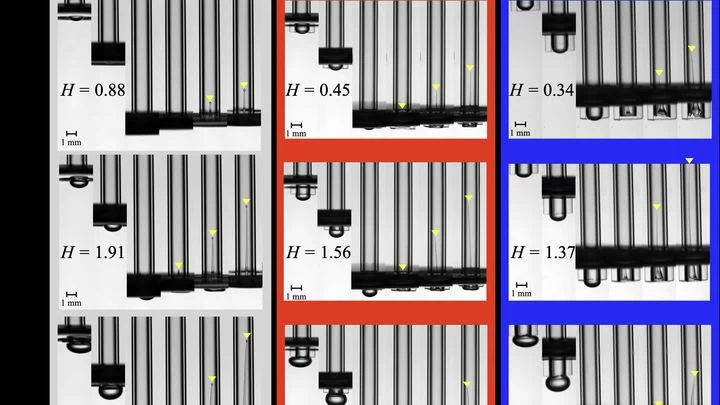
A drop falls into a glass, and a tiny jet, a thin fountain, shoots up from the surface for an instant. Something similar happens with a bubble stuck to the wall of a tube when you yank the tube downward. Water around the bubble rushes in, and a jet fires from its top. The speed of this jet depends on the bubble's shape — how much it bulges, like an umbrella dome.
Two particles cling to each other like climbers on the same rope and fly toward a wall. When they hit, will they bounce off together, or will the rope snap? What does it depend on? Physicists considered the simplest case: everything happens on a single line, the particles attract only when they occupy the same point, and the wall is perfectly rigid.