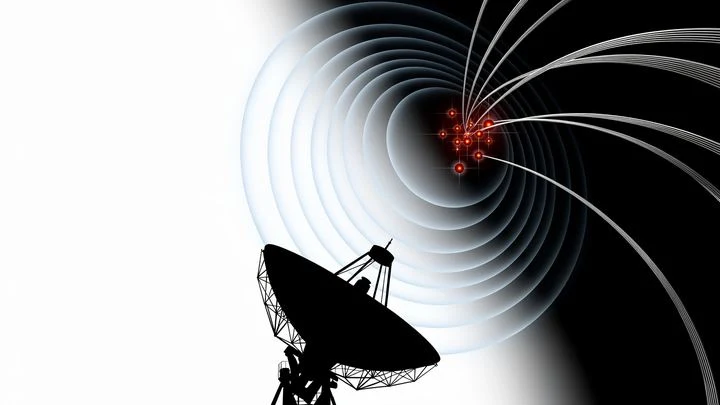
The ionosphere is a region of Earth's upper atmosphere, extending from about 60 km to 1000 km altitude, where solar radiation ionizes atoms and molecules, creating a plasma of free electrons and ions. This layer is crucial for radio communication because it reflects and refracts radio waves, allowing signals to travel beyond the horizon. In the context of the given titles, the ionosphere is used as a natural resonator for electromagnetic waves, enabling experiments that probe its properties and the effects of solar activity.
History
The existence of the ionosphere was first proposed in 1901 by Guglielmo Marconi and Oliver Heaviside to explain long-distance radio transmission. The term 'ionosphere' was coined by Robert Watson-Watt in 1926, and systematic study began with radio sounding experiments in the 1920s.
How it works
Solar ultraviolet and X-ray photons knock electrons off neutral atoms, creating free charges. The density of these charges varies with solar activity, time of day, and altitude. When radio waves encounter the ionosphere, they interact with the free electrons, causing the waves to bend or reflect back to Earth. This plasma also supports characteristic oscillation frequencies, such as the plasma frequency, which determines which frequencies are reflected or transmitted.
In practice
The ionosphere is used for long-distance radio communication, GPS signal correction (accounting for ionospheric delay), and over-the-horizon radar. It also affects satellite drag and is studied for space weatherforecasting.
Fun fact
The ionosphere can act as a giant natural antenna, and lightning strikes in the lower atmosphere can induce 'whistler' waves that travel along Earth's magnetic field lines through the ionosphere and into space.
Picture a guitar string stretched between two frets. When you pluck it, a standing wave forms: some points on the string oscillate strongly, while others, the nodes, remain almost still. The chromosphere, a layer of the solar atmosphere sandwiched between the photosphere and the corona, behaves in much the same way.
The Sun has quiet regions where the magnetic field is barely visible. But even there, sound waves find loopholes to rise higher. These loopholes are magnetic tubes that expand upward like funnels. Inside them, sound travels more freely.
Pulsar PSR J1740+1000 is a city-sized star spinning faster than a kitchen blender. After a supernova explosion, it left behind a dense core that accelerates particles to near-light speeds. These particles fly into space, and previously it was thought they scatter in all directions, like splashes from a stone thrown into water.
Light from quasar J0744+2052 traveled to us for almost 12 billion years. Along the way, it bumped into hydrogen clouds that snatched individual lines from the spectrum — like a comb sifting through delicate frequencies. Astronomers call this pattern the Lyman-alpha forest in spectroscopy.
The Sun is a boiling cauldron of hydrogen and helium, where scorching gas is caught in magnetic snares. When invisible ropes reconnect, energy comparable to billions of thermonuclear explosions is released. Where does it go?
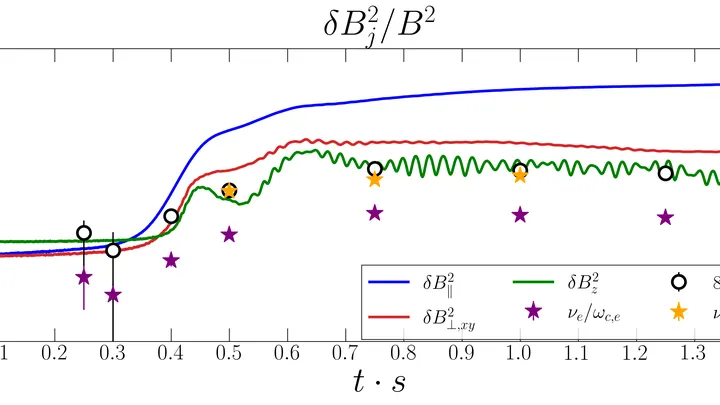
A crowd is trapped in a narrow corridor between two rows of mirrors. Every now and then, someone shoves the wall hard, and a rumble rolls down the corridor — similarly, in the plasma of galaxy clusters, whistler waves and ion-cyclotron waves appear.
Gravitational waves are ripples in space from the mergers of black holes and neutron stars. Existing detectors, built with contributions from Kip Thorne and Rainer Weiss, work like highly sensitive microphones but only hear the highest 'notes'.
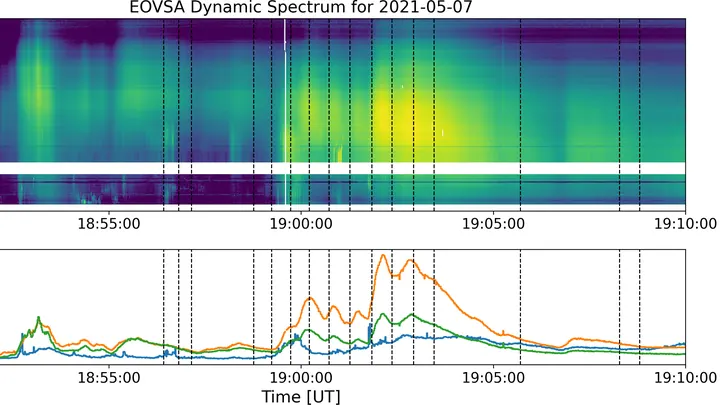
The ionosphere at an altitude of 70 kilometers acts like a giant mirror for radio waves. Ground antennas constantly beam signals into it and listen for the reflection. When a solar flare occurs on the Sun, a stream of X-rays reaches Earth in 8 minutes and compresses the lower layer of the ionosphere.
The crown of a huge tree sways in the wind, but the roots and trunk are hidden underground. On the Sun, magnetic fields play the role of such invisible roots. They emerge from the depths, thread through the entire atmosphere, and govern the motion of the hot gas — plasma.
A planet's magnetic field is like an invisible shield: it catches charged particles from the solar wind and stretches out behind the planet into a long tail, like a fluttering scarf.
In the cold gas cloud where a star is born, chemistry sleeps. Molecules barely collide, reactions stall. But when a charged particle zips through the cloud, it knocks electrons off atoms — ionizing them. That's how active ions appear in a dormant cloud, ready to build new molecules.
A gas bubble in water sings loudly — this is Minnaert resonance: the heavy liquid prevents the bubble from compressing quickly, forcing it to vibrate. In air, there's no such effect: air is too light. But if you dress the bubble in a soft silicone shell, like rubber, it plays the role of the water mass. You get an 'elasto-bubble'.
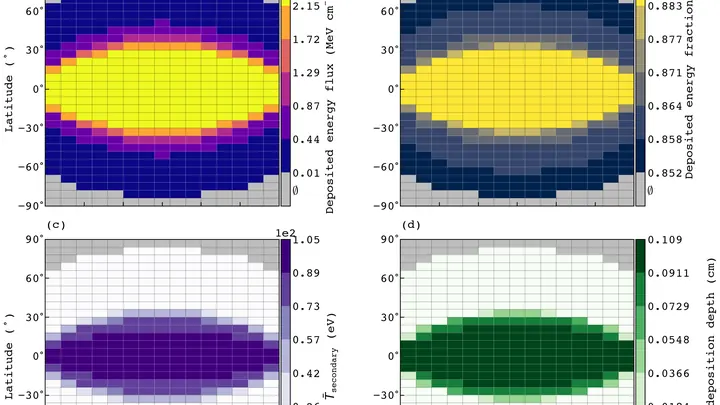
Europa's surface is an icy armor continuously bombarded by charged particles from Jupiter's magnetosphere. Electrons slam into the ice's crystal lattice, lose energy, and kick off chemical reactions. Until now, there was no tool to show how deep such bombardment pierces the ice.
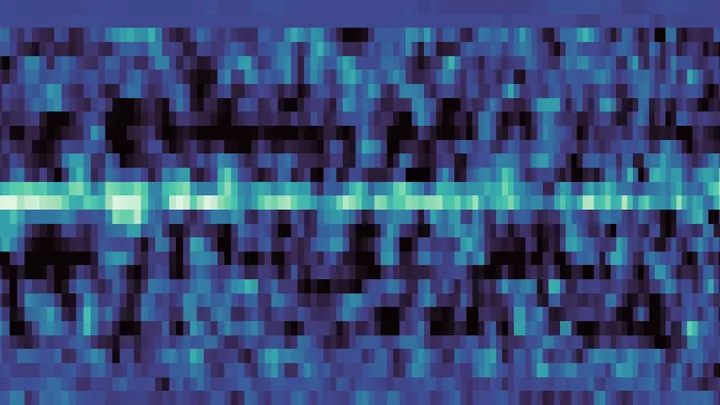
Light from a distant galaxy traveled to us for 13.4 billion years. The James Webb Space Telescope caught it and split it into colors. The spectrum shows a bright hydrogen line, like a fingerprint saying that galaxy GS-z13-1-LA is actively forming stars.
Young hot stars inside the galaxy act like floodlights.
Above Jupiter's poles, auroras blaze as electrons are accelerated by electric fields and slam into the upper atmosphere, making the gas glow. But not all electrons head downward. Some, it turns out, get a kick in the opposite direction — away from the planet, into deep space.
If you build a giant blanket around a star, you get a Dyson sphere. It absorbs all the radiation and glows in invisible heat rays. No such sphere has been seen yet, but astronomers know: to find it, look for this thermal glow.
A solar flare is like a giant spring that gets twisted and twisted, and then suddenly snaps. The energy stored in the magnetic field is unleashed into space within minutes, heating plasma to millions of degrees.
The scorching gas streaming from the Sun is not a continuous flow but rather a soup of charged particles. In this soup, waves constantly boil up: electric fields flare and fade like ripples on water from a tossed stone. One such wave is the ion-ion acoustic wave.
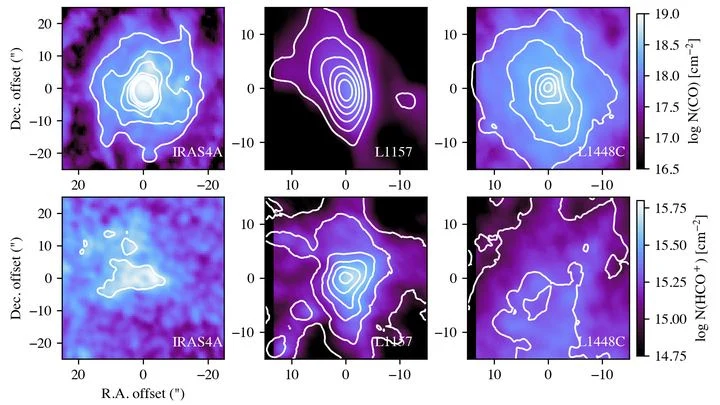
In cold clouds of interstellar gas, carbon hides inside carbon monoxide (CO) molecules, like sugar dissolved in tea. But near hot, massive stars, this 'tea' boils: harsh radiation tears the molecules apart, and carbon escapes as lone atoms or ions.
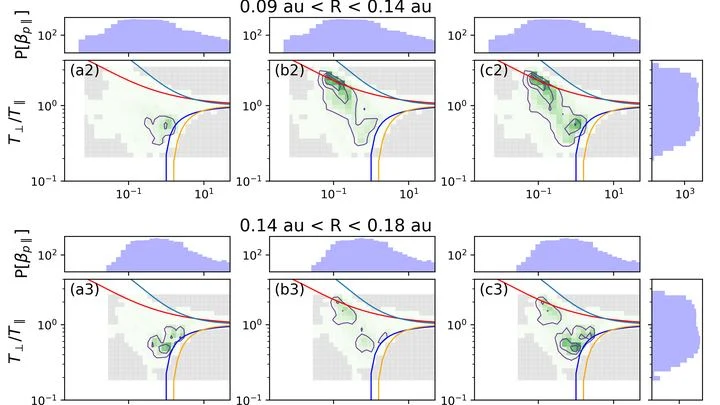
The solar wind isn't a calm stream but a bubbling soup of charged particles. Diving close to the Sun, the Parker probe picked up two types of stirring waves. Left-handed ones, like a whisk in a chef's hand, whip up the material when the temperature differs along and across the flow.
The Moon is not just a rocky sphere, but a giant bell. Passing through it, gravitational waves cause it to vibrate almost imperceptibly. This tremor was predicted by Einstein, and Weber was the first to try to hear it with Earth-based detectors.
The Moon is not just a satellite; it is a potential gravitational bell. When massive bodies collide, spacetime shudders, and that shudder, gravitational waves, makes everything in their path vibrate.
The RATAN-600 radio telescope is a ring of hundreds of aluminum panels on a mountainside in Karachay-Cherkessia. In the spring of 2018, its mirror caught radio waves from sixteen red dwarfs — small, dim, but very long-lived stars.