The Piston That Waits for Emptiness ✛
A piston in a cylinder with gas usually moves when the gas pushes on it. But there is a piston that moves when the space in front of it is empty. Every five seconds, it checks the space near its wall, and if no one is there, it takes a step inward, compressing the gas without direct mechanical force. That is how an information engine works: it converts knowledge about particle positions into useful work.
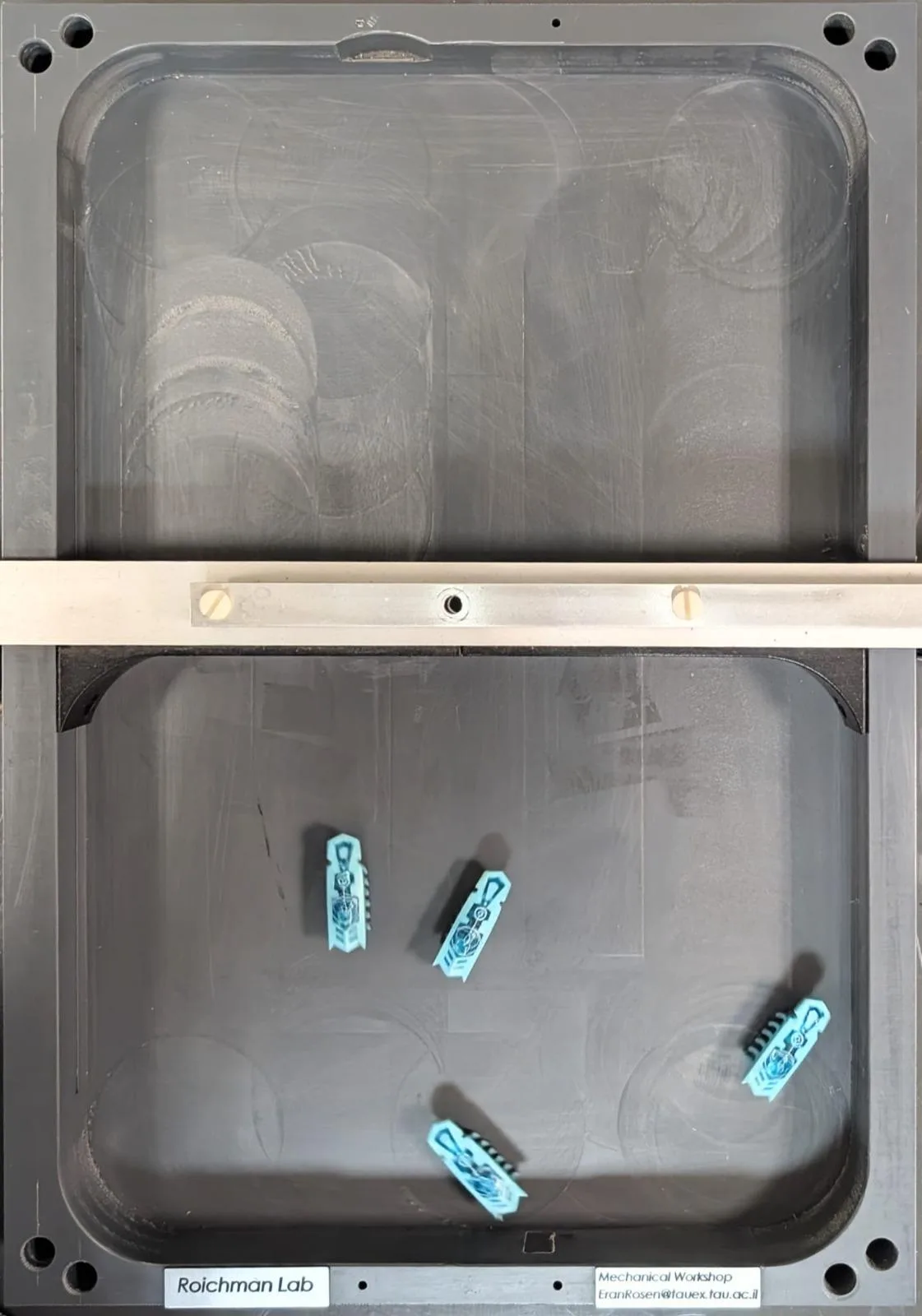
In the new experiment, the working substance is not an ordinary gas but a gas made of self-propelled robots. These palm-sized brush robots vibrate and crawl around the arena like living creatures, and they accumulate at the walls. That accumulation is exactly what changes the rules of the game. For an ordinary gas, the average work per measurement follows a universal formula, and the maximum is reached when the probability of finding the region empty is about 37%. For an active gas, things are different.
At low robot density, it is advantageous to check large regions: they are empty more often, and the piston makes a large step. But when there are many robots, a boundary layer forms at the wall, and the optimal strategy switches. Now it is better to check a small region right next to the piston, within that layer, where emptiness occurs more frequently. The transition happens at an area fraction of about 8%, which is like having eight robots, each palm-sized, in a room of 30 square meters.
Even when the piston experiences dry friction and moves in jerks, the regime switching persists. This means that engineers designing micromachines powered by bacteria or artificial swimmers must account not only for particle energy but also for how particles accumulate at boundaries. The piston that waits for emptiness turns out to be smarter than it seems: it chooses where to look for that emptiness depending on how crowded things have become.
The energy scale of the active gas, α̃ ≈ 2.0 mN·cm, is 15 orders of magnitude larger than the thermal energy kBT at room temperature, reflecting the macroscopic size of the robots. Yet formally the pressure behaves like that of an ideal gas, only with temperature replaced by an 'active temperature'.
The idea of extracting work from information about particle positions echoes Maxwell's demon, which appears in many science fiction works, for example, in Stanislaw Lem's story 'The Demon' from the 'Cyberiad' cycle, where a demon of the second kind tries to circumvent the second law of thermodynamics.