Automation is the use of control systems, such as computers or robots, to handle processes with minimal human intervention. It spans from simple mechanical timers to complex artificial intelligence algorithms that adapt in real time. The goal is to increase efficiency, consistency, and safety while reducing human error and labor costs. Automation is a cornerstone of modern industry, but it also extends to homes, transportation, and data processing.
History
The concept of automation dates back to ancient times with water clocks and simple mechanical devices, but the term was coined in 1947 by Del Harder, an engineer at Ford Motor Company, to describe the automatic handling of parts in manufacturing. The development of programmable logic controllers in the 1960s and the rise of computers accelerated its adoption.
How it works
Automation relies on sensors to gather data about the environment, a controller to process that data and make decisions based on programmed logic or learned models, and actuators to execute the decisions. Feedback loops are critical: the system continuously compares the actual output to the desired setpoint and adjusts accordingly, a principle known as closed-loop control.
In practice
Automation is used in manufacturing assembly lines, self-driving vehicles, automated trading systems in finance, and smart home devices like thermostats that learn user preferences.
Fun fact
The earliest known automated device is the Antikythera mechanism, a Greek analog computer from around 100 BC that predicted astronomical positions and eclipses.
A piston in a cylinder with gas usually moves when the gas pushes on it. But there is a piston that moves when the space in front of it is empty. Every five seconds, it checks the space near its wall, and if no one is there, it takes a step inward, compressing the gas without direct mechanical force.
The race for fusion energy is like trying to bottle a lightning bolt. For decades, physicists have struggled to recreate on Earth the processes that power the Sun. The main challenge is getting light nuclei to fuse despite their mutual repulsion, while extracting more energy than was spent heating and confining the plasma.
The robot juggler catches and throws balls in precise rhythm with a human, like two пульсара sending pulses in unison. Juggling three balls is a classic cascade, governed by a steady beat, like the uniform rotation of a cosmic lighthouse. Break the rhythm and the pattern crumbles.
In calm water, the route is clear. But in turbulent flows, a robot needs a different strategy. Typical approaches demand an accurate map of currents, but in reality, you can't get one. Nature does it differently: fish feel pressure and vortices right against their bodies.
At intersections without traffic lights, people negotiate with glances. A self-driving car can't do that: it has to simultaneously decide whether to go or yield and plan its trajectory. Previously, these tasks were separated, making maneuvers jerky and dangerous.
Scientists have combined them using virtual force fields enveloping each car.
When a pipe bursts in the basement, a plumber acts step by step: locates the leak, measures the pressure, determines the cause, patches it up, and checks if it's dry. The same recipe — the standard model DMAIC — is being proposed against epidemics.
First, they determine the scope — how many hospital beds are occupied, which industries are sagging.
Technological disasters like Chernobyl rarely strike without warning. They gestate for years: organizations ignore warnings, their complexity mirroring the rise of entropy — a measure of relentless chaos that builds up unnoticed until it avalanches.
A person in a boat turns by shifting their body weight. An unmanned vessel uses the same trick: a sliding weight inside the hull does the steering. Its movement is controlled by a neural network, anticipating the chaos of waves and gusts of wind. The propeller pushes the boat forward, while the weight shifts balance — like moving from one foot to the other.
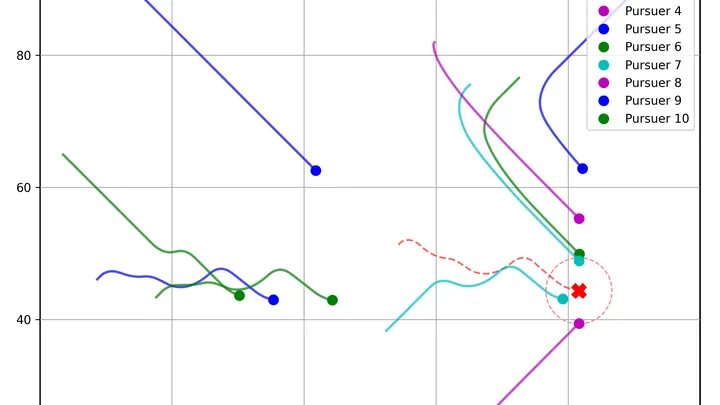
A robot swarm is like a cloud of fireflies: each moves on instinct to wherever is freer, and chaos turns into order. For a long time, it was a mystery how coherence emerges without communication or commands. The answer came with the creation of the Response Map — a tool that, like an X-ray, illuminates the hidden logic of the machine brain.
Code-writing assistants often behave like a chef who, to boil a single egg, rereads the whole cookbook. When asked to make a tiny fix, they reopen dozens of files and retrace long-familiar connections. This is unnecessary work — energy going to waste.
A wolf pack switches from chasing prey to defending its den in an instant. Engineers have instilled this same versatility into an algorithm for a robot swarm. The key is a method proposed by John von Neumann: instead of chasing the target, the robots calculate its future moves and block escape routes, like beaters cutting off trails.
Complex machinery, from drones to surgical robots, sometimes behaves like a wild mustang: full of disorder and whims, where the slightest touch triggers a storm. Instead of rote memorization of formulas, the new method observes the system like a horse breaker.
Inside each of us, invisible clocks are ticking. They control the release of cortisol — the hormone that helps us wake up in the morning, cope with anxiety, and keep our immune system on its toes. In adrenal insufficiency, these clocks break down: the body can't produce the right amount of cortisol on its own.
In the courtroom, a string is presented as input. Twelve jurors (computation paths) examine it symbol by symbol. Each can render a 'guilty' (accept) or 'not guilty' verdict. For a conventional nondeterministic automaton (NFA), one 'yes' vote suffices.
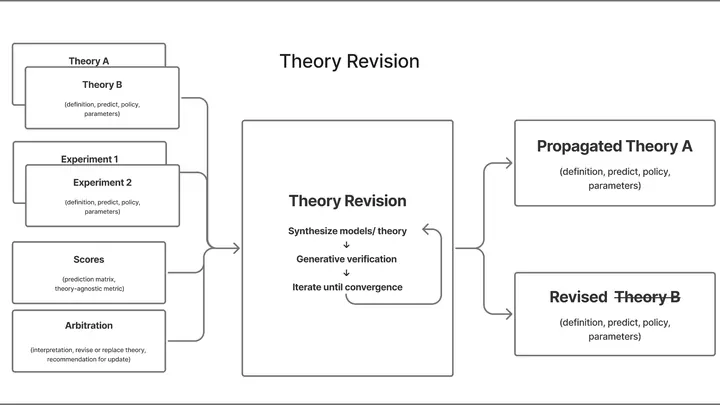
A closed loop: the machine proposes an idea, tests it on people, sees the failures, and spawns a new, more accurate guess. That's how AutoCog works — an automatic cognitive scientist. Previously, in the science of thinking (cognitive science), the hardest part, coming up with a theory, was done only by humans.
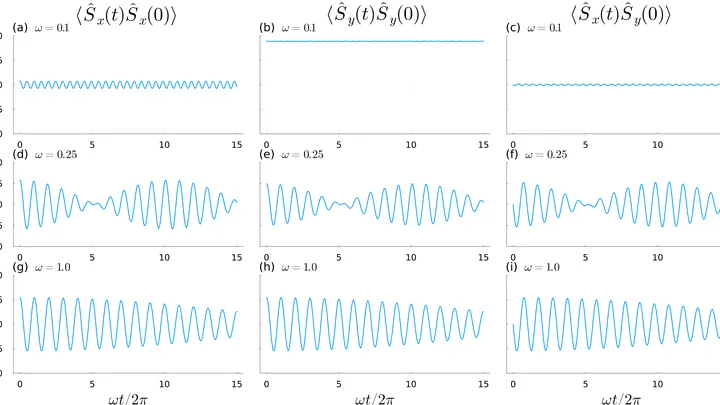
In the world of atoms and particles, everything tends toward rest: particles lose energy, just as a swing slows down due to energy loss (friction). But many devices — from hydrogen masers to atomic clocks — live by repetitive cycles.
Computational studies of material behavior have long suffered from two extremes: either fast but inaccurate models, or accurate but slow physical calculations. Modern programs, trained on data, have nearly resolved this dilemma — now the bottleneck is not computing power, but human routine: setting up simulations and checking results.
Paimon works like an autonomous chef.
Every morning you pick up the same mug, but the coffee tastes either bitter or just right. It's not about the coffee, and not about your character. Inside us, an invisible panel with dozens of sliders is constantly shifting: fatigue, hunger, anxiety, hormone levels.
A person looks at a door lock and sees a keyhole. They know that a key is inserted and turned. But if instead of a keyhole there's a touch panel, the familiar frame breaks. The person doesn't just make a mistake: they realize that the usual approach won't work and can say, "There's no place for a key here; a different approach is needed."
Such an honest stop with an explanation is rare for machines.
A driver turns the steering wheel to make the car turn. The quantum world also has its own "steering wheels"—external parameters that are slowly varied to shuttle particles from one place to another.
A neutron spectrometer is like a blind geologist who taps on rock and guesses what's inside by the sound. It sends a beam of neutrons into a crystal and watches how they scatter. From this pattern, you can deduce how atomic magnets, spins, oscillate. But where exactly to dig and how long to listen used to be decided by a human.
Now, the TAS-AI algorithm has taken the helm.
In a lab where crystals are studied, a technician stares at a screen covered in bright spots and slowly rotates the sample, trying to get the spots to form a symmetric pattern. It's like tuning an old radio: you turn the knob until the static gives way to a clear signal. Now, a machine can turn that knob.
Scientists have created a program that learns to align crystals without any knowledge of how those spots work.
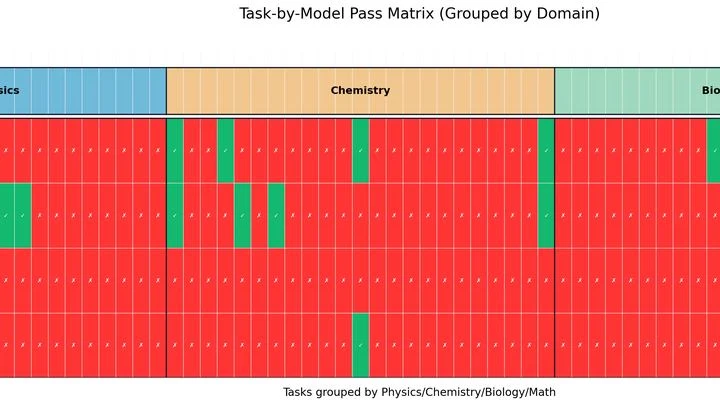
The best AI assistant for scientists scored worse on this exam than a C student on a pop quiz. Just 21% correct answers, and that's the ceiling for the four strongest models. The problems for the new test were written not by programmers but by graduate students: people who deal with real science every day.
The test is called COMPOSITE-STEM.
Creating a new material, like a tough alloy, requires thousands of computer experiments. Usually, a scientist manually writes instructions and hunts for errors. AutoMOOSE is a robotic kitchen: say 'I want a light and strong metal,' and five software chefs whip up a recipe, launch the synthesis, and adjust if something goes wrong.
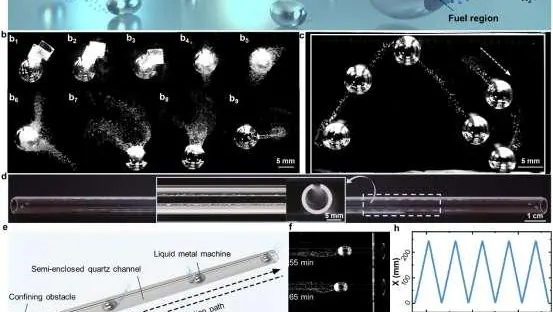
A droplet of liquid metal glides along a narrow channel like mercury from a broken thermometer. It needs no motor — the fuel is a chemical reaction with the surrounding liquid. But what happens when the droplet hits a wall? Previously, such machines were studied in open spaces, and in tight channels they behave differently.
A steady laser beam is like a taut string: if it vibrates even a little, the music turns into cacophony. In a quantum computer, the laser holds atoms in a trap, and any frequency jitter ruins the computation. That's why laser setups used to occupy entire tables, and tuning took weeks.
A film of a shattered cup played backward looks absurd: shards don't spontaneously reassemble. This intuitive sense of irreversibility is tied to the increase of entropy — a measure of disorder in a system. The second law of thermodynamics states that the entropy of an isolated system never decreases, setting time's direction from past to future.
A radiation sensor in the city is like a street musician: it has to hit the right notes even when fingers go numb from cold or the instrument is baked by the sun. Usually, such devices are kept in greenhouse conditions, with heating or cooling, otherwise the energy scale (which distinguishes harmless potassium in concrete from dangerous cesium) starts to lie.
To understand a mechanism, you have to poke it. A child taking apart an alarm clock doesn't just stare at the gears: they turn the wheel and listen to how the ticking changes. Scientists do the same: instead of passive observation, they feed specially chosen signals into the system and watch the response.
A chef tastes the soup after every pinch of salt and instantly decides what to add next. That's roughly how the new setup for growing thin crystalline films works — except instead of taste, it uses an image from an electron microscope, and instead of a chef, a computer program.
A solar panel on a roof produces little current in the morning, a lot at noon, and stays silent at night. Wind doesn't blow randomly either: it's often stronger in the morning and evening than during the day. Energy providers need to know in advance how much energy will be available in an hour or three, so they can switch on backup plants or store electricity in batteries in time.
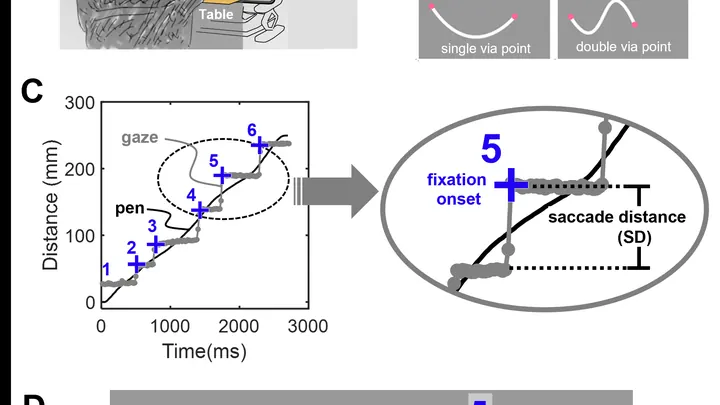
When the hand draws a line, the gaze almost always runs ahead, like a scout peeking around the corner before the column turns. But how far ahead? It turns out that each person has their own distance, and it does not change from attempt to attempt.
In the experiment, professional calligraphers and ordinary people traced a contour on a screen while instruments recorded eye and pen movements.
A chemist searching for a new drug is like a cook without a recipe: they have a list of desired properties but millions of possible ingredients. Each trial is costly and time-consuming, so you need to experiment wisely.
The new program SEISMO acts like a chef who tastes the dish after every step and immediately decides what to add next.
A quantum computer is like an orchestra where each musician plays their own part. With few instruments, the conductor can manage each one separately. But when there are thousands of musicians, individual commands become overwhelming.
Computer models that predict material properties at the atomic level usually require long, manual tuning. To work accurately, the model needs to see many examples — how atoms are arranged and how they interact. Scientists spend weeks hand-picking these examples. The new program AutoPot does it all by itself.
Electrons — tiny particles in molecules — constantly maneuver, avoiding collisions like passengers during rush hour. To calculate their behavior, scientists set a personal distance rule: a mathematical function that indicates how close one electron can get to its neighbor.
Science is a vast kitchen where scientist-cooks seek new recipes. Once, they sifted ingredients by hand; now artificial intelligence, a seasoned chef, lends a hand. AI memorizes millions of flavors and suggests surprising pairings: through information search, the algorithm uncovers hidden patterns.
Fog thickens over the line "def max(a: Int, b: Int): Int". What does it do? It returns the larger of two numbers, but how can you verify that? You could write a dozen tests with specific pairs: max(2,3)=3, max(5,5)=5, max(-1,0)=0. Still, a nagging doubt remains: what if it breaks for, say, a million and minus a million?